What St. Paul Bank Branches Need From Snow Removal That Most Businesses Do Not
More Access Points, Higher Standards, Zero Room for a Missed Spot
A typical small business has a parking lot, a sidewalk, and a front door. A bank branch in St. Paul has all of that plus a drive-through with multiple lanes, a walk-up ATM that needs to be accessible around the clock, an employee entrance on a different side of the building, a night deposit drop, and a parking lot that sends a trust signal to every customer who pulls in.
I've been servicing bank branch properties for over two decades, and the scope of work at a financial institution is more complex than what most commercial property managers realize until they walk the site with me. Every one of those access points functions independently. A lot that's plowed but has an icy ATM walkway is still a problem. A front entrance that's clear but a drive-through that's snowpacked is still a service failure. The snow removal scope for a bank branch has to address each zone on its own terms.
We service bank branches and financial institution properties across the metro through our St. Paul snow removal service, and here's what makes these properties different from anything else on the route.
Bank Branches Have More Access Points Than Almost Any Other Business
The access point complexity at a bank branch is unusual in commercial snow removal. Most retail and office properties have one primary entrance, maybe a secondary entrance, and a parking lot. A bank branch can have five or six distinct access zones, each with its own clearance requirements and its own timeline.
The main customer entrance gets the most foot traffic. This is where customers walk in for teller service, account openings, and appointments. It needs to be clear and treated before the branch opens, typically 8 or 9 AM, though some locations open earlier for business banking. When I walk a bank property during the pre-season assessment, I start at the main entrance and work outward, because that entrance sets the customer's first impression of whether this institution has its act together.
Drive-through lanes are a defining feature of most bank branches and one of the biggest snow removal challenges on any commercial property. A branch may have two to four lanes running along the side or rear of the building. Each lane needs to be cleared individually, and the approach from the parking lot into the drive-through needs to be navigable by passenger vehicles, not just trucks. I've seen drive-throughs where the previous contractor left a 4-inch windrow at the entrance because the plow truck was too wide to fit inside the lanes. That's a service failure that sends customers to the branch across the street.
Walk-up ATMs are 24-hour access points, which means the path to the ATM, the area immediately around it, and the connecting sidewalk all need maintenance around the clock, not just during branch hours. ATM locations on exterior walls are exposed to wind-driven drifting and develop black ice quickly because they're often shaded by the building during winter days.
The employee entrance, usually on a side or rear wall, needs to be cleared early because staff arrive 30 to 60 minutes before the branch opens. The night deposit drop is another 24-hour access point where business customers make after-hours deposits. Both of these areas need their own attention on the scope document. They can't be afterthoughts.
Drive-Through Snow Removal Requires Specialized Equipment
Drive-through lanes are one of the most technically demanding features to plow at any commercial property, and I've been running compact equipment through bank drive-throughs since the early 2000s. The combination of low canopy clearance, narrow lane widths, bollards, and transaction infrastructure makes standard plow trucks impractical.
A full-size plow truck with a blade extended is too wide for most drive-through lanes. Even if it physically fits, the canopy clearance is often too low. We use compact equipment for every bank drive-through on our route: small wheel loaders with box plows, track machines, and utility vehicles that can fit under the canopy and navigate between bollards without risk to the infrastructure or the equipment.
Bollards are everywhere in a drive-through. They protect canopy support columns, pneumatic tube systems, transaction windows, and lane dividers. An operator working a bank drive-through for the first time needs a full walkthrough of the property before touching a blade to the surface. I assign specific operators to bank properties and keep them on the same accounts season after season, because familiarity with the layout prevents the kind of mistakes that cost money and damage trust with the facilities manager.
Lane-by-lane clearing is necessary when the branch needs some lanes to remain open during service. The operator works one lane at a time, stacking snow at the end of the lane or pushing it to a designated area outside the drive-through zone. This takes more time than clearing an open lot, and the contract pricing needs to reflect that reality.
Ice management in the drive-through is as important as plowing. The canopy protects the lanes from direct snowfall but traps moisture from vehicle exhaust, dripping from car roofs, and condensation. That moisture freezes overnight on the lane surface, creating a deceptively slick surface that customers roll over at low speed. Pre-treatment and post-plow salt application in the drive-through lanes are core scope items in every bank contract we write.
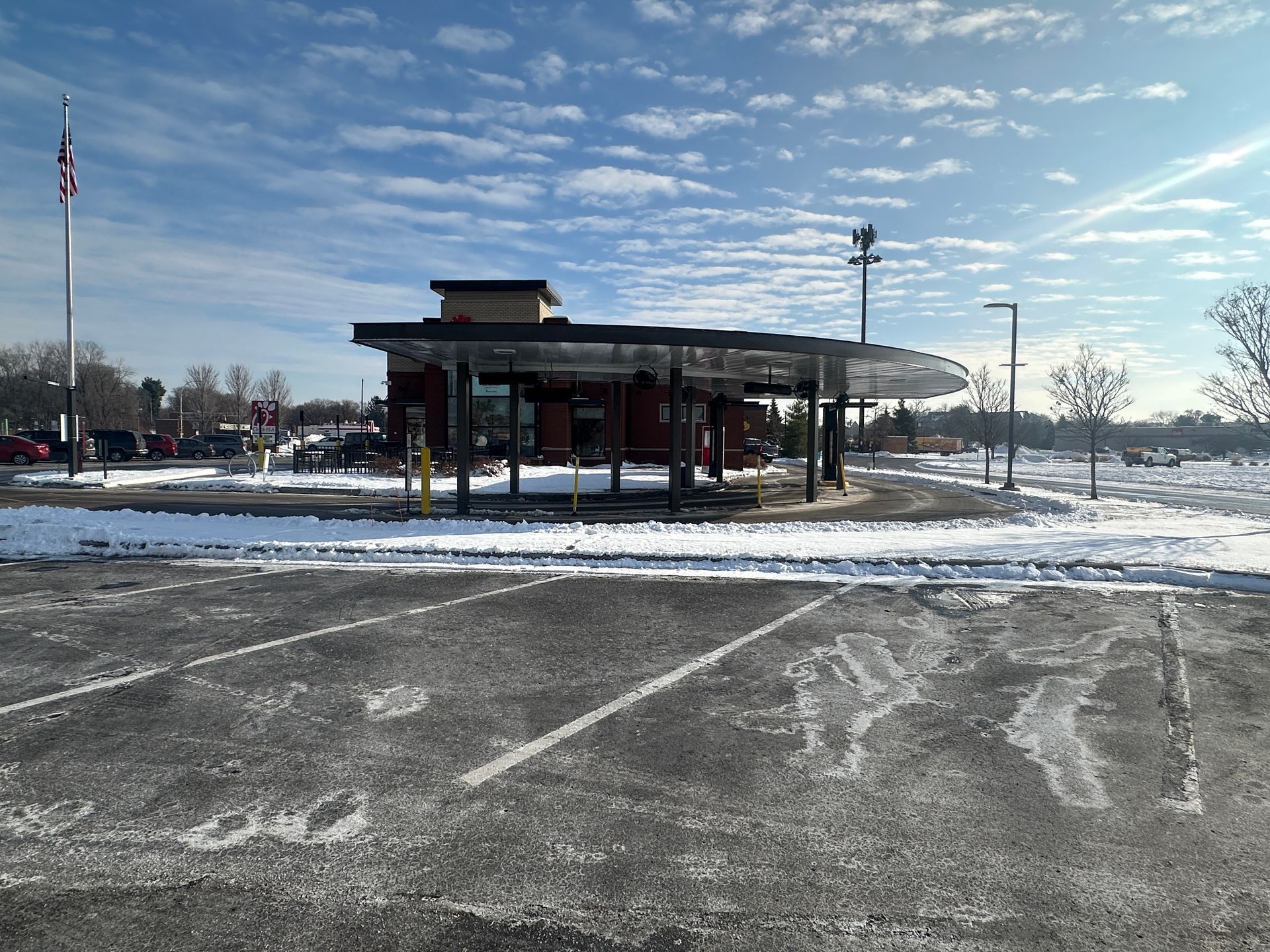
Bank drive-through lanes require precise plowing to keep ATM and teller access clear in St. Paul
ATM Areas and Pedestrian Zones Need Separate Ice Management
Walk-up ATMs are high-priority ice management zones because they combine 24-hour access, exposed conditions, and users who are focused on the screen rather than their footing. I treat ATM zones as a separate line item on every bank branch contract because the service frequency and material requirements are different from the general lot.
ATM locations on exterior building walls get wind-driven drifting that can deposit snow against the machine even after the lot has been plowed clean. The concrete pad in front of the ATM also develops black ice quickly because building shade prevents sun from warming the surface during short winter days.
Handicap accessibility at ATM locations is a federal requirement under the Americans with Disabilities Act. The accessible path from the nearest handicap stall to the ATM must be clear, and the surface in front of the ATM must be navigable by wheelchair. Snow or ice blocking that route is a compliance issue, not just a customer service issue. I check ATM accessibility during every pre-season walkthrough because it's one of the most commonly missed items I see at bank properties that were serviced by a previous contractor.
Deicing material selection matters at entrances and ATM areas. Some deicers track inside the building on shoes, creating slippery conditions on tile or marble lobby floors. Others leave a white residue that degrades the appearance of entrance mats and flooring. For a bank, where the interior appearance is part of the trust equation, the materials used at these areas should be chosen to minimize tracking and residue. We specify materials by zone in our bank contracts as part of our full de-icing and salting service because what works on the parking lot surface may not be appropriate at the front entrance.
ATM areas may need more frequent treatment than other zones. A single post-storm salt application is often not sufficient if temperatures fluctuate, moisture refreezes, or wind pushes new drift against the machine. We build re-treatment provisions into our bank contracts specifically for ATM and entrance zones.
Pro Tip: After every storm, walk the path from each handicap stall to your front entrance and to the ATM. If there's a snow ridge in the access aisle, an icy patch on the ATM pad, or a windrow blocking a curb ramp, your contractor missed it and it needs immediate attention.
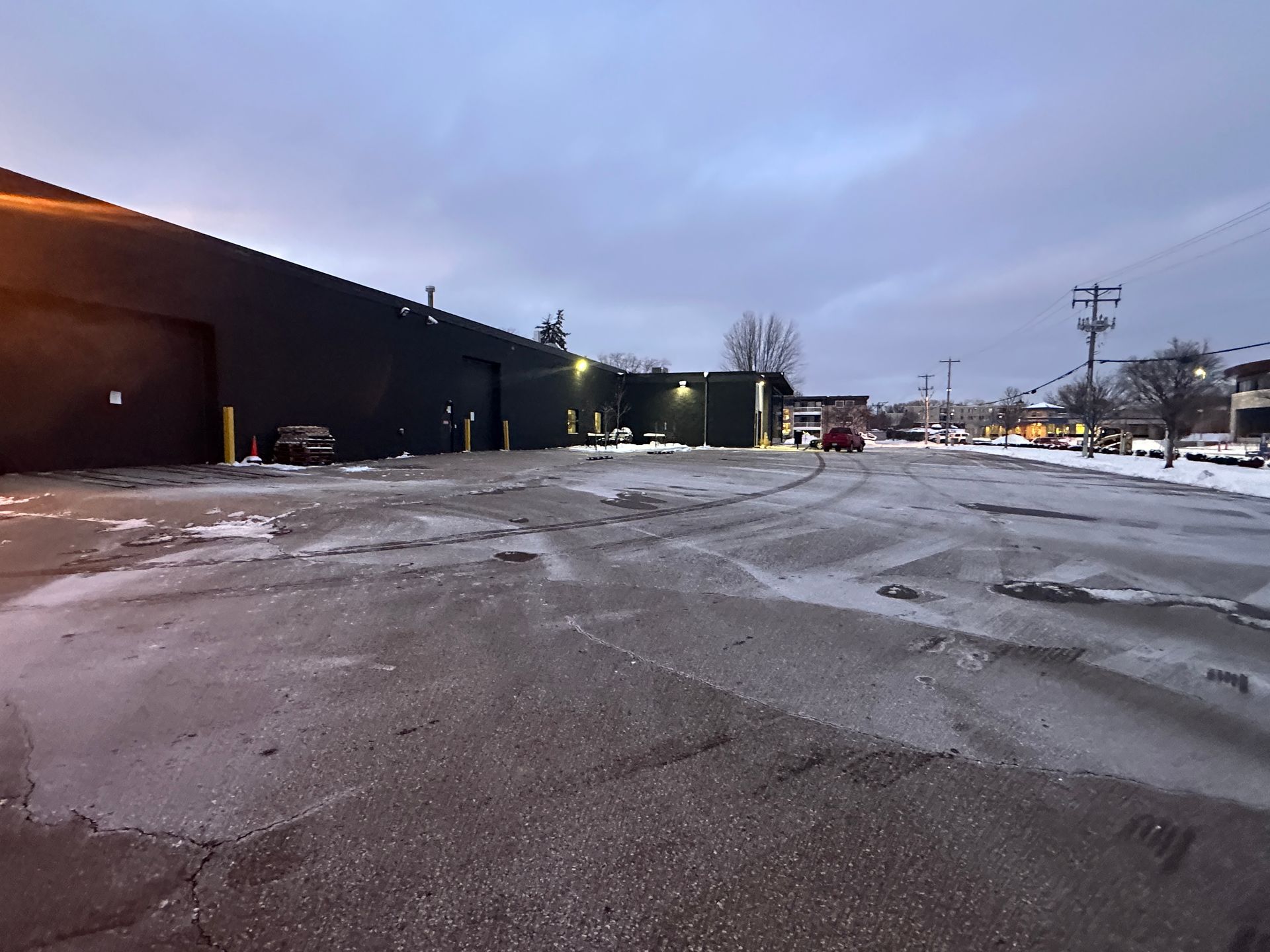
Pedestrian zones at St. Paul bank branches need complete clearing down to pavement
Appearance Standards at Financial Institutions
A bank parking lot communicates something before a customer ever walks through the door. A clean, well-maintained lot signals that the institution is organized, professional, and trustworthy. A lot with plowed berms blocking the entrance, slush puddles in the handicap stalls, and uncleared sidewalks sends the opposite message.
I've worked with bank facilities managers who understand this intuitively. For most businesses, a parking lot is functional. For a bank, it's part of the brand. Snow berms stacked along the front of the property look neglected. Sight lines blocked at lot exits create safety concerns for customers pulling out onto the street. Salt residue on walkways and entrance mats degrades the appearance of the building face.
This means snow removal at a bank branch includes an appearance standard that goes beyond "is the lot passable." Berms get pushed to the rear or sides of the lot, not along the front facade. Lot entrances and exits maintain clear sight lines for turning traffic. The front walkway and entrance area look maintained, not just functional. When stacking areas fill up, hauling snow off site is worth the cost to preserve the property's appearance. The standards we maintain at office parks in Arden Hills are similar in terms of documentation and professionalism, but bank branches push the appearance expectation even further.
These appearance priorities get communicated during the pre-season walkthrough. I walk the property with the facilities manager and the assigned operator together so that everyone sees the same picture of what "done right" looks like. Where do berms go. Where are the sight line concerns. What does the front of the building need to look like at 7:30 AM. That alignment before the first storm prevents the calls and complaints that consume everyone's time during the season.
Multi-Location Coordination for Regional Bank Operations
Many bank branches aren't standalone operations. They're part of a regional network with a single facilities manager or regional director overseeing five, ten, or twenty locations across the metro. Snow removal across a multi-branch portfolio adds coordination demands that single-location businesses don't deal with.
Consistency across locations is the primary concern. If the Plymouth branch lot is impeccable but the St. Paul branch drive-through is snowpacked, the customer experience is inconsistent, and for a financial institution that relies on brand consistency, that's unacceptable. The snow removal provider, whether it's one company handling all locations or multiple contractors coordinated by the facilities team, needs to deliver the same standard everywhere.
Single-vendor management simplifies the operation. One contractor handling all branches in a region means one point of contact, one set of service logs, one insurance certificate, and one contract. It also means the contractor can allocate resources across locations based on which branches are getting hit hardest by a particular storm. We service multi-location accounts across our commercial snow removal portfolio and assign dedicated account managers to each relationship so the facilities director has a single person to call during events.
Reporting across a portfolio is essential for the facilities team. We provide service reports broken out by location showing dates, times, areas serviced, and materials applied. This lets the facilities manager track performance, compare response times across branches, and identify any location that consistently receives lower-quality service. The SIMA snow and ice management standards identify standardized documentation as a core practice for multi-location commercial accounts, and it's something we build into every portfolio contract.
According to NSC injury data on same-level falls, slips and falls remain one of the most frequent and costly workplace injury categories. For a bank with multiple locations, a consistent winter maintenance standard across all branches isn't just an operational preference. It's a risk management strategy.
End-of-season portfolio reviews give the facilities team data for budget planning, contract renewal decisions, and identifying branches that need scope adjustments the following year. I sit down with our multi-location bank clients every spring to walk through the season's data because the information from one winter shapes the plan for the next.
If you manage bank branch properties in St. Paul or across the Twin Cities metro, contact our team to discuss a snow removal scope built for the specific needs of financial institutions.
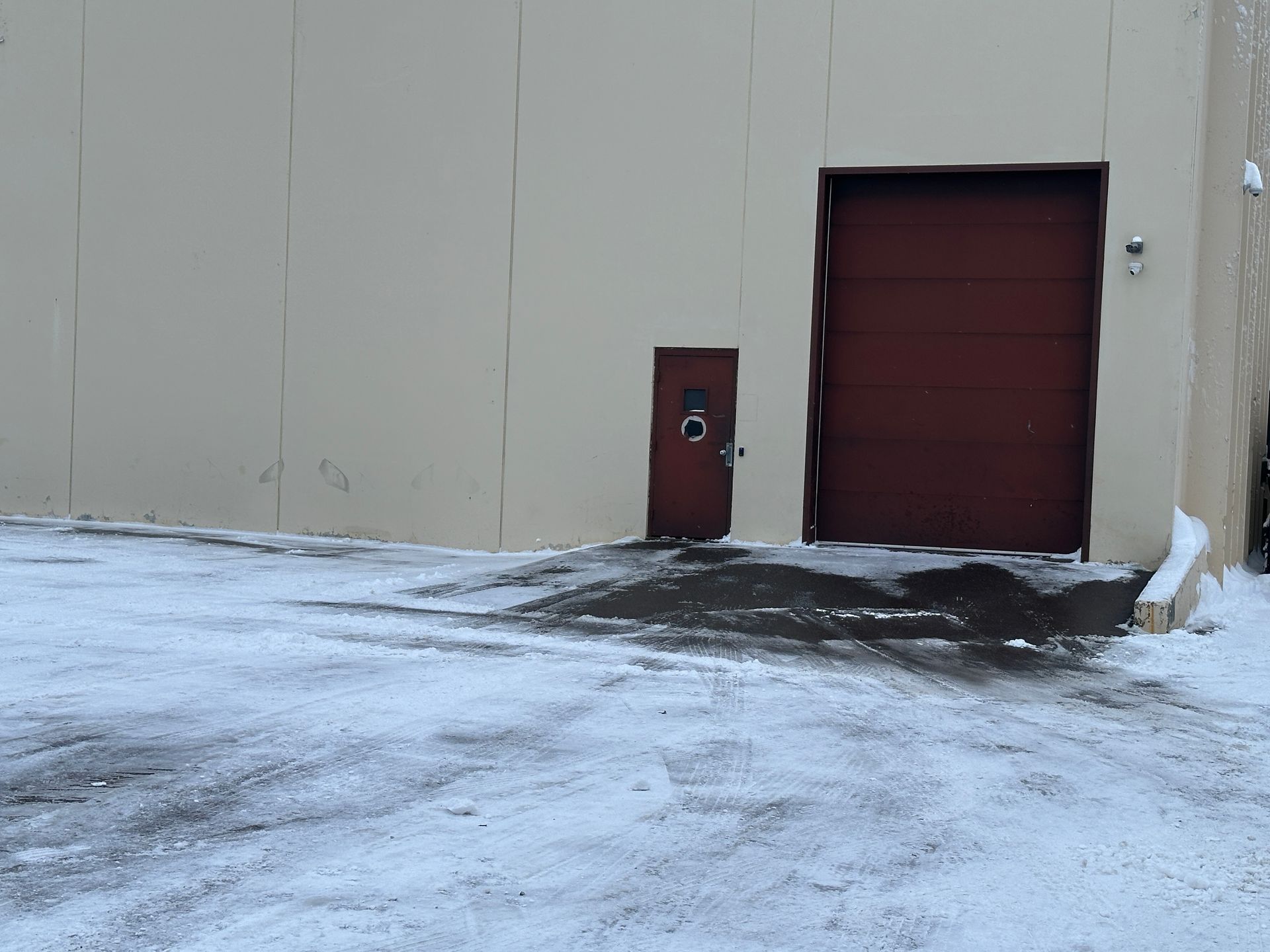
Professional-grade service maintains the polished appearance bank customers expect
Frequently Asked Questions
What equipment is used for drive-through snow removal?
Drive-through lanes require compact equipment that fits under low canopies and between bollards. We use small wheel loaders with box plows, compact track machines, and utility vehicles designed for tight-clearance work. Full-size plow trucks are too wide and too tall for most drive-through configurations. Our operators are assigned to specific bank properties and trained on each drive-through's layout, including bollard positions, canopy heights, and pneumatic tube locations, to prevent damage during clearing.
How do banks handle ATM area ice management?
ATM areas are treated as a separate ice management zone with more frequent attention than the general lot. Because walk-up ATMs are accessible 24 hours a day, the area around the machine receives pre-treatment before storms, reactive salt application after plowing, and monitoring for refreeze between events. Wind-driven drifting and building shade make ATM locations prone to ice formation even after the lot has been cleared. We use materials that minimize tracking into the lobby when applied near building entrances.
Do bank branches need snow removal before standard business hours?
Yes, and typically earlier than most commercial properties. Bank staff arrive 30 to 60 minutes before the branch opens, and some branches offer early business banking appointments. The lot, employee entrance, and customer entrance should all be cleared and treated before staff arrives, which means a target completion time of 7 AM or earlier for most branches. The drive-through may need attention before opening as well if it operates on a different schedule than the lobby.
What's different about snow removal for a financial institution?
Bank branches have more distinct access zones than most properties: main entrance, drive-through lanes, walk-up ATM, employee entrance, and night deposit drop. Each requires specific equipment, timing, and ice management. Banks also have higher appearance standards because the property reflects on the institution's brand. Drive-through clearing requires specialized compact equipment, and ATM areas need around-the-clock ice management rather than just pre-business-hours service.
Can one snow removal company handle multiple bank locations?
Yes, and it's the preferred arrangement for most regional operations. A single contractor managing all branches provides consistent standards, streamlined communication, consolidated reporting, and more efficient resource allocation during storms. When selecting a single-vendor partner, confirm the company has sufficient equipment and crew depth to service all locations simultaneously during large events without sacrificing quality at any individual branch.
How much does snow removal cost for a bank branch?
Bank branch snow removal costs more than a similarly sized office or retail property because of the specialized scope: drive-through clearing with compact equipment, 24-hour ATM ice management, multiple entrance zones, and higher appearance standards. Pricing is typically seasonal. Total cost depends on lot size, number of drive-through lanes, sidewalk footage, and ice management scope. Multi-location contracts may offer per-location savings compared to contracting branches individually.
About the Author
I'm Kent Gliadon, founder of KG Landscape and a graduate of the University of Minnesota Landscape Design program. For over 20 years, I've focused on integrating well-planned landscape design and installation work with properly engineered outdoor drainage solutions. I believe discerning homeowners deserve landscaping and drainage renovations that are carefully planned from the beginning, accounting for water movement, grading, soils, hardscaping, and future use, so problems are prevented before they occur. These articles explain how and why specific solutions are implemented and what it takes to maintain properties that truly last.
Ready to Start on Your Next Project?
Call us at (763) 568-7251 or visit our quote page.