A Hopkins Gas Station Cannot Close for a Snowstorm. So How Does the Lot Get Cleared?
The Property That Never Gives You an Empty Lot
I've plowed just about every type of commercial property in the south and west metro over the past 20-plus years. Office parks, strip malls, apartment complexes, medical offices, restaurants. Every one of them gives the crew a window when the lot empties out. Every one of them except gas stations.
A gas station in Hopkins is open at 2 AM. It's open at 4 AM. There are cars at the pumps on Christmas morning. The volume drops overnight, but it never hits zero, and that changes how snow removal has to work. There's no post-close window. There's no "come back when everyone's gone." The crew works around live traffic, running vehicles, and customers standing at fuel pumps in a snowstorm.
We service gas stations and 24-hour convenience operations across the south metro, and these properties require a fundamentally different approach from anything else on our route. The equipment is different, the timing is different, and the ice management demands are continuous in a way that other commercial properties don't require. Our Hopkins snow removal service is built to handle these kinds of operations, and here's what that actually looks like.
Snow Removal at a Business That Never Closes
The absence of downtime is what makes gas station snow removal its own category. When I walk a gas station property during a pre-season site assessment, the first thing I'm mapping is traffic flow, because the crew will need to work in sections around vehicles that are moving through the lot the entire time they're on site.
The approach is zone-based. Pump islands divide the lot into natural sections, and the crew clears one zone while traffic flows through another, then switches. At least one clear path from the street to the pumps has to be maintained at all times. If a customer pulls in and can't reach a pump, they leave. If enough customers leave, the station owner is losing revenue every hour of the storm.
Fuel delivery access adds a hard constraint that most property managers don't think about until a tanker can't get through. The delivery lane from the street entrance to the fill ports, usually at the back or side of the lot, has to stay open regardless of what's happening with the rest of the clearing. Tanker trucks are large, have limited turning radius, and run on schedules that don't flex for weather. I've seen stations nearly run dry during a three-day storm because the previous contractor hadn't prioritized the delivery lane. That's a mistake we account for from the first walkthrough.
Staff shift changes happen around the clock, so employee walkways need attention at hours when most commercial properties are getting no service at all. The path from employee parking to the building entrance, the route to the dumpster, and any connection to a car wash bay all need to be cleared and treated, not just during the morning rush, but at 10 PM and 2 AM shift changes too.
How Our Crews Work Around Fuel Pumps, Islands, and Canopies
A gas station lot is one of the most obstacle-dense properties we service. Pump islands, canopy columns, bollards, payment kiosks, air stations, trash enclosures, and signage bases, all in a space that's often smaller than a standard retail lot. The equipment and technique have to match the environment.
Our standard plow trucks handle the open areas: main driving lanes, parking stalls away from the islands, and the perimeter. But around the pump islands themselves, we bring in compact equipment. Track loaders and small wheel loaders with box plows can navigate between islands, under canopies, and around bollard clusters without damaging infrastructure. I've been running compact equipment on gas station accounts for years because a full-size truck blade in a pump island area is asking for a clipped bollard or a damaged curb.
Canopy areas are deceptive. The fuel canopy keeps snow off the pumps, which makes the area look clear. But moisture drips from vehicles, condensation forms on the concrete surface, and melt runs off the canopy edges. During cold nights, all of that refreezes into a thin, invisible ice layer right where customers are standing while they fuel. The canopy doesn't need plowing, but it almost always needs ice treatment, and it's one of the first things I check on a post-storm walkthrough.
Bollards are everywhere on a gas station property, protecting pumps, columns, curbs, and kiosks. An operator who isn't familiar with the specific layout can clip a bollard at speed and damage the blade, the bollard, or the post anchor below the surface. This is why we do a detailed pre-season walkthrough with the operator assigned to every gas station on our route. They need to know where every bollard, every island edge, and every low-clearance point sits before the first storm, not during it.
Pro Tip: Walk your gas station lot with the plow operator before the season starts. Point out every bollard, every underground access cover, and every tight clearance point. Twenty minutes in October prevents thousands of dollars in damage in January.
Hand clearing around pumps, payment terminals, and trash stations is part of the scope. Equipment gets close, but the final few feet around a fuel pump or card reader need hand shoveling and manual salt application. We assign a separate crew member for hand work at gas station properties while the equipment operator handles the broader lot. It's the only way to clear these properties properly without slowing down the overall operation.
Ice Management for High-Traffic Concrete and Fueling Areas
In my experience, gas stations carry some of the highest slip-and-fall risk of any commercial property type. Customers are walking on wet, cold concrete at all hours, often in low light, often in a hurry, and the lot surface stays wet from tire spray and melt throughout every storm. Ice management at a gas station isn't a seasonal add-on. It's a continuous requirement from November through March.
Pre-treatment before a forecasted event is where we start. We apply a liquid brine to the lot surface, walkways, and pump island areas before the snow arrives. This prevents ice from bonding to the pavement, which makes post-storm clearing faster and cuts the total salt needed. For gas stations with concrete surfaces, which is most of them, pre-treatment is especially important because concrete is more porous than asphalt and holds moisture longer.
During active storms, ice management is continuous, not a single post-storm application. We apply salt or deicer between plow passes to prevent compacted snow from turning to sheet ice. Customer traffic actually helps grind salt into the surface, but it also tracks slush and moisture into areas that need repeated treatment. The pump island area, the entrance walkway, and the ADA-accessible route to the building all get attention throughout every event as part of our de-icing and salting service.
Material selection matters on concrete. Rock salt is the cheapest option, but it degrades concrete over time, especially through the freeze-thaw cycles that define a Minnesota winter. Calcium chloride is more effective at lower temperatures and less damaging to concrete but costs more per application. Some of our gas station clients specify calcium chloride for the pump island areas and walkways where concrete preservation matters most, and standard salt for the broader lot surface. The Minnesota Pollution Control Agency runs a Smart Salting training program that our applicators follow, which helps us balance effectiveness with responsible application rates.
Drain and catch basin awareness is critical near fuel areas. Excess salt and runoff near pump islands can create environmental compliance issues. Our crews are trained to apply materials carefully in areas near storm drains and fuel containment systems. Over-salting near these features isn't just wasteful. It can trigger regulatory concerns that land on the station owner's desk.
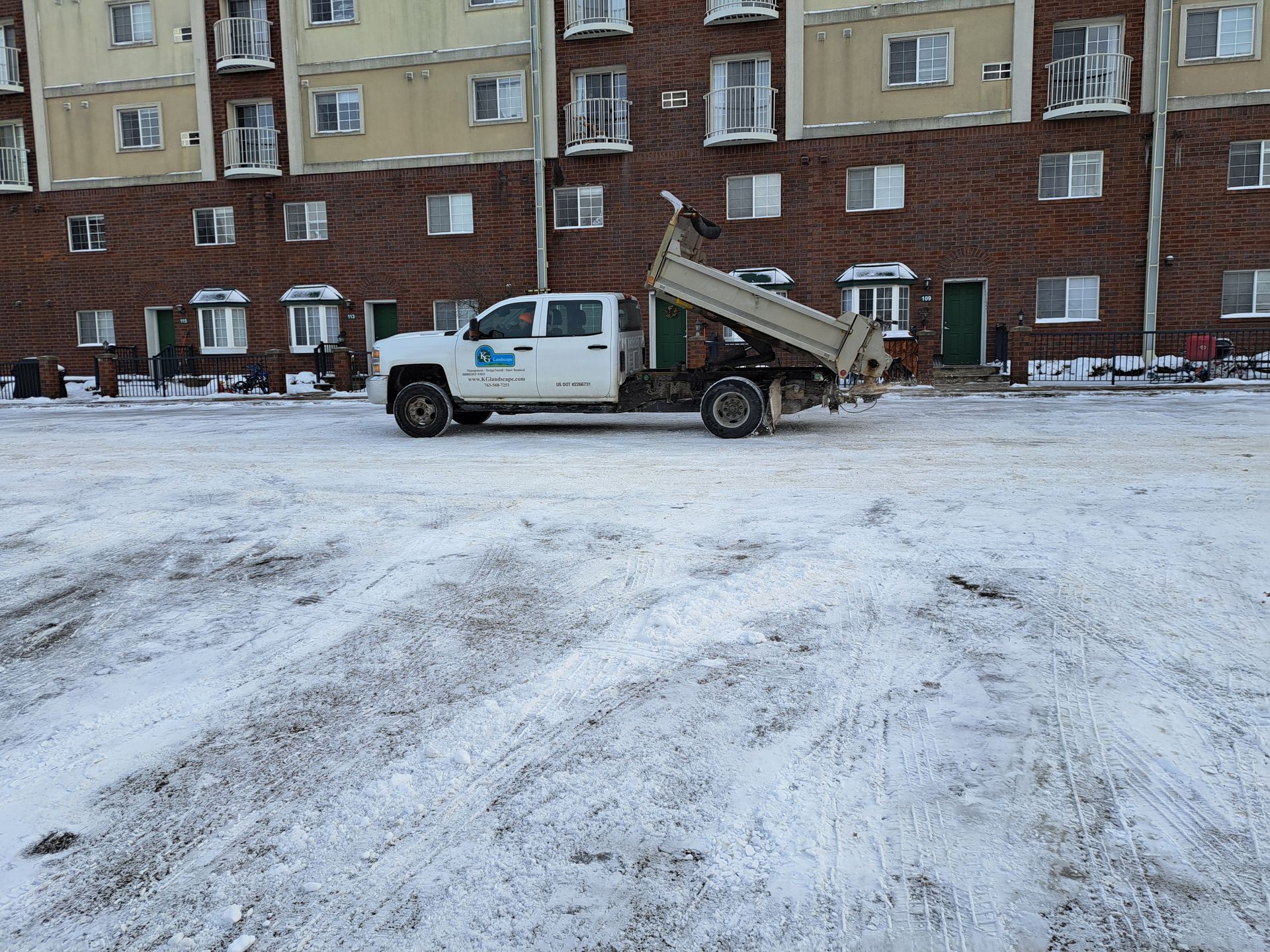
Targeted salt application prevents ice buildup on high-traffic fueling areas in Hopkins
Continuous Service During Multi-Day Storms
A single overnight storm is manageable at any property. The real test of a commercial snow removal operation is the multi-day event, the kind of system that drops snow for 18 or 24 hours straight, or the back-to-back storms with only a few hours between them.
For a gas station, waiting until a storm ends to do one big cleanup is not an option. By the time 8 inches accumulate on a lot with active traffic, customers are getting stuck at the pumps, fuel delivery is blocked, and the property is a liability problem. Our approach during extended events is continuous pass-through service, with the crew returning every 2 to 3 inches of accumulation to keep the lot functional.
Real-time monitoring drives the service schedule. We track accumulation rate, temperature trends, and surface conditions across our route and dispatch based on what each property actually needs, not on a rigid clock. A gas station seeing steady customer traffic at 2 AM during a storm gets attention sooner than an empty office park lot on the same route. The National Weather Service tracks conditions we monitor closely, including freezing rain warnings and overnight temperature drops that change surface conditions even after plowing.
Communication with store management during events is proactive. We update the station manager or owner on crew timing, next-pass schedule, and any conditions that need attention, like a fuel delivery lane that's drifting shut or a pump island area that needs re-treatment. The store manager shouldn't have to chase us for information during a storm. I've learned over 20 years that proactive communication during events is what separates a contractor you keep from one you replace.
Crew rotation matters during prolonged storms. Our operators can't run equipment for 24 hours straight. We maintain bench depth across the team, rotating drivers on staggered shifts to keep continuous coverage. How a company handles crew rotation during a three-day event is a reasonable question to ask before signing a contract. If they don't have a clear answer, they probably don't have a clear plan. We wrote about multi-day storm logistics in detail in our piece on office park snow removal in Arden Hills, and the operational principles are the same for any 24-hour property.
What 24-Hour Businesses Need in a Snow Removal Contract
A gas station or convenience store in Hopkins needs a snow removal contract that's structured differently from a standard commercial agreement. I've written these contracts for years, and the key differences come down to response time, during-storm service, and priority classification.
Guaranteed response time is the first item. For a 24-hour business, "we'll get there when we can" doesn't work. The contract should specify a maximum response time after the trigger depth is hit. For gas stations, that response time should be faster than what a standard commercial property receives, typically 30 minutes to 1 hour for priority accounts. We commit to specific response windows because vague language creates the exact disputes that end contractor relationships.
During-storm service clauses need to be explicit. The contract should state that the property will receive multiple passes during active events at defined intervals. Without this language, you may get one visit after the storm ends, which is 12 hours too late for a business that was open the whole time. The Occupational Safety and Health Administration identifies continuous maintenance of walking and working surfaces as a core component of slip-and-fall prevention, and for a 24-hour property, that means service during the storm, not just after.
Priority status is what separates a gas station contract from a routine commercial account. We offer tiered service levels where 24-hour businesses and critical-access properties are serviced first on the route. Ask any prospective contractor whether your property will be on the priority tier and what that means in practical terms during a heavy storm when every property on the route needs attention simultaneously.
Ice management should be a standalone line item, not an add-on. For a gas station, ice treatment isn't something you do after the storm. It's something you do before, during, and after, continuously, throughout the winter. The contract should reflect this as a core service, not as a per-application charge that discourages frequent treatment. I've seen station owners try to save money by dropping ice management to a per-application basis, and they end up spending more on reactive callouts than they would have on a seasonal ice program.
If you operate a gas station, convenience store, or other 24-hour business in Hopkins and need a snow removal plan designed for operations that never close, contact our team to set up a property walkthrough. We also work with restaurant properties in Bloomington and other businesses with tight service windows, so we understand what it takes to keep a customer-facing operation accessible through every storm.
Frequently Asked Questions
Can snow plows operate around fuel pumps safely?
Yes, but it requires compact equipment and an operator who knows the property. Our standard plow trucks handle the open lot areas while smaller machines like track loaders and box-plow wheel loaders work the tight spaces between pump islands and canopy columns. The operator assigned to a gas station property walks the site before the season to map every bollard, island edge, and underground access point. That familiarity is what prevents equipment damage and keeps the operation safe around active fueling infrastructure.
What deicing materials are safe for gas station concrete?
Calcium chloride is the preferred material for pump island areas and walkways because it works at lower temperatures and is less corrosive to concrete than standard rock salt. Magnesium chloride is another option with lower surface impact. We commonly use calcium chloride on the pump island and entrance areas where concrete preservation matters, and standard salt on the broader asphalt lot surface. The specific material plan should be part of your contract, not left to the crew's discretion during a storm.
How fast should a snow removal company respond during a storm?
For a 24-hour gas station, response time should be 30 minutes to 1 hour after the trigger depth is reached. This is faster than a standard commercial response because the business is operating throughout the storm. During multi-day events, crews should return every 2 to 3 inches of accumulation rather than waiting for the storm to end. We build our routes so that 24-hour properties are prioritized in the dispatch sequence, which means they get attention first when conditions hit the trigger threshold.
Do gas stations need a different type of snow removal contract?
Yes. A gas station contract requires during-storm service provisions, priority response commitments, continuous ice management, and scope that addresses fuel-specific features like pump islands, canopy areas, bollards, and tanker delivery lanes. A standard commercial contract designed for properties that close overnight doesn't account for any of these requirements. If the contract you're reviewing doesn't mention fuel delivery access or during-storm pass frequency, it wasn't written for your type of operation.
How much does 24-hour snow removal service cost?
Pricing is higher than standard commercial service because the scope demands more visits per event, work around live traffic, specialized compact equipment for pump areas, and continuous ice management. Seasonal contracts are the most common structure for gas stations because per-event pricing becomes volatile with the number of visits a 24-hour property requires. Cost depends on lot size, number of pump islands, and ice management scope. Contact us for a property-specific quote built around your actual operation.
What happens if a fuel delivery truck can't access the station during a storm?
Fuel delivery access is a priority-one clearing item in every gas station snow plan we write. The path from the street entrance to the fill port location stays clear throughout every storm event, including during active snowfall. If a tanker arrives and can't reach the fill ports, the delivery gets delayed or rescheduled, which can leave the station without fuel during peak winter demand. We flag the delivery lane during the pre-season walkthrough and treat it with the same urgency as fire lane access.
About the Author
I'm Kent Gliadon, founder of KG Landscape and a graduate of the University of Minnesota Landscape Design program. For over 20 years, I've focused on integrating well-planned landscape design and installation work with properly engineered outdoor drainage solutions. I believe discerning homeowners deserve landscaping and drainage renovations that are carefully planned from the beginning, accounting for water movement, grading, soils, hardscaping, and future use, so problems are prevented before they occur. These articles explain how and why specific solutions are implemented and what it takes to maintain properties that truly last.
Ready to Start on Your Next Project?
Call us at (763) 568-7251 or visit our quote page.