Bloomington Restaurants Have a Narrow Window for Snow Removal
Why Restaurant Snow Removal Doesn't Fit a Standard Schedule
A restaurant in Bloomington closes at 10 PM. The kitchen staff leaves by 11. The lot sits empty for maybe six hours before the prep cook shows up at 5 AM and the first customers start arriving around 11. That's the entire window for snow removal, and if a storm is still going at midnight, the window shrinks to almost nothing.
Most commercial snow removal contracts are built around office parks and retail properties that close at 5 or 6 PM and don't reopen until 8 AM. Restaurants don't fit that model. The hours are later, the gaps are shorter, and the consequences of a poorly timed plow run are more immediate. A customer who can't find a clear parking spot at 6 PM on a Friday isn't going to circle the lot. They're going to the restaurant down the street that took care of theirs.
I've been servicing restaurant properties across the south metro for over two decades, and the conversations always start in the same place: the timing doesn't work with a standard commercial contract. They're right. It doesn't. I learned early in my career that restaurant accounts need their own operational approach, and it's one of the reasons I build these contracts differently from anything else on our route. Here's what actually works.
The Timing Problem Restaurants Face
The core challenge for restaurant snow removal is that the business operates on a schedule that doesn't leave a clean window for standard commercial service.
A typical sit-down restaurant closes between 9 PM and 11 PM. Some bars and late-night spots stay open past midnight. Staff leave 30 minutes to an hour after the last customer. That means the lot isn't fully empty until 10 PM at the earliest, and often not until midnight.
On the other end, prep cooks and managers arrive between 5 and 7 AM for lunch service. Breakfast and brunch spots are even tighter, with staff arriving as early as 4 AM. The available window for snow removal is somewhere between four and seven hours, and that assumes the storm cooperates by stopping before close.
During-service storms create a different problem entirely. When it starts snowing at 3 PM and your dining room is full at 6 PM, the lot can't be plowed in the usual way. Customers are walking in and out. Cars are parked in every stall. A plow truck working a busy restaurant lot during dinner service is a safety and customer experience disaster.
This is why I build restaurant contracts around the restaurant's actual operating schedule, not around a generic commercial template. The service window is shorter, the stakes during business hours are higher, and the approach has to flex around a rhythm that's different from every other property on the route. Our Bloomington snow removal services account for these kinds of scheduling demands.
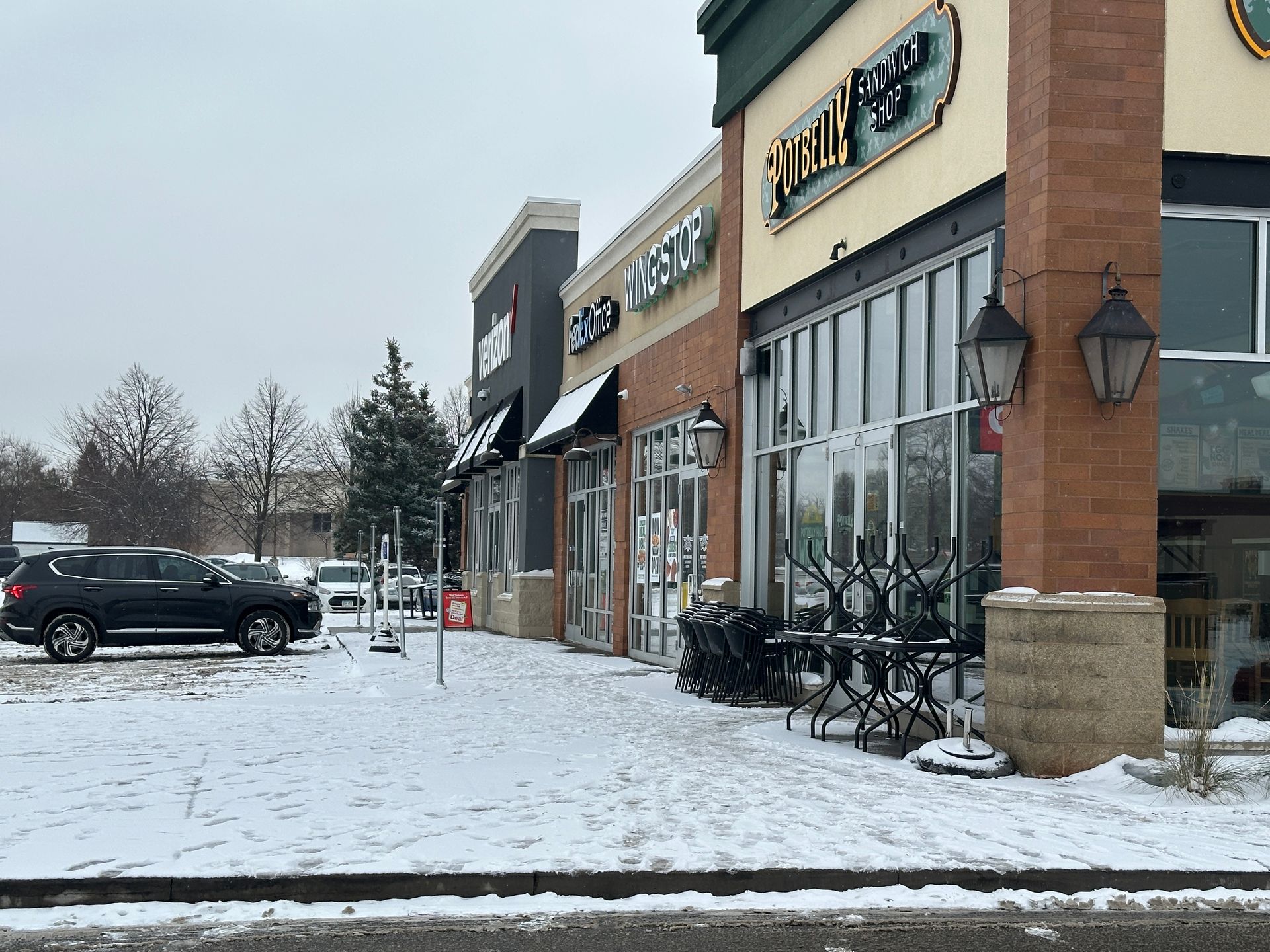
When snow removal timing doesn't match restaurant hours, this is what customers walk into
How Snow Removal Works Around Restaurant Hours
Restaurant snow removal requires a multi-phase approach that adapts to the business cycle rather than forcing the business to adapt to the plow schedule.
During an active storm while the restaurant is open, the priority is keeping driving lanes and the main entrance area accessible. A plow truck can make careful passes through the unoccupied portions of the lot, clearing lanes and stacking snow away from the entrance while avoiding the rows where customer cars are parked. This isn't a full cleanup. It's a maintenance pass to keep the lot functional so customers keep coming in the door.
Post-close clearing is the main event. Once the last vehicle leaves, the crew does a full plow pass, clears every stall, pushes snow to the stacking area, and addresses the areas that were inaccessible during service. For restaurants that close at 10 PM, this work typically happens between 11 PM and 2 AM. The crew needs to know your actual closing time, not just the time posted on the door, because kitchen staff and managers leave later.
Pre-open touchup is the final phase. Even after a thorough post-close clearing, conditions change overnight. Temperatures drop, moisture refreezes, and plowed surfaces develop a thin ice layer. A pre-open visit between 4 and 6 AM handles salt application on the lot and sidewalks, clears any light overnight accumulation, and makes sure the entrance area is safe for the first staff arriving. The National Weather Service notes that freezing rain and overnight temperature drops are among the most dangerous winter conditions because they develop after the initial storm passes and catch people off guard.
If your restaurant has a drive-through window or a designated pickup area for delivery orders, those access points need their own attention. Delivery drivers don't park in a stall and walk to the door. They pull up to a specific spot, and that spot needs to be clear and accessible throughout the evening, even during active storms.
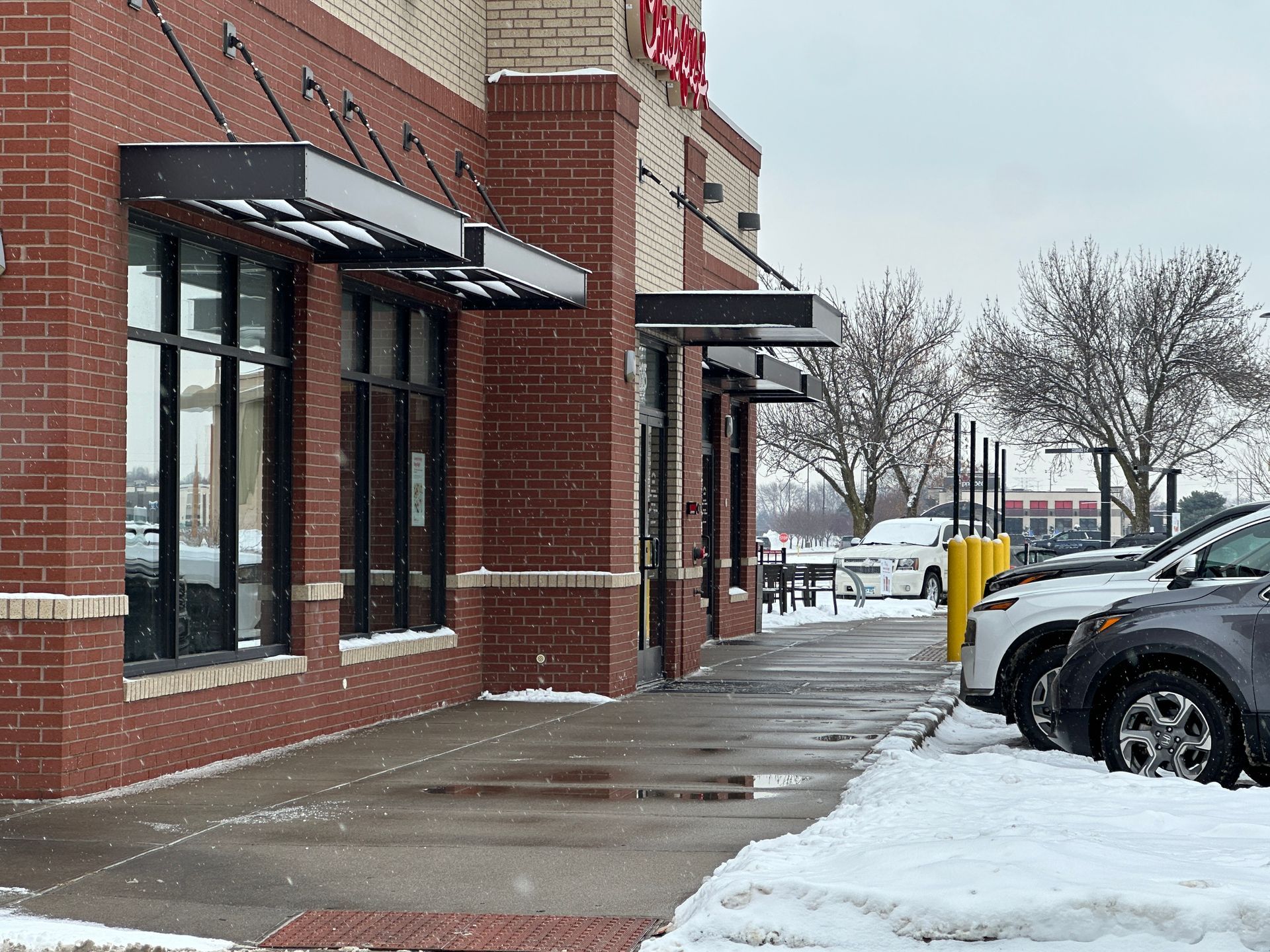
Mid-service clearing keeps Bloomington restaurants accessible even during active snowfall
Ice Management for Customer-Facing Businesses
For a restaurant, ice management isn't an optional add-on. It's the most important part of the winter maintenance program, and it's the area where I spend the most time during pre-season walkthroughs with restaurant owners.
The liability exposure of a customer slipping on ice in your parking lot or on the walkway to your front door is significant. Restaurants serve alcohol. Customers leave after dark. The lot surface is wet from melting snow tracked by tires. The walkway has transition zones where outdoor and indoor surfaces meet. I've walked restaurant entrances on Friday evenings during storm season where every one of these factors was in play simultaneously. Every one increases fall risk, and every one falls within the property's responsibility to manage.
Front entrance and walkway treatment is the highest priority. The path from the nearest parking stalls to the front door should be clear, dry, and treated before the restaurant opens and maintained throughout service. This means pre-treatment before a forecasted storm, reactive salting during and after, and monitoring for refreeze throughout the evening. We manage this as part of our full de-icing and salting service because relying on reactive salt-only approaches leaves gaps that create real liability.
Handicap-accessible routes require specific attention. Under ADA requirements, accessible paths of travel must be maintained in usable condition. That includes the accessible parking stalls, the access aisle next to them, and the route from those stalls to the entrance. Snow and ice on accessible routes isn't just a safety issue. It's a federal compliance issue, and it's one of the items we check during our pre-season property walkthroughs.
The transition zone at your front entrance is where many restaurant falls happen. Customers walk from a treated walkway onto a tile or concrete vestibule with wet shoes. A rubber mat and some ice melt outside the door isn't a complete solution, but it's a necessary layer. Your snow removal scope should include entrance area treatment as a specific line item, not something you assume is covered under "parking lot service."
Pro Tip: Walk the path from your farthest handicap stall to your front door after every storm. If you wouldn't feel comfortable watching your grandmother walk that path, your ice management isn't adequate.
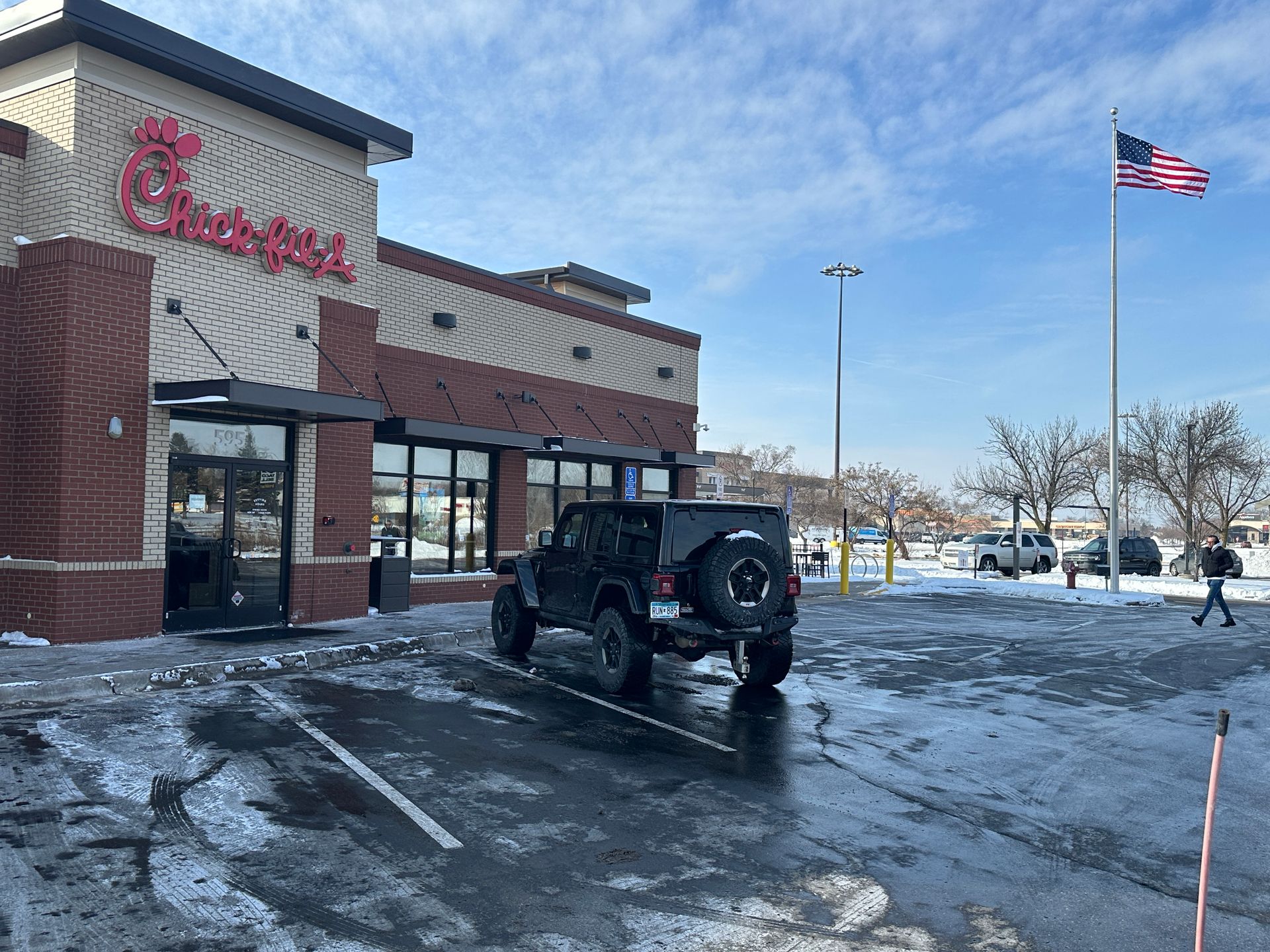
Complete lot treatment protects both drive-through and walk-in customers
What a Restaurant Snow Removal Contract Should Include
A snow removal contract for a Bloomington restaurant needs to reflect the realities of the business, not default to a generic commercial template.
Service windows should be specific to your operating hours. The contract should state when post-close clearing will begin and when the pre-open touchup will be completed. Generic language like "before business hours" is meaningless for a restaurant that's open until 11 PM. We build restaurant contracts around the actual schedule because a 7 AM completion target that works for an office park in Arden Hills makes no sense for a property that needs service at midnight.
During-storm service should be addressed explicitly. If it's snowing while the restaurant is open, what happens? Does the contractor make maintenance passes through the lot? At what interval? Is this included in the base contract or billed separately? A restaurant that loses a Friday evening's worth of customers because the lot was impassable is losing real revenue.
Sidewalk and entrance scope needs to be separated from the parking lot scope. Many commercial contracts cover the lot and leave sidewalks to the tenant. For a restaurant, the most dangerous surfaces are the walkways and entrance area, not the parking lot itself. Make sure the contract specifically includes sidewalk clearing, entrance treatment, and ice management for pedestrian zones.
Emergency re-service should be an option. If the lot was cleared at midnight but conditions deteriorated by 4 AM due to freezing rain, you need a way to request a return visit before you open. The contract should specify whether re-service calls are included, billed at a set rate, or handled case by case. The National Restaurant Association includes winter weather in their operational continuity guidance for exactly this reason: restaurants can't just close when conditions change overnight.
Coordinating With Your Landlord
Many restaurants in Bloomington operate in leased spaces, whether it's a standalone building in a retail center, a unit in a strip mall, or a space in a multi-tenant property. When you don't own the building, the snow removal responsibility question gets complicated.
In most multi-tenant leases, the landlord handles parking lot plowing and passes the cost through via CAM charges. This means you're paying for snow removal whether you chose the contractor or not, and the service level may not match what a restaurant actually needs. We cover the landlord-tenant snow removal dynamic in detail in our piece on strip mall properties in Plymouth, and the same principles apply to any leased restaurant space.
The gap is usually at the entrance. Even when the landlord handles the lot, tenant spaces are typically responsible for their own storefront: the sidewalk directly in front of the unit, the entrance area, and any patio or outdoor seating space. If you assume the landlord's snow removal covers your front door, you're probably wrong.
When the landlord-provided service isn't meeting your needs, you have a few options. Review your lease for language about supplemental service. Talk to the property manager about adjusting the contractor's schedule for your section. Or get your own sidewalk and entrance contract. Even if the lot is the landlord's responsibility, having a separate agreement for your entrance area and walkway gives you control over the one area that matters most for your business.
If you're a restaurant owner in Bloomington looking for commercial snow removal that works around your schedule, reach out to our team to discuss a scope that fits your operation.
Frequently Asked Questions
Can snow removal happen while the restaurant is open?
Yes, with limitations. During business hours, crews make maintenance passes through unoccupied portions of the lot, clearing driving lanes and empty rows. Full clearing of occupied stalls happens after close. Your contract should include during-storm service provisions that specify what level of maintenance occurs while the restaurant is operating.
Who is responsible for snow removal at a leased restaurant space?
This depends on your lease. In most multi-tenant properties, the landlord handles parking lot plowing through CAM charges. The sidewalk and entrance area directly in front of your unit is almost always the tenant's responsibility. Review your lease for specific language about common area maintenance and whether you're permitted to contract supplemental service.
What happens if someone slips on ice in a restaurant parking lot?
The property owner, the tenant, and the snow removal contractor can all potentially face liability. The key factors are who was responsible for maintaining the area where the fall occurred, what the contract specified, and whether documentation shows the property was serviced. A clear lease, a snow removal contract with ice management and documentation, and adequate general liability insurance provide the strongest protection.
How much does snow removal cost for a restaurant?
Cost varies based on lot size, number of service phases needed (during-service, post-close, pre-open), and ice management scope. Restaurant snow removal requires more flexibility and more visits per event than a typical commercial property, so per-event pricing can be volatile. Seasonal contracts are generally more predictable for budgeting.
Do restaurants need salt application or just plowing?
Both, and ice management is arguably more important than plowing for a customer-facing business. Plowing clears snow but doesn't prevent the ice that forms on walkways and lot surfaces during temperature fluctuations. Customers walking to and from their cars in the evening face elevated fall risk on untreated surfaces. Pre-treatment, reactive salting, and refreeze monitoring are all essential components.
When should a restaurant parking lot be cleared?
Full clearing happens after close, typically between 11 PM and 2 AM. A pre-open touchup with salt application should be completed before the first staff member arrives, usually by 5 or 6 AM. During active storms, maintenance passes keep driving lanes and entrances accessible without disrupting service. The contract should reference your actual schedule rather than generic commercial service windows.
About the Author
I'm Kent Gliadon, founder of KG Landscape and a graduate of the University of Minnesota Landscape Design program. For over 20 years, I've focused on integrating well-planned landscape design and installation work with properly engineered outdoor drainage solutions. I believe discerning homeowners deserve landscaping and drainage renovations that are carefully planned from the beginning, accounting for water movement, grading, soils, hardscaping, and future use, so problems are prevented before they occur. These articles explain how and why specific solutions are implemented and what it takes to maintain properties that truly last.
Ready to Start on Your Next Project?
Call us at (763) 568-7251 or visit our quote page.