Edina Medical Offices Open Early. Their Parking Lots Need to Be Ready First.
The Earliest Deadline on Any Commercial Snow Route
The first patient at an Edina dental office is scheduled for 7:15 AM. The hygienist arrived at 6:30. The front desk opened the door at 6:45. By the time that first patient pulls into the lot, everything needs to be clear: the driving lanes, the stalls closest to the entrance, the handicap spaces, the walkway, the ramp, and the path to the front door.
I've been managing winter maintenance for commercial properties for over 20 years, and medical offices consistently have the tightest service window of any property type on our route. Office parks target 7 AM completion. Retail centers have breathing room until 9 or 10. But healthcare providers see patients early, often before the sky is fully light, and those patients may be elderly, post-procedure, on medication, or using a walker or wheelchair.
We service medical and dental offices across the south metro through our Edina snow removal service , and these properties demand a level of precision and reliability that goes beyond what most commercial contracts require. Here's what that looks like in practice and what medical office managers should expect from a snow removal partner.
Medical Offices Have the Earliest Snow Removal Deadline in Commercial Properties
The 7 AM patient appointment drives the entire snow removal timeline at a medical office. Staff arrives 30 to 60 minutes before the first appointment to prep the office, which means the lot and entrances need to be safe and accessible by 6 or 6:30 AM. That's earlier than most commercial properties require, and it compresses the service window on storm nights considerably.
When I build a route for a night with predicted accumulation, the medical offices get slotted first. They have to. A dental practice that tells its first patient "the lot isn't ready" faces cancellations, schedule disruptions, and a patient who may have fasted, arranged childcare, or taken time off work for the appointment. The cost of a delayed clearing isn't abstract. It hits the practice's revenue and patient trust on the same morning.
Dental offices, urgent care clinics, physical therapy centers, dialysis clinics, and specialty practices all share this early timeline. Some, like dialysis centers, have patients arriving as early as 5:30 AM. The snow removal contract needs to reflect the actual start time of the practice, not a generic "before business hours" target. I've had conversations with practice managers who signed contracts with a previous provider that specified "by 7 AM" and then discovered their 6:15 AM staff was navigating an unplowed lot. That's a contract that wasn't written for a medical office.
The liability multiplier at medical offices is significant. Patients arriving at a healthcare property aren't typical commercial visitors. They may be in pain, managing a chronic condition, or recovering from surgery. Elderly patients with mobility limitations are a large portion of most medical practice populations. A lot that's adequate for a 35-year-old heading to his cubicle is not adequate for an 80-year-old using a walker to reach her orthopedist. I factor this into the ice management plan at every medical property on our route because the patient population defines the standard.
What Gets Cleared and When
The priority sequence at a medical office starts at the front door and works outward, the opposite of how I approach a standard parking lot.
Patient parking closest to the entrance gets top priority. The first 10 to 15 stalls nearest the front door, including all handicap-accessible stalls and their access aisles, should be cleared and treated before anything else. This is where patients walk, and it's where fall risk is highest.
The walkway from patient parking to the building entrance is the next priority. This includes the sidewalk, any curb ramps, the landing in front of the entrance, and any steps or graded areas between the lot and the door. Every inch of this path should be clear and treated. For a medical office, this path is as important as the parking lot itself. We handle walkway treatment as a core scope item in our de-icing and salting service, not as an afterthought.
The building entrance and vestibule area require specific attention. Door mats should be down and dry. The exterior surface in front of the door should be deiced. Any overhang or canopy edge that drips water should have the area beneath it treated, because that's where refreezing concentrates. I check canopy drip lines during every pre-season walkthrough at medical properties because they're one of the most predictable ice formation points on the property and one of the easiest to miss if you haven't walked the site.
Staff parking and secondary entrances come next. Employees arriving before patients need safe access, and the path from staff parking to the employee entrance should be cleared by the time the first staff member arrives, which may be 30 to 45 minutes before the first patient.
Delivery and service access rounds out the scope. The path to the dumpster, loading areas, and any medical supply delivery points can be completed after patient areas but should still be done before business hours. Medical supply deliveries often arrive early, and the driver needs a clear path to the drop point.
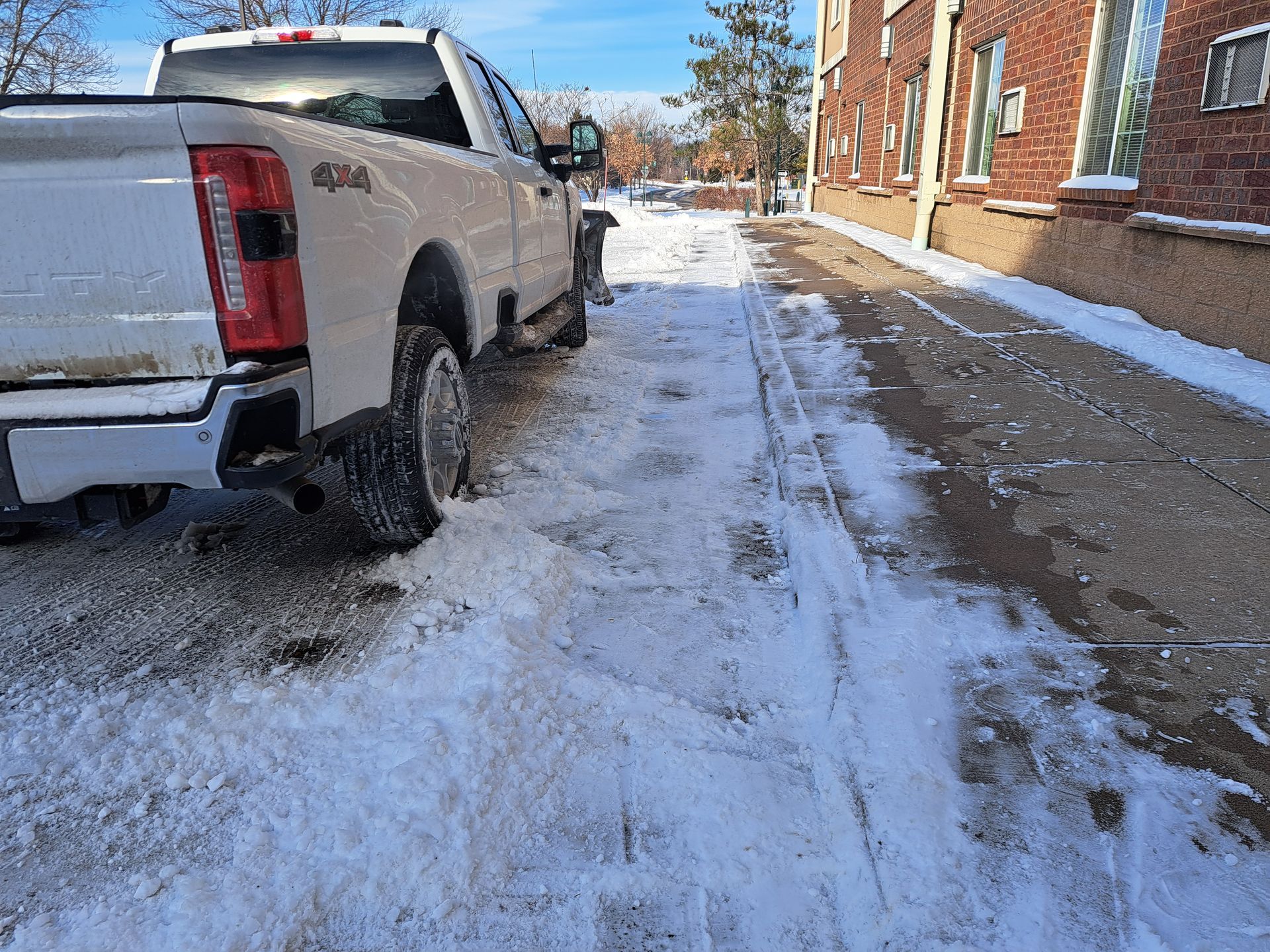
Curb-to-sidewalk clearing ensures ADA-compliant access at Edina medical offices
Accessibility Standards for Healthcare Properties
ADA compliance at medical offices isn't optional, and it applies to winter conditions the same way it applies to permanent building features. I bring this up with every medical office practice manager during the pre-season walkthrough because the accessible route requirements are more detailed than most people realize.
ADA accessibility standards require that accessible routes be maintained in usable condition. For a medical office, that means the accessible parking stalls, the access aisle next to them (the striped area where wheelchair users open doors and deploy ramps), and the entire path from those stalls to the building entrance must be free of snow and ice during business hours.
The access aisle is the most commonly missed element. I've walked medical office lots after storms where the previous contractor cleared the stalls and driving lanes but left a ridge of plowed snow right through the access aisle. A wheelchair user can't get out of their vehicle if the aisle is blocked by a snowbank. This isn't a convenience issue. It's a federal compliance requirement, and failure to maintain accessible routes can result in complaints, fines, and litigation.
Curb ramps and curb cuts along the accessible route need to be clear. Snow pushed against a curb during plowing often blocks the ramp, forcing wheelchair and walker users to navigate the curb without a ramp. Our operators are trained to keep curb ramps clear during every pass, and it's one of the items I check on post-storm quality inspections.
Patient drop-off zones at the building entrance are another accessibility consideration. Many medical offices have a designated area where patients can be dropped off close to the door, particularly patients with severe mobility limitations. This zone is one of the first areas cleared and treated during every event.
Pro Tip: After every storm, walk the full accessible route from each handicap stall to your front entrance. Check the access aisle, the curb ramp, and the entire sidewalk path. If any of those elements are obstructed, the property is out of ADA compliance regardless of how clean the rest of the lot looks.
Ice Management for Medical and Dental Offices
Patient fall risk at a medical office is elevated by factors that don't exist at most commercial properties. Patients may be elderly, on crutches or using walkers, recovering from surgery, or taking medications that affect balance and coordination. Some patients leave the office in worse condition than they arrived, having just had a tooth extracted, received an injection, or undergone a minor procedure that affects their gait or alertness.
This means ice management at a medical office needs to be more aggressive than at a typical commercial property. Pre-treatment before every forecasted event is the starting point. We apply brine to the lot surface, sidewalks, and entrance area before the storm arrives, which prevents ice bonding and makes post-storm clearing faster.
The entrance transition zone is where many medical office falls happen. Patients step from a treated exterior walkway onto a smooth interior floor with wet shoes. The solution starts outside: the exterior surface should be treated with deicing materials that break down ice but don't create excessive slush or residue that gets tracked inside. Some of our medical office clients specify materials like calcium magnesium acetate (CMA) for entrance areas because it produces less residue than rock salt, though it costs more per application.
Material selection matters throughout the property, but at medical offices the interior tracking issue makes it critical. Salt tracked onto tile, linoleum, or polished concrete creates a slip hazard inside the building. The SIMA snow and ice resource center publishes guidance on material selection for healthcare and pedestrian-heavy properties that balances exterior effectiveness with interior safety. We follow these recommendations and specify materials by zone in our medical office contracts: premium low-residue materials at entrances and walkways, standard salt on the broader lot surface.
Re-treatment during the day should be available on call. If a patient or staff member reports icy conditions on the walkway at 10 AM, the contractor should be able to respond within a reasonable timeframe. We build during-hours re-service provisions into our medical office contracts, either as part of the base scope or at a specified callback rate. Waiting until the next scheduled visit when a patient has already reported ice is the kind of gap that creates claims.
What Medical Office Managers Should Look for in Snow Removal Service
The difference between an adequate snow removal provider and the right one for a medical office comes down to specifics that matter more in healthcare settings than anywhere else. I've been working with medical and dental practices long enough to know which contract terms separate the providers who understand these properties from the ones who treat them like any other commercial lot.
Guaranteed completion time is the most important term. The agreement should state a specific time by which the property will be cleared and treated. Not "before business hours." A specific time: "by 6 AM" or "by 5:30 AM" if the practice opens early. The medical office schedule drives the deadline, and the contractor needs to commit to meeting it in writing. We specify completion times to the half-hour in our medical office contracts because the 6:15 staff arrival doesn't care about a 7 AM completion estimate.
Sidewalk and entrance scope should be treated as equal to, or more important than, the parking lot scope. Many commercial contracts put the lot first and sidewalks second. At a medical office, the walkway from the lot to the front door is where the highest-risk interactions happen. The contract should specify entrance clearing, sidewalk deicing, curb ramp maintenance, and accessible route compliance as core scope items.
During-storm communication matters because medical offices don't close for weather. If it's snowing during patient hours and conditions are deteriorating, the office manager needs to know when the crew is returning. The contract should specify the contractor's response to changing conditions during the day, and the office manager should have a direct line to the account manager or dispatcher. The same service approach we bring to restaurant properties in Bloomington, where the business stays open during storms, applies here: the contractor has to be reachable and responsive during active weather, not just before and after.
Documentation protects the practice. Service logs, timestamps, and material records are the evidence that reasonable care was provided. If a patient slips on ice and files a claim, the practice's defense starts with proof that the property was professionally maintained. The Occupational Safety and Health Administration identifies documentation of winter safety practices as a recommended component of slip-and-fall prevention, and for a medical office where the patient population includes high-risk individuals, that documentation isn't optional.
The elevated care standards we apply at medical offices share principles with our work at senior living facilities in Minneapolis, where the resident vulnerability is even higher. If your practice serves a predominantly elderly patient base, the ice management and accessibility standards should reflect that population, not default to generic commercial snow removal standards.
If you manage a medical or dental office in Edina and need snow removal that meets the demands of early-morning patient care, contact us to discuss a scope built around your practice schedule.
Frequently Asked Questions
Does a medical office need snow removal for sidewalks and entrances separately?
Yes. Parking lot plowing and sidewalk/entrance treatment are different services requiring different equipment and materials. The sidewalk from the lot to the front door, the entrance landing, any ramps or steps, and the handicap-accessible route should all be explicitly included in the contract. Confirm that pedestrian areas are covered at the same priority level as the parking lot, because at a medical office, the walkway is where the highest risk lives.
What happens if it's still snowing when patients arrive?
During active storms, the crew makes maintenance passes to keep the lot navigable and entrance areas safe. Full clearing may not be possible while snow continues, but driving lanes, patient parking near the entrance, and walkways are maintained throughout the day. We apply deicing materials between plow passes to prevent ice formation on walkways and entrance areas. The contract should include during-storm service provisions specifying how the property will be managed while the practice is open.
Are medical offices liable if a patient falls on ice in the parking lot?
Medical offices have a duty to maintain their property in a reasonably safe condition for patients and visitors. If a patient falls on ice and the office cannot demonstrate that reasonable steps were taken, the practice may face a premises liability claim. Having a professional snow removal contract with documented service, adequate ice management, and proper insurance helps establish that the practice met its duty of care. The contractor may also face liability if the fall occurred because they failed to perform contracted work.
What deicing materials are best for medical office walkways?
For entrance areas and walkways, materials should be effective, minimize residue tracking onto interior floors, and avoid excessive surface damage. Calcium chloride works at lower temperatures than rock salt and produces less residue. Calcium magnesium acetate (CMA) is gentler on surfaces with minimal residue but costs more and is less effective at very low temperatures. A common approach is premium material at entrances and walkways where tracking matters, and standard salt on the broader lot surface.
How early should a medical office parking lot be cleared?
The lot should be cleared and treated before the first staff member arrives, typically 30 to 60 minutes before the first patient appointment. For a practice with 7 AM appointments, that means completion by 6 to 6:30 AM. Specialties with earlier hours, like dialysis or surgical centers, may need completion by 5 AM. The specific time should be a guaranteed commitment in the contract, not an estimate.
How much does snow removal cost for a medical office?
Cost depends on lot size, sidewalk footage, number of entrance areas, and ice management scope. Medical offices typically pay a premium over similarly sized office or retail properties because the timeline is earlier, accessibility requirements are more demanding, and ice management expectations are higher. Seasonal contracts provide predictable budgeting. Get quotes specifying the same scope across contractors so you can compare accurately.
About the Author
I'm Kent Gliadon, founder of KG Landscape and a graduate of the University of Minnesota Landscape Design program. For over 20 years, I've focused on integrating well-planned landscape design and installation work with properly engineered outdoor drainage solutions. I believe discerning homeowners deserve landscaping and drainage renovations that are carefully planned from the beginning, accounting for water movement, grading, soils, hardscaping, and future use, so problems are prevented before they occur. These articles explain how and why specific solutions are implemented and what it takes to maintain properties that truly last.
Ready to Start on Your Next Project?
Call us at (763) 568-7251 or visit our quote page.