Arden Hills Office Parks Sit Empty at 4 AM. That's When Snow Removal Happens.
The Overnight Operation That Keeps Office Parks Running
By the time the first car pulls into an Arden Hills office park at 6:30 AM, the lot should look like it never snowed. Driving lanes clear. Parking stalls accessible. Sidewalks treated. Entrances open. The whole property ready for a full day of business before anyone walks through the door.
What most people don't see is what happened between 3 AM and 6 AM to make that possible. I've been running overnight snow operations at office parks for over 20 years, and the work is almost entirely invisible. The lots sit dark and empty. The crew comes through. And the results get judged by people who never saw the storm. That's the way it should work.
We service office park properties across the north metro, and the ones that run smoothly have something in common: the property manager understands how this process works and holds the contractor to a defined standard. If you manage commercial office space in Arden Hills, here's what that standard looks like.
Why Office Park Snow Removal Starts Before Dawn
The timeline for office park snow removal is built around one deadline: the lot needs to be safe and passable before the first employees arrive. For most office properties, that means 6 to 7 AM. Some buildings with early-shift tenants or fitness centers push that window even earlier.
During an overnight storm, our crews typically begin mobilizing between 2 and 4 AM, depending on the trigger depth and the rate of accumulation. We monitor weather conditions through radar, ground-level observations, and real-time temperature data. When conditions meet the trigger threshold, usually 1 to 2 inches for commercial properties, crews deploy.
The pre-dawn window is the most productive time for office park snow removal because the lots are empty. No cars to work around. No pedestrians crossing. No delivery trucks blocking loading docks. Crews can run full-width plow passes across entire parking areas without stopping, stack snow efficiently in designated areas, and apply salt to every surface before anyone arrives. We wrote about this dynamic with commercial snow service in Orono, and the operational approach is the same across our office park accounts.
When a storm ends during business hours or starts in the middle of the day, the operation changes. Crews work around occupied vehicles, keep driving lanes open while plowing adjacent areas, and coordinate with building management on timing. The pre-dawn window is cleaner, faster, and safer for everyone involved.
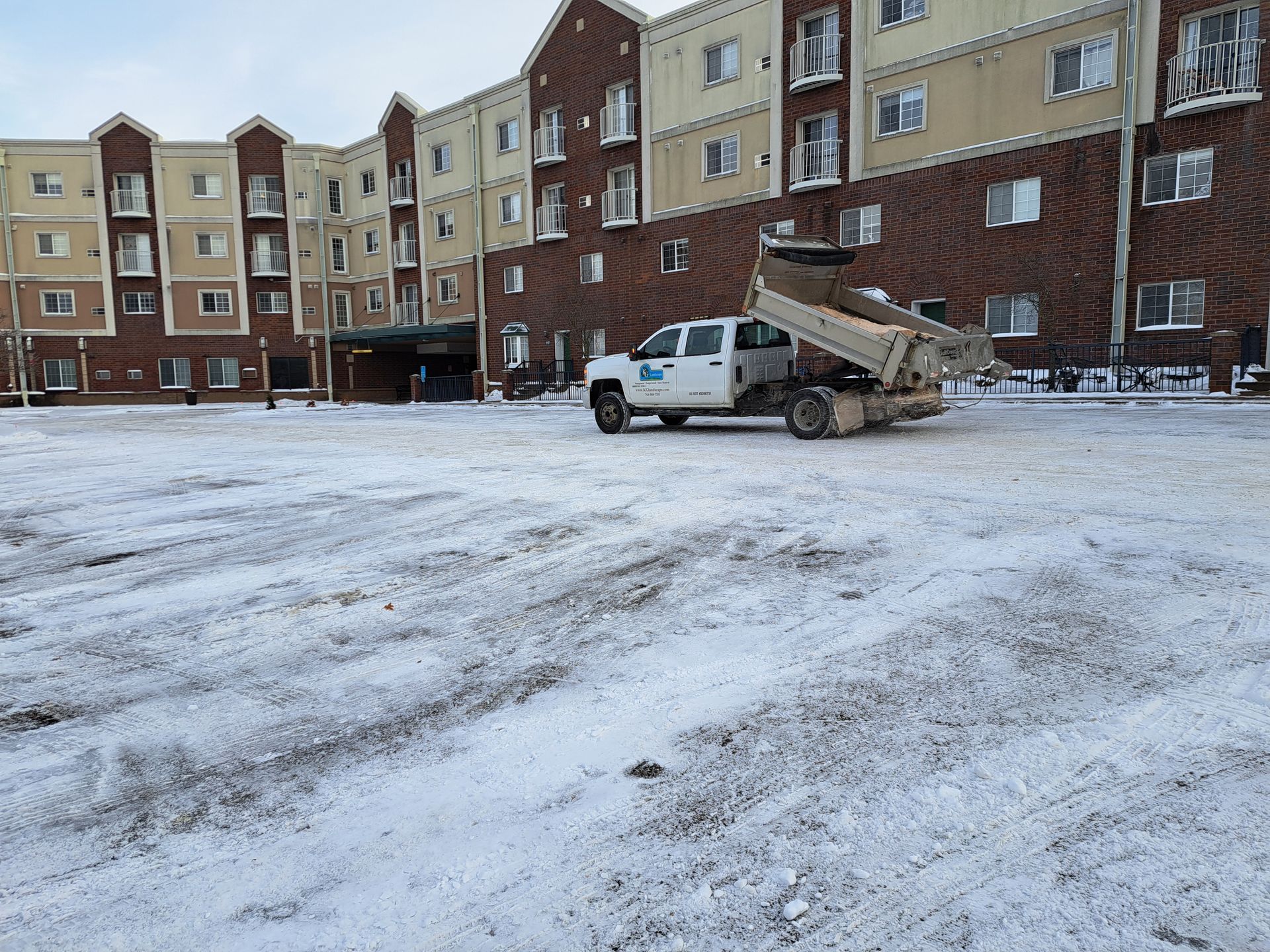
Pre-dawn operations ensure parking lots are clear before the first employees arrive in Arden Hills
What Gets Cleared and in What Order
Commercial snow removal at an office park follows a priority sequence. Not everything gets cleared at the same time, and the order matters.
Priority one is always access and safety. Main entrances to the property, fire lanes, and building access points get cleared first. If an emergency vehicle needs to reach the building, these routes have to be open regardless of what's happening in the rest of the lot. Loading dock access falls into this tier too, especially for buildings that receive early-morning deliveries.
Priority two is the primary parking lot. Driving lanes and aisles first, then individual stalls working outward from the building entrances. The stalls closest to the front doors get attention before the far corners. This staging approach means that even if the crew is still finishing when early arrivals show up, the most-used areas are already clear.
Priority three covers secondary lots, overflow parking, and less-trafficked areas. If the park has multiple buildings, each building's primary lot takes precedence over shared overflow areas. The last areas addressed are typically perimeter zones, back lots, and employee-only parking.
Throughout the process, sidewalks and pedestrian pathways are handled separately, often by a different crew member using hand tools, walk-behind blowers, or small utility vehicles. Sidewalks can't wait until the parking lot is finished. They need to be clear and treated by the time anyone walks from their car to the building entrance. Our Arden Hills snow removal service includes pedestrian path clearing as a core scope item, not an afterthought.
Multi-Day Storms and Continuous Service
Single overnight storms are straightforward. The real test of a snow removal operation, and the test I use to evaluate how well our own team is performing, is the multi-day event: the kind of storm that drops snow for 18 or 24 hours straight, or the back-to-back system that brings 4 inches Tuesday night and another 6 Wednesday afternoon.
During extended events, the approach shifts from "clear once and done" to continuous pass-through service. Crews make repeated passes to keep accumulation manageable, typically every 2 to 4 inches depending on the contract terms. The goal during an active storm isn't a pristine lot. It's a usable one. Driving lanes stay open. Entrances stay accessible. Accumulation stays below the point where cars get stuck or pedestrians struggle.
Crew rotation is a logistics challenge during prolonged storms. Operators can't run equipment for 24 hours straight. We maintain bench depth across our team, rotating drivers and machines on staggered shifts to keep continuous coverage across the route. How a company handles crew rotation during a three-day event is a reasonable question to ask before you sign a contract. If they don't have a clear answer, they probably don't have a clear plan.
Communication with property management during ongoing events is critical. You need to know when crews are on site, what areas have been addressed, and what the next pass looks like. Some companies provide GPS tracking. Others use text updates at set intervals. The worst approach is silence, where the property manager has no idea what's happening until they drive through the lot themselves. According to FEMA's winter weather preparedness guidance, maintaining communication protocols during extended weather events is a fundamental part of operational continuity for commercial properties.
Snow stacking reaches its limits during heavy winters. Office parks have designated stacking areas, usually along the perimeter or in unused corners. When those areas fill up, or when stacked snow starts blocking sight lines at exits, hauling becomes necessary. Snow hauling means loading snow into trucks and removing it from the property. It's expensive but sometimes unavoidable, and it should be addressed as a contingency in the contract so the cost doesn't surprise you in January.
Ice Management for Commercial Office Properties
Plowing moves snow. Ice management prevents the conditions that cause people to fall. For commercial office parks, both are essential, and they operate on different timelines.
Pre-treatment is the first phase. Before a forecasted storm, we apply a liquid brine or anti-icing agent to parking lot surfaces and sidewalks. This prevents ice from bonding to the pavement, which makes plowing more effective and reduces the amount of granular salt needed after the storm. The SIMA snow and ice resource center publishes operational guidance on pre-treatment protocols, and it's a practice we follow on every commercial property we manage. Our full approach to de-icing and salting is outlined on our service page.
During and after plowing, granular salt or deicer goes down on the lot surface, driving lanes, and pedestrian areas. The timing matters. Salt applied to a lot that's still being plowed gets pushed aside with the snow. Effective ice management means applying after each plow pass is complete, targeting the areas where moisture refreezes first: entrances, shaded areas, ramps, curb cuts, and anywhere water pools.
Entrance areas and building vestibules deserve special attention. These are transition zones where snow and moisture get tracked inside on shoes. The ice that forms at the threshold of a building entrance is some of the most dangerous on the property because people are shifting their gait from outdoor walking to indoor walking and their attention moves away from footing. The Occupational Safety and Health Administration identifies these transition zones as a primary factor in workplace slip-and-fall incidents.
Temperature swings create the sneakiest ice conditions. A sunny afternoon that melts surface snow followed by an evening freeze produces black ice on lots that were plowed clean 12 hours earlier. I've walked lots at 6 PM that were dry and clean at noon and found a sheet of ice forming across the entire surface. Good ice management includes monitoring for these conditions and re-treating when temperatures drop, even when there's no new snowfall. This is the kind of proactive attention that separates a snow management program from someone who just owns a plow.

Building entrances require dedicated attention for both safety and professional appearance
What Property Managers Should Expect From Their Provider
If you manage an office park in Arden Hills, there are a few things that separate a professional commercial snow operation from a company that just shows up with a blade.
Service documentation is the baseline. Every visit should be logged with arrival and departure times, areas serviced, equipment used, and materials applied. GPS tracking provides independent verification that crews were on site when they said they were. Timestamped condition photos add another layer of accountability. This documentation isn't just for your records. It's your evidence in the event of a premises liability claim, and it's what allows you to answer tenant questions with data instead of guesswork.
Communication protocols during storms should be established before the season starts. How will you be notified when crews deploy? Who do you contact if conditions change? Is there a single point of contact, or are you calling a general dispatch number? For office parks with multiple buildings and tenants, having a dedicated account manager who knows your property makes a meaningful difference. We assign account contacts to our commercial snow removal clients for this reason.
Dedicated equipment assignment matters for larger properties. If your park has a 200-stall lot plus sidewalks, ramps, and loading docks, the contractor should have specific equipment assigned to your route, not shared across distant properties. Ask what machines they'll use and whether they're dedicated or floated between accounts.
End-of-season reporting is a sign of a contractor who thinks beyond the current storm. A season-end summary showing total events serviced, materials used, response times, and any property damage gives you data for budgeting, contract renewal decisions, and long-term planning. It's the kind of detail that St. Paul bank branches and other demanding commercial clients expect, and office parks should expect the same. We provide this level of reporting to our commercial landscaping clients in New Brighton and across the north metro because the data from one season shapes the plan for the next.
If your office park needs commercial snow removal that meets these standards, contact our team for a property walkthrough and scope discussion.
Frequently Asked Questions
What happens if it's still snowing when employees arrive?
During active storms, commercial snow removal shifts from full-lot clearing to continuous maintenance. Crews keep driving lanes, building entrances, and primary walkways accessible while snow continues to fall. Plow trucks make repeated passes at regular intervals to prevent excessive accumulation. Once the storm ends, a full cleanup pass follows. Tenants should expect some snow on the ground during an active event, but the lot should remain safe and navigable throughout.
How do snow removal companies handle multi-day storms?
Multi-day storms are managed through continuous service with rotating crews. Rather than waiting for the storm to end, contractors make pass-through runs every few hours to keep accumulation manageable. Operators rotate on staggered shifts to maintain coverage. The property manager receives progress updates. The goal during a prolonged event is a usable lot and safe walkways, with a full cleanup once accumulation stops.
Do office parks need ice management in addition to plowing?
Yes. Plowing removes snow but does nothing to address ice that forms underneath, during temperature swings, or in areas where moisture refreezes after dark. Office parks have high pedestrian traffic between parking areas and building entrances, making ice the primary slip-and-fall risk. Pre-treatment before storms, post-plow salt application, and ongoing refreeze monitoring are all components of a complete commercial ice management program.
What's the difference between snow plowing and snow management?
Snow plowing is pushing snow with a blade. Snow management is the complete winter maintenance of a commercial property: pre-storm preparation, active plowing, ice prevention and treatment, sidewalk clearing, documentation, post-storm monitoring, and communication. For an office park, plowing alone leaves major gaps in ice control, pedestrian safety, and liability protection.
How much does snow removal cost for an office park?
Pricing depends on lot size, sidewalk footage, number of buildings, trigger depth, and ice management scope. Office parks are typically priced on seasonal contracts because the scope is complex and the service expectation is high. Request quotes with identical scopes from multiple contractors so you're comparing equivalent services. Make sure ice management, sidewalks, and documentation are included in the base scope rather than billed as add-ons.
What equipment is used for office park snow removal?
Commercial office parks use a combination of equipment matched to different areas. Full-size plow trucks handle open lot areas. Compact wheel loaders or track machines work tighter spaces like loading docks and building islands. Walk-behind blowers and hand tools clear sidewalks and entrances. Truck-mounted and walk-behind salt spreaders apply deicing materials. For large lots, mechanical spreaders ensure even coverage.
About the Author
I'm Kent Gliadon, founder of KG Landscape and a graduate of the University of Minnesota Landscape Design program. For over 20 years, I've focused on integrating well-planned landscape design and installation work with properly engineered outdoor drainage solutions. I believe discerning homeowners deserve landscaping and drainage renovations that are carefully planned from the beginning, accounting for water movement, grading, soils, hardscaping, and future use, so problems are prevented before they occur. These articles explain how and why specific solutions are implemented and what it takes to maintain properties that truly last.
Ready to Start on Your Next Project?
Call us at (763) 568-7251 or visit our quote page.