
Drain Tile Installation to Fix Wet & Soggy Lawns
Precision Drain Tiling for lawns in the Greater Twin Cities Metro - 2003
We Fix Wet, Soggy Yards
Is your yard constantly wet, muddy, or soft underfoot?
Standing water after rain, soggy soil that lingers for days, and that spongy feeling every spring are clear signs your property isn’t draining the way it should.
At KG Landscape, we design and install professional-grade drainage tile systems across the Minneapolis–St. Paul metro — delivering permanent, engineered solutions that move water away from your home and restore your yard to firm, usable ground.
Why Yards Stay Wet in the Twin Cities
Homeowners throughout Minneapolis, St. Paul, Edina, Minnetonka, Plymouth, Maple Grove, Bloomington, Wayzata and surrounding communities frequently search for:
- Why is my yard always wet?
- How to fix a soggy lawn in Minnesota
- Standing water in yard after rain
- Backyard flooding after snow melts
- Muddy lawn that won’t dry
- Yard not draining properly
In the Twin Cities metro, the causes are predictable:
- Clay-dominant glacial soils that don’t absorb water
- Spring snowmelt saturating frozen ground
- Poorly graded yards
- Freeze-thaw soil expansion
- Heavy summer thunderstorms
- Compacted urban and suburban lots
- Flat grading common in post-war neighborhoods
When water cannot drain downward naturally, it collects in the root zone. That’s when lawns become soft, muddy, and unusable. Once the water gets into poorly drained soils, it has no place to go and can take days or even weeks to dry out enough to walk on.
Drain tile installation solves the soggy lawn problem beneath the surface — where grading alone often in certain instances cannot. Drain tile provides an open void below ground, a clear "path of least resistance" for water to drain out of saturated soils into the drain tiling pipe via weep holes.
When Grading Alone Can Fix Drainage — And When It Can’t
In many cases, proper grading is the first and most effective solution for yard drainage problems. When a lawn is pitched correctly — with consistent slope away from structures and toward safe discharge areas — surface water can move naturally without requiring subsurface intervention.
However, in the Minneapolis–St. Paul metro, grading alone does not always solve the issue.
There are specific scenarios where drain tile becomes necessary for lawns.

Where Sloped Areas Meet Flat Lawn Sections
One of the most common problem areas in the Twin Cities occurs where a steep hillside meets a flatter lower lawn.
This is particularly common:
- In walkout homes throughout Plymouth and Maple Grove
- On rolling lots in Medina
- Along lakeside properties throughout the west metro
- In neighborhoods with elevation transitions common to glacial terrain
When heavy rain or snowmelt sends water rushing down a slope, it often collects at the transition point where the yard levels out. That flatter lower section becomes saturated because water accumulates faster than it can drain.
In these transition zones, grading alone cannot increase drainage without significantly altering the landscape. A properly designed drain tile system intercepts groundwater beneath the surface and redirects it before saturation occurs.
Walkout Basement Yards & Side-Yard Convergence Zones
In many Twin Cities neighborhoods — especially in Plymouth, Maple Grove, Medina, and other west metro communities — walkout basement homes create a very specific drainage challenge.
These properties typically feature:
- Sloped side yards
- A flatter backyard area directly behind the home
- Roof runoff converging toward the rear yard
- Neighboring properties draining downhill into the same space
The most problematic area is often where the sloped side yards meet the flat backyard along the rear of the house. This transition zone becomes a natural collection point for:
- Water rushing down hillsides
- Downspout discharge
- Surface runoff from adjacent lots
- Spring snowmelt accumulation
Because the backyard is intentionally flattened for usability, decks, patios, fence posts, and lawn areas in this zone can remain saturated for extended periods. Grading alone often cannot create additional slope without significantly altering the yard.
In these cases, drain tile installed beneath the transition zone intercepts groundwater and redirects it before it damages hardscapes or turns the lawn into a muddy, unstable surface.

Lakeside Lawns Where Hills Flatten at the Shoreline
Lakeside properties throughout the Minneapolis–St. Paul metro — particularly near Lake Minnetonka and other regional lakes — present a different but equally challenging scenario.
Many lakefront lots slope downward from the home and then flatten into a usable lawn space near the shoreline. This creates a beautiful level gathering area — but also a natural water collection basin. As part of well planned landscaping projects for lakeside properties, drain tile can be an effective solution for managing excess water and improving drainage.
As rainfall or snowmelt moves down the hillside, it slows dramatically once it reaches the flat lakeside lawn. With:
- Elevated groundwater tables
- Limited grading flexibility due to shoreline regulations
- Wind-driven rain events
- High seasonal soil saturation
Water often accumulates in these flattened lower zones.
Because level and function lawn space is soo ideal along shorelines, subsurface drain tile becomes one of the most effective methods to maintain a lawn that feels level and stabile without compromising drainage, aesthetics or shoreline compliance.

Swales & Engineered Drainage Channels That Stay Wet
Swales are intentionally graded depressions designed to channel water safely through a landscape. They are common in newer developments throughout Minneapolis suburbs and in properties with complex grading patterns.
While swales are designed to carry water efficiently, they often experience prolonged saturation because:
- Large volumes of runoff pass through them
- Clay soils slow infiltration
- Water concentrates in the center line of the swale
- Spring thaw overwhelms surface flow capacity
Even when grading is technically correct, the soil within the swale can remain soft and muddy long after a storm.
This commonly leads to:
- Muddy mower tracks
- Ruts in turf
- Mushy walking surfaces
- Thinning grass along the swale bottom
In these cases, drain tile is often installed directly beneath the centerline of the swale. This allows surface water to move as designed while subsurface tile removes lingering groundwater — significantly improving soil stability and turf performance.

Why This Matters for Twin Cities Drainage
These transition zones — walkout backs, lakeside flats, and swales — are among the most common areas where grading alone is insufficient.
Understanding when to rely on slope and when to incorporate subsurface drain tile is what separates surface-level fixes from long-term drainage performance.
What Is Yard Drain Tile?
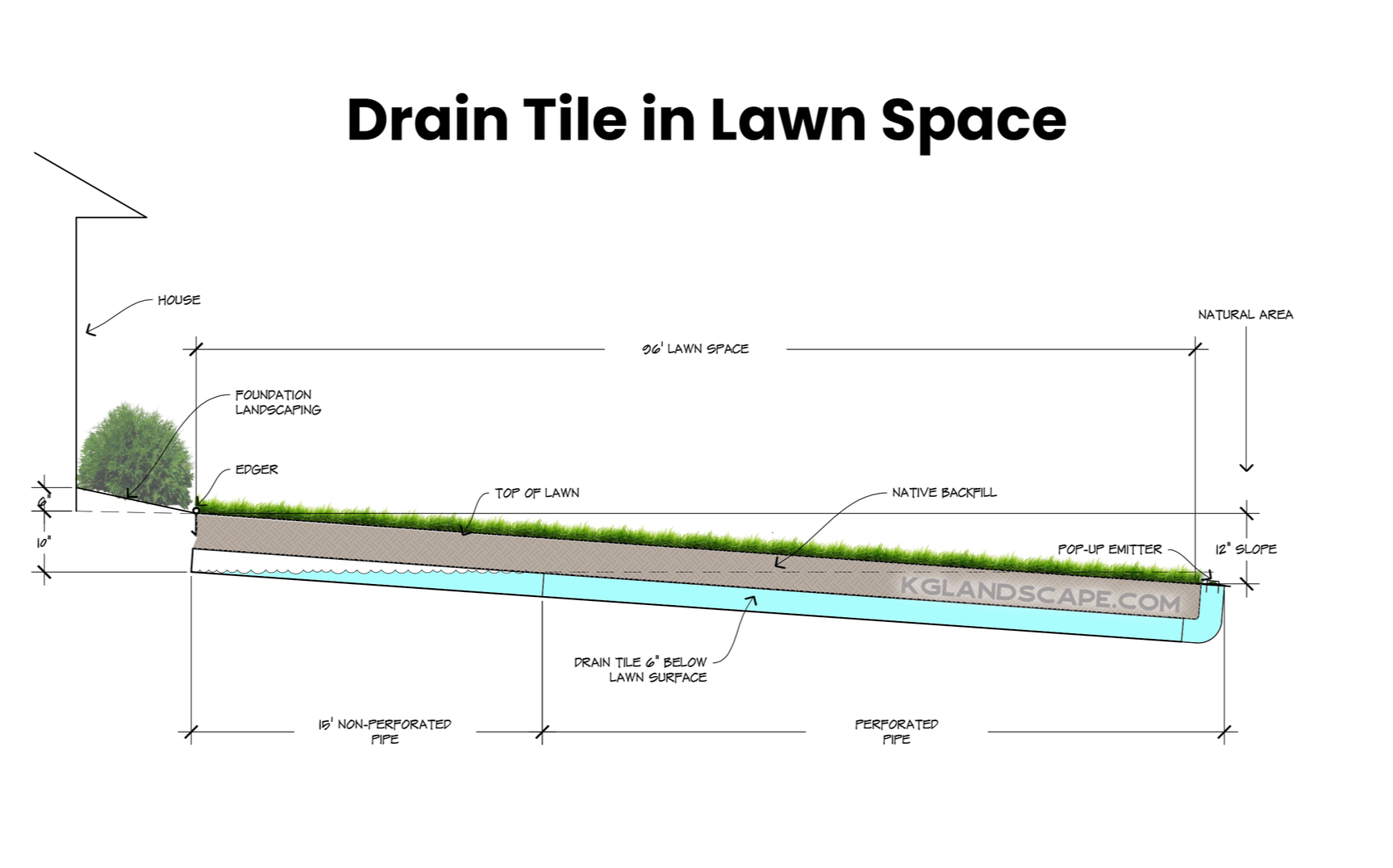
Drain tile is a perforated subsurface pipe system installed below your lawn to collect and redirect excess groundwater away from saturated areas.
Unlike surface drainage systems, drain tile works below grade — removing water before it can pool on top of your yard.
In Minneapolis and St. Paul, drain tile is commonly used when:
- Broad sections of lawn stay waterlogged
- Clay soil prevents percolation
- Regrading hasn’t solved the issue
- Water sits for days after rain
- Turf roots are suffocating from saturation
When Drain Tile Is the Right Solution — And When It’s Not
Not every drainage issue requires subsurface drain tile. In many cases, correcting surface grading alone can resolve minor pooling or redirect roof runoff away from problem areas.
If water is simply flowing toward the house due to improper slope, regrading may be the most direct and cost-effective solution.
However, drain tile becomes necessary when:
- The lawn remains saturated even after grading corrections
- Clay soil prevents natural infiltration
- Water collects at slope-to-flat transition zones
- Swales stay soft long after storms
- Broad sections of yard feel spongy underfoot
In many Twin Cities clay soils, infiltration rates are significantly slower than sandy soils, which is why subsurface systems are often required to remove excess groundwater effectively.
When surface pitch cannot be adjusted without compromising usability, subsurface drainage provides the needed relief beneath the lawn.
Drain Tile vs. French Drain: How We Define the Difference
Some contractors use the terms drain tile and French drain interchangeably. At KG Landscape, we differentiate between the two because the construction methods and intended performance characteristics are distinct.
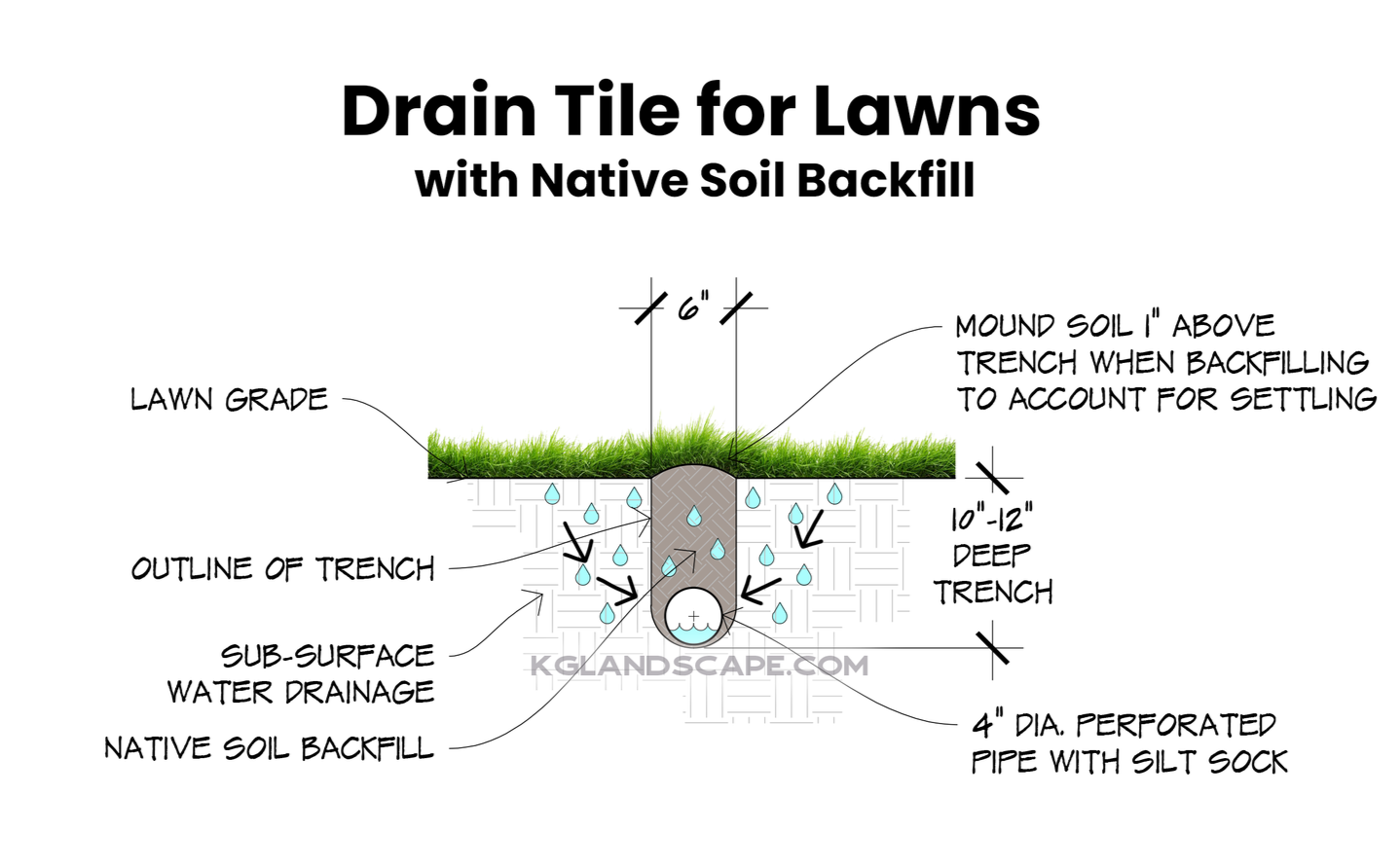
Drain tile, as we define it, consists of perforated pipe installed below grade without rock backfill. The trench is backfilled with native soil or a specialized soil blend designed to encourage subsurface water movement while maintaining a streamlined and cost-efficient installation. Drain tile is typically used to relieve widespread lawn saturation, intercept groundwater at slope transitions, or dry out problem areas where clay soils prevent natural drainage.
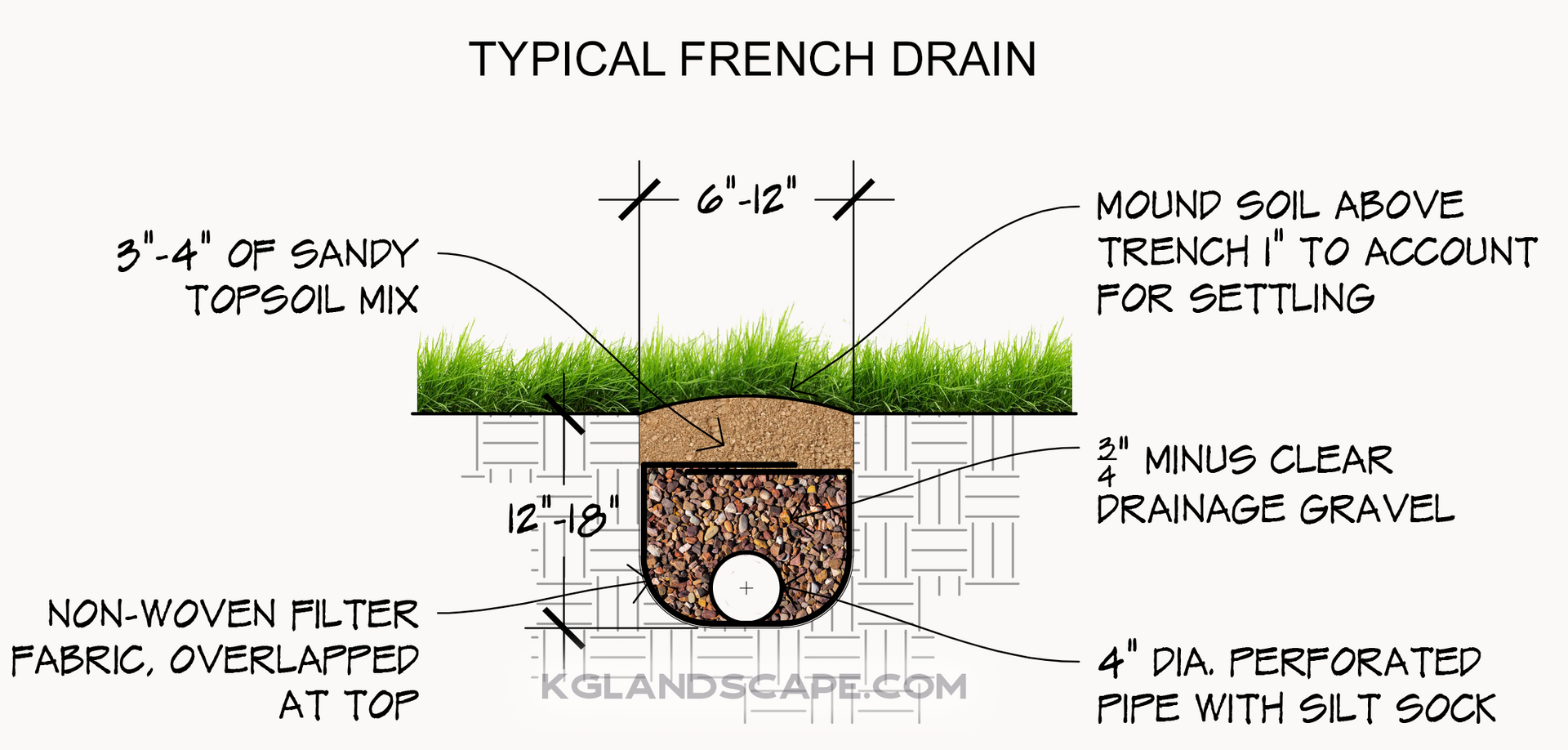
A French drain, by contrast, consists of perforated pipe surrounded by clean ¾-inch drainage rock (with no fines) and fully encapsulated in filtration fabric. The stone creates engineered void space around the pipe, allowing water to enter, disperse, and move efficiently. The filtration fabric prevents surrounding soil from migrating into the stone and compromising performance over time. French drains are often used where higher water volumes are present or where additional protection and distribution capacity are needed.
Both systems play important roles in outdoor drainage design. The right solution depends on soil conditions, water volume, location, and the long-term performance goals of your property.
Drain Tile
- Perforated pipe installed directly within a trench
- No surrounding stone backfill
- No fabric enclosing rock backfill and pipe
- Ideal for widespread lawn saturation
- Ideal to be installed in grid patterns
- Efficient for large turf areas across Twin Cities properties
- Less expensive per linear foot that French drains
If you’re dealing with a wet lawn rather than foundation water intrusion, drain tile is often the more appropriate solution.
French Drains
- Perforated pipe surrounded by rock backfill
- Rock and pipe are wrapped completely in filtration fabric
- Often used near foundations or concentrated runoff areas
- Larger drainage capacity than drain tile per linear foot
- Can hold more water
- Lasts longer, more durable
- Are more expensive per linear foot that drain tile
Signs You May Need Drain Tile Installation
If you notice any of the following, drain tile may be appropriate:
- Lawn feels spongy or soft underfoot
- Mowing causes lawn rugs, muddy tracks and damage
- Grass thinning in low areas
- Standing water that lasts more than 24–48 hours
- Muddy sections that never fully dry
- Saturated yard after spring snowmelt
- Water collecting near patios or hardscapes
- Recurring drainage problems year after year
These symptoms indicate excess subsurface water that needs a controlled exit path.
Types of Drain Tile Systems We Install Across the Twin Cities
No two yards in the Minneapolis–St. Paul metro handle water the same way. Soil composition, slope transitions, neighborhood grading, and runoff volume all affect how moisture moves — or fails to move — through a property.
As part of our outdoor drainage consultation,
KG Landscape evaluates your yard to determine where drain tile and complementary solutions will deliver the most effective and cost-efficient results. Below are the primary drain tile configurations we install across the Twin Cities.
Single-Run Drain Tile
A single-run system consists of one continuous line of perforated pipe installed to intercept groundwater in a concentrated problem area. This approach is commonly used:
- Along swales
- At the base of slopes
- Beneath consistently wet lawn sections
- Where water collects at predictable transition points
The goal is simple: capture subsurface water and redirect it underground to a safe discharge location.
Single-run systems are ideal when moisture follows a defined path rather than affecting an entire yard.
Drain Tile Beneath Swales
Swales are intentional drainage channels built into many Twin Cities neighborhoods. These shallow depressions — often located along property lines or rear lot lines — are designed to carry surface water between homes.
However, because many swales are gently pitched, especially in clay-heavy soils, water tends to infiltrate the surrounding ground as it flows through. Over time, this leads to:
- Persistent wet turf
- Muddy mower tracks
- Soft walking surfaces
- Thinning grass along the swale center
Installing drain tile beneath the swale allows excess groundwater to exit efficiently while preserving the intended grading pattern. This helps the area dry significantly faster after storms or snowmelt.
Interceptor Drain Tile at Slope Transitions
In neighborhoods like Plymouth, Maple Grove, and Medina, walkout homes frequently create a common drainage scenario: sloped side yards meetisng a flat backyard.
As runoff moves downhill, it slows dramatically when it reaches the flat section below. Because the yard is intentionally level for usability, water often becomes trapped at this transition point.
Interceptor drain tile is installed perpendicular to the slope at the base of the hill. It captures groundwater beneath the surface before it saturates the rest of the soil / turf space within the larger flat lawn space below. using drain tile this way also helps protect the home's foundation, deck footings, patios, and fence posts by helping drain oversaturated soils and thereby preventing damage to thee features during freeze thaw cycles that can expand and lift structures below ground.
This solution corrects the issue without requiring major regrading.

Grid-Pattern Drain Tile
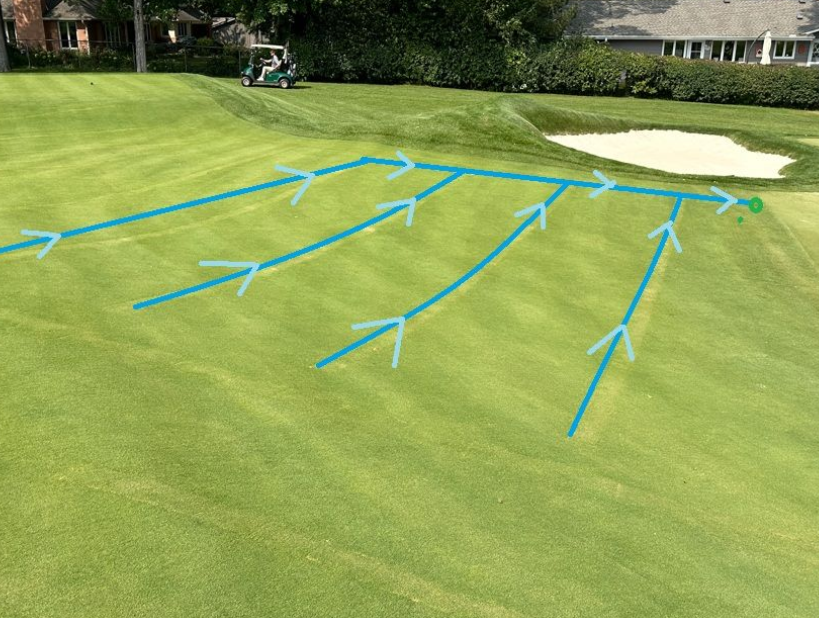
Grid-pattern systems are used when an entire lawn area remains saturated rather than one defined section.
In these cases, water lingers across a broad, flat surface with no natural channel for exit.
This is common in:
- Large suburban backyards
- Lakeside lawn terraces
- Compacted clay soils
- Open areas that stay soft after rain
Multiple subsurface lines are installed beneath the turf to evenly remove excess moisture. Depending on the yard layout, this may resemble a grid, branching “fingers,” or artery-style connections feeding a central outlet.
Each layout is customized based on slope, soil behavior, and observed saturation patterns.
Integrated Drain Tile Systems
Drain tile is a powerful tool — but it is rarely a standalone solution.
In many cases, we design integrated outdoor drainage systems that combine drain tile with other corrective measures, including:
- Underground downspout extensions
- French drain sections near patios, foundations, acute wet areas
- Surface drains in the lawn and landscape
- Sump pump discharge water routing
- Grading adjustments
- Surface water redirection
By integrating drain tile into a larger drainage plan, we create coordinated systems that manage water across the entire property — from roofline to lawn to discharge point.
This approach ensures that water is controlled above and below ground, preventing recurring issues and protecting your long-term landscape investment.

Our Drain Tile Installation Methods
At KG Landscape, we know that no two yards — or budgets — are the same. Soil composition, water volume, slope, tree cover, future construction plans, and long-term performance goals all influence how a drain tile system should be built. That’s why we don’t believe in a one-size-fits-all approach.
Instead, we design every system using a range of proven installation methods that allow us to deliver the right solution for each property. From standard native backfill systems to upgraded sand backfill installations, heavy-duty PVC applications, root-protected systems, and larger primary drain lines for integrated drainage networks — we engineer each project with long-term durability and performance in mind.
Many projects utilize a single method. Others combine multiple approaches into one comprehensive drainage plan, especially when tying together downspouts, French drains, sump discharge lines, and yard collection systems. Our goal is simple: educate you on the options, explain the benefits of each, and build a system that performs reliably for years to come.
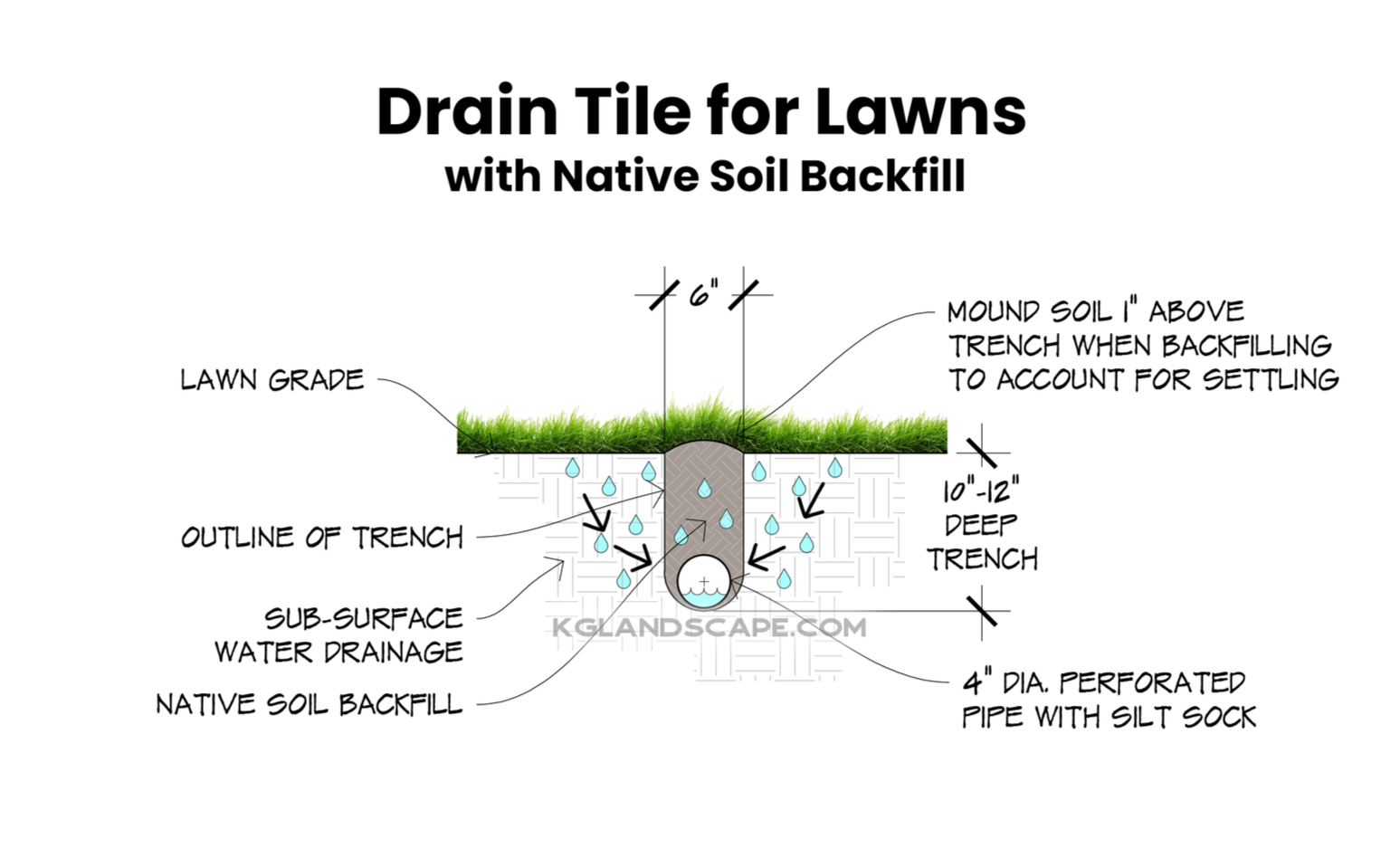
Drain Tile with Native Backfill (4” Corrugated Pipe with Silt Sock)
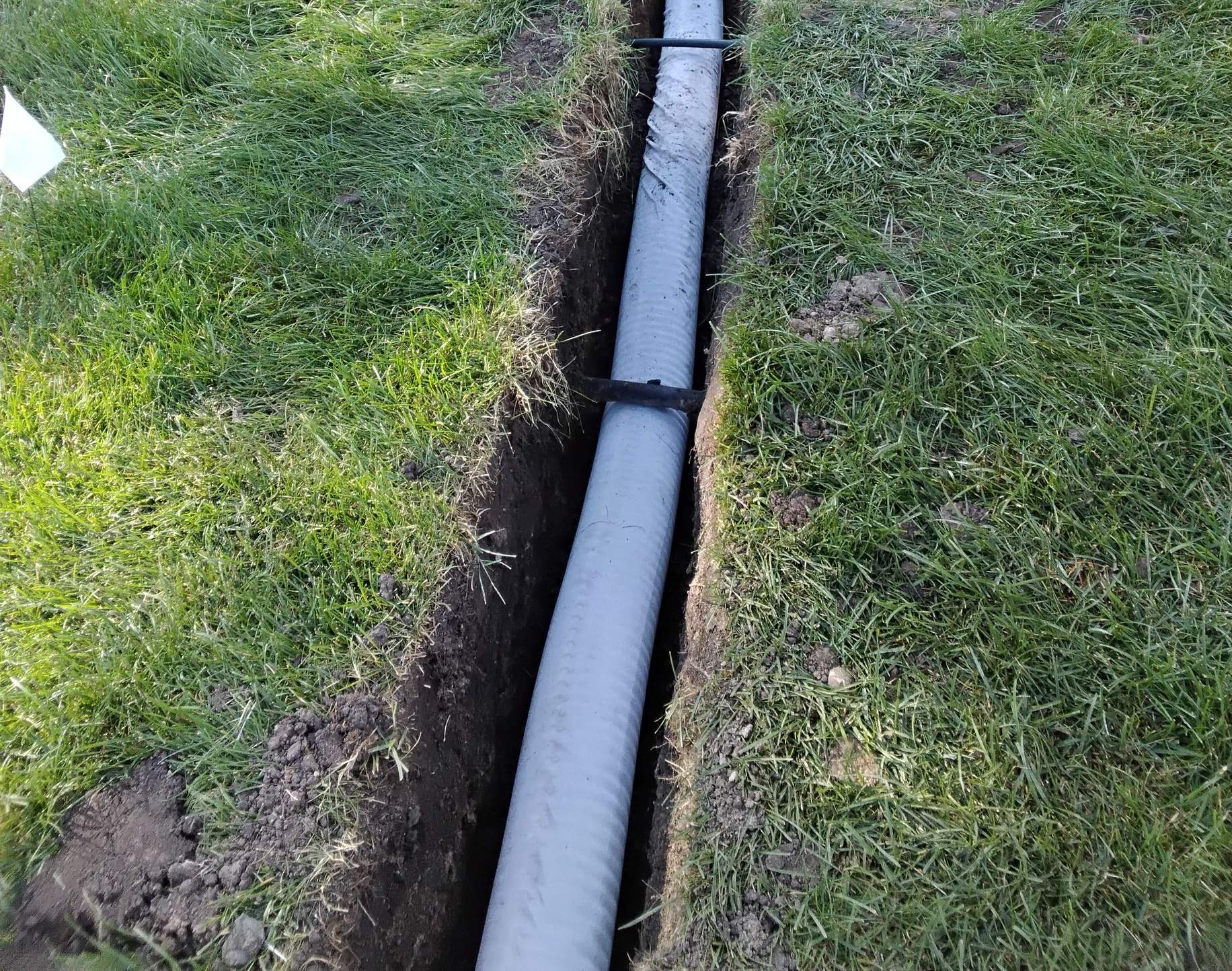
This is our standard and most commonly installed drain tile system. We trench the affected area, install 4-inch perforated corrugated drain tile wrapped in a protective silt sock, and then backfill the trench using the native soil removed during excavation.
The silt sock helps prevent soil infiltration while allowing water to enter the pipe. This method is cost-effective and performs well in many soil conditions, making it a strong “good” option for properties where surface drainage is adequate and subsurface water movement is the primary concern.
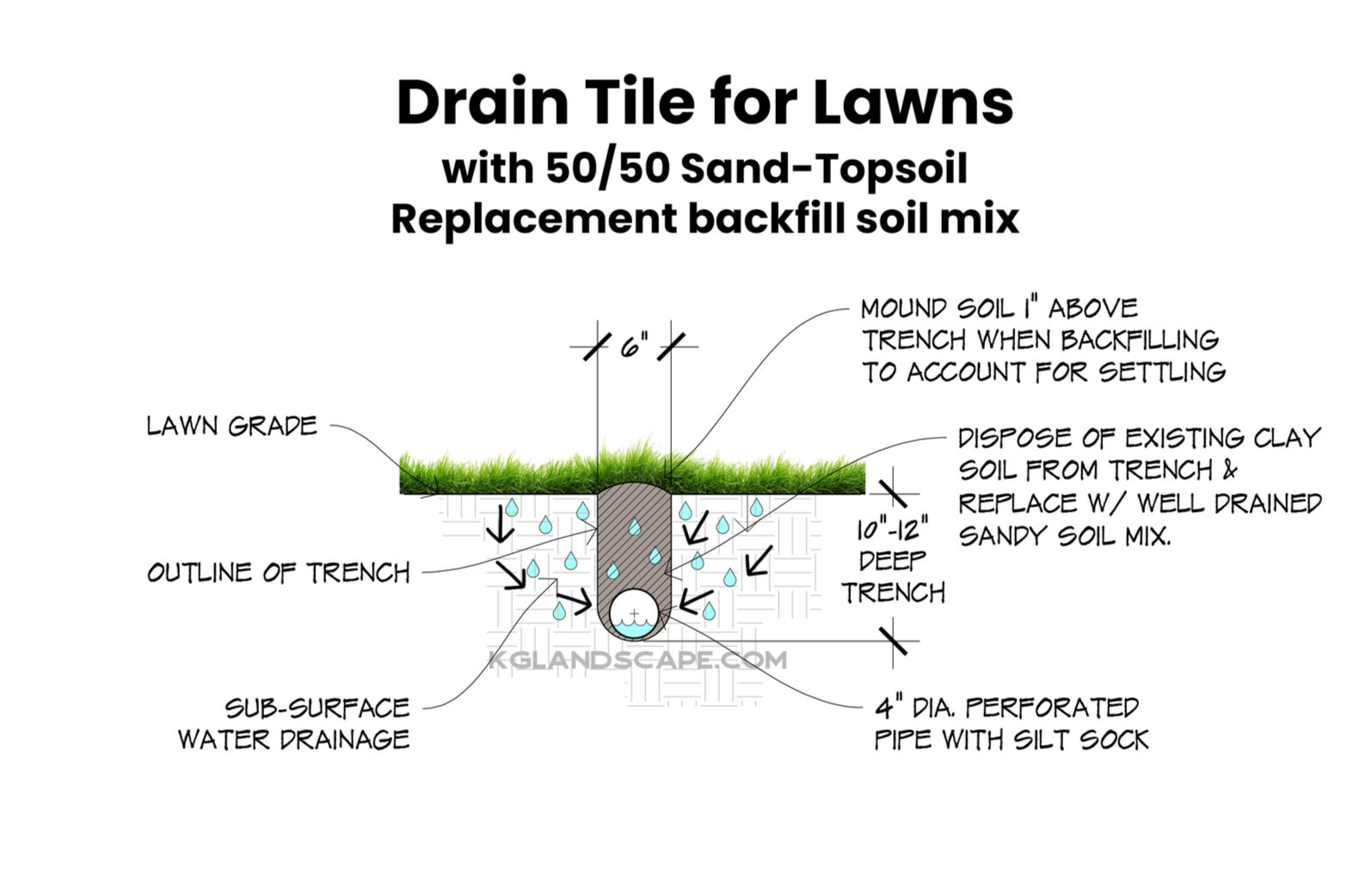
Drain Tile with 50/50 Sand–Topsoil Backfill
For properties with heavy clay soils — common throughout the Minneapolis–St. Paul metro — we often recommend upgrading the backfill material.
In this method, we remove and haul away the dense clay soil excavated during trenching. The trench is then backfilled with a 50/50 sand–topsoil blend. This dramatically improves the trench’s ability to collect and move water. In effect, the system functions not only as subsurface drain tile but also as a surface-collecting channel — performing similarly to a French drain while maintaining the efficiency of a traditional drain tile system.
This is a highly effective “better” or “best” solution for yards that experience persistent saturation, slow absorption, or standing surface water.
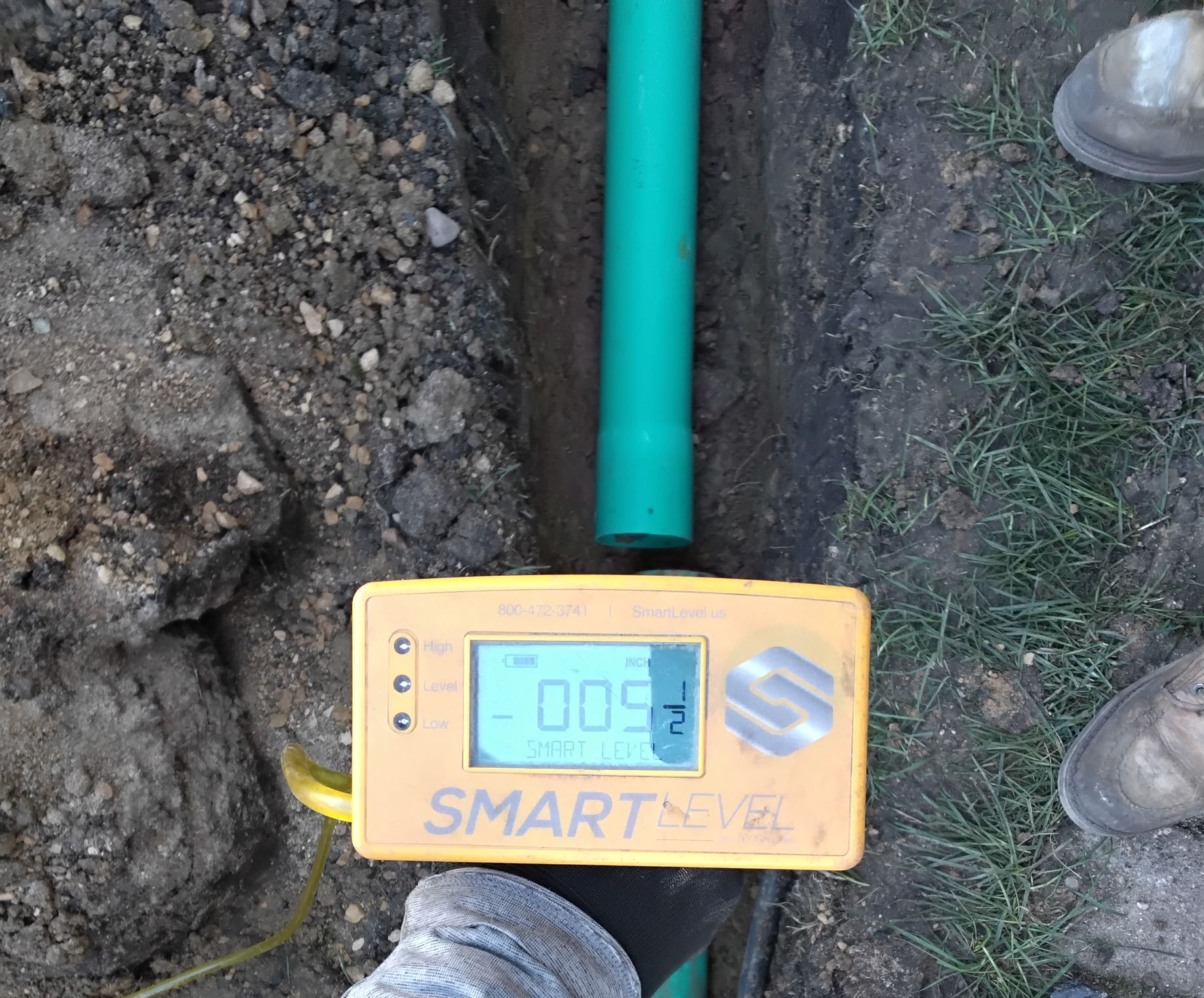
PVC Drain Tile (Perforated PVC Pipe)
In areas requiring increased durability and structural strength, we install perforated PVC drain tile instead of corrugated pipe.
PVC pipe is rigid and crush-resistant, making it ideal beneath hardscapes, drive lanes, patios, or side yards where heavy equipment access may be necessary — including future Phase 2 backyard projects. It provides long-term structural integrity while maintaining excellent drainage performance.
This option is typically recommended when load-bearing capacity and longevity under stress are key considerations.
Root-Protected Drain Tile (8-Mil Filtration Fabric Wrap)
When installing drain tile near mature trees, shrubs, or planting beds, root intrusion becomes a legitimate long-term concern. Over time, aggressive root systems can penetrate perforation openings and cause blockages.
To protect against this, we wrap our standard perforated corrugated pipe — already fitted with a silt sock — in an additional heavy-duty 8-mil filtration fabric. This added barrier significantly reduces the risk of root penetration while still allowing water infiltration.
It’s a proactive upgrade designed to extend system life and prevent costly future maintenance in root-dense areas.
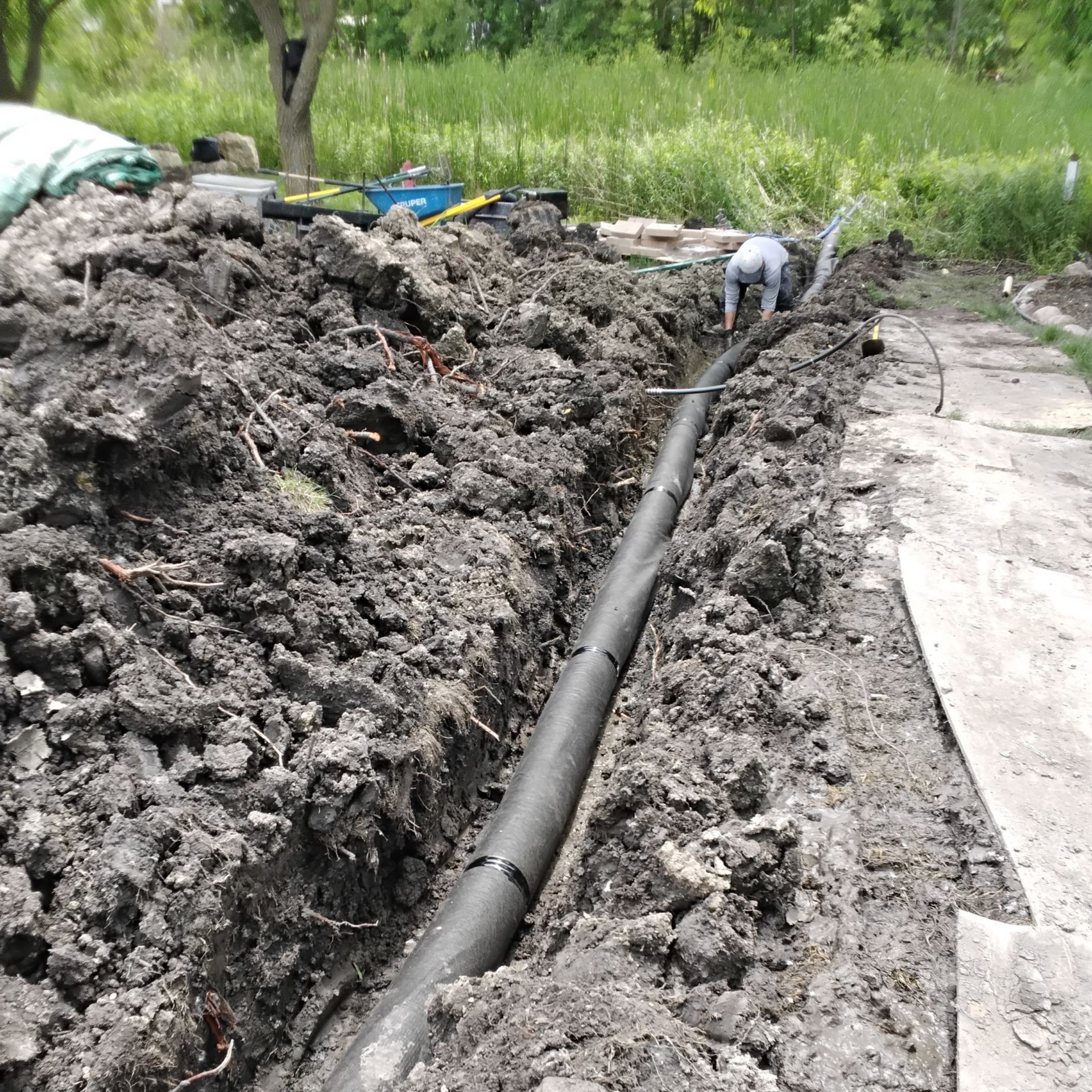
6” Drain Tile as Main Artery Lines (Primary Drain Lines)
For larger or more complex drainage systems, we incorporate 6-inch drain tile as primary artery lines. These larger pipes act as the main collection channels, carrying water from multiple feeder lines into a single discharge point.
This approach is most common in integrated drainage systems that combine:
- Underground downspouts
- French drains in acute problem areas
- Standard yard drain tile sections
- Sump pump discharge lines
Using larger primary drain lines ensures the system can handle higher water volumes efficiently and prevents bottlenecks during heavy rain events.
Every installation detail matters
From pipe selection to backfill composition to root protection and system sizing, we evaluate how each component works together to create a drainage solution that performs season after season. By offering clearly defined “good, better, and best” options — and often combining methods where appropriate — we build systems engineered for long-term reliability, not short-term fixes.
Built for Minnesota Soil & Climate
Twin Cities properties face unique drainage challenges:
- Clay-dominant soils
- Frozen ground / frost layer
- Rapid spring snowmelt
- Freeze-thaw expansion
- Heavy summer rainstorms
- Compacted urban lots
Drain tile systems installed improperly will fail under these conditions. We design systems specifically for Minnesota’s soil behavior and seasonal water movement patterns.
Since 2003, KG Landscape has engineered drainage systems that hold up through repeated seasonal cycles.
Drain Tile as Part of a Complete Landscape Strategy
Drain tile is rarely a standalone fix. At KG Landscape, subsurface drainage is integrated into our broader landscape design philosophy, hardscape construction, and lawn renovation programs across Minneapolis, St. Paul, and surrounding suburbs.
Water management is foundational. Before we
install patios, regrade lawns,
build retaining walls or renovate turf, we evaluate how water moves across and beneath the property. Every project is designed around long-term drainage performance — not short-term appearance.
Integrated Into Landscape Design & Hardscape Installation
When designing and building outdoor spaces throughout the Twin Cities, drainage is addressed from the start — not added later.
We plan for:
- Proper grading and slope transitions
- Runoff from patios and around/ below hardscape features
- Soil stability beneath retaining walls and steps
- Foundation protection
- Controlled discharge points
In many projects, drain tile is installed beneath or adjacent to new landscape features to protect the investment. A patio is only as durable as the base below it. A retaining wall performs best when hydrostatic pressure is relieved. Proper drainage ensures your outdoor living space in Minneapolis or St. Paul performs for decades — not just seasons.
Protecting Lawn Renovation Investments
Drain tile also plays a key role in comprehensive lawn renovation across the Minneapolis–St. Paul metro.
When we regrade, level, or rebuild lawns, we determine whether subsurface drainage is necessary to prevent recurring saturation. Installing drain tile alongside other drainage improvements allows us to solve problems completely — not temporarily.
What’s the point of a great lawn if it’s too wet to use?
By correcting both the surface slope and wel las subsurface moisture, in addtion too addressing downspout & sump pump water, we ensure:
- Faster dry-out after rain
- A well drained lawn you can always use
- Erosion won't ruin your lawn
- Stronger turf root systems
- Thicker and healthier turf
- Reduced mud and compaction
- Long-term performance that doesn’t regress
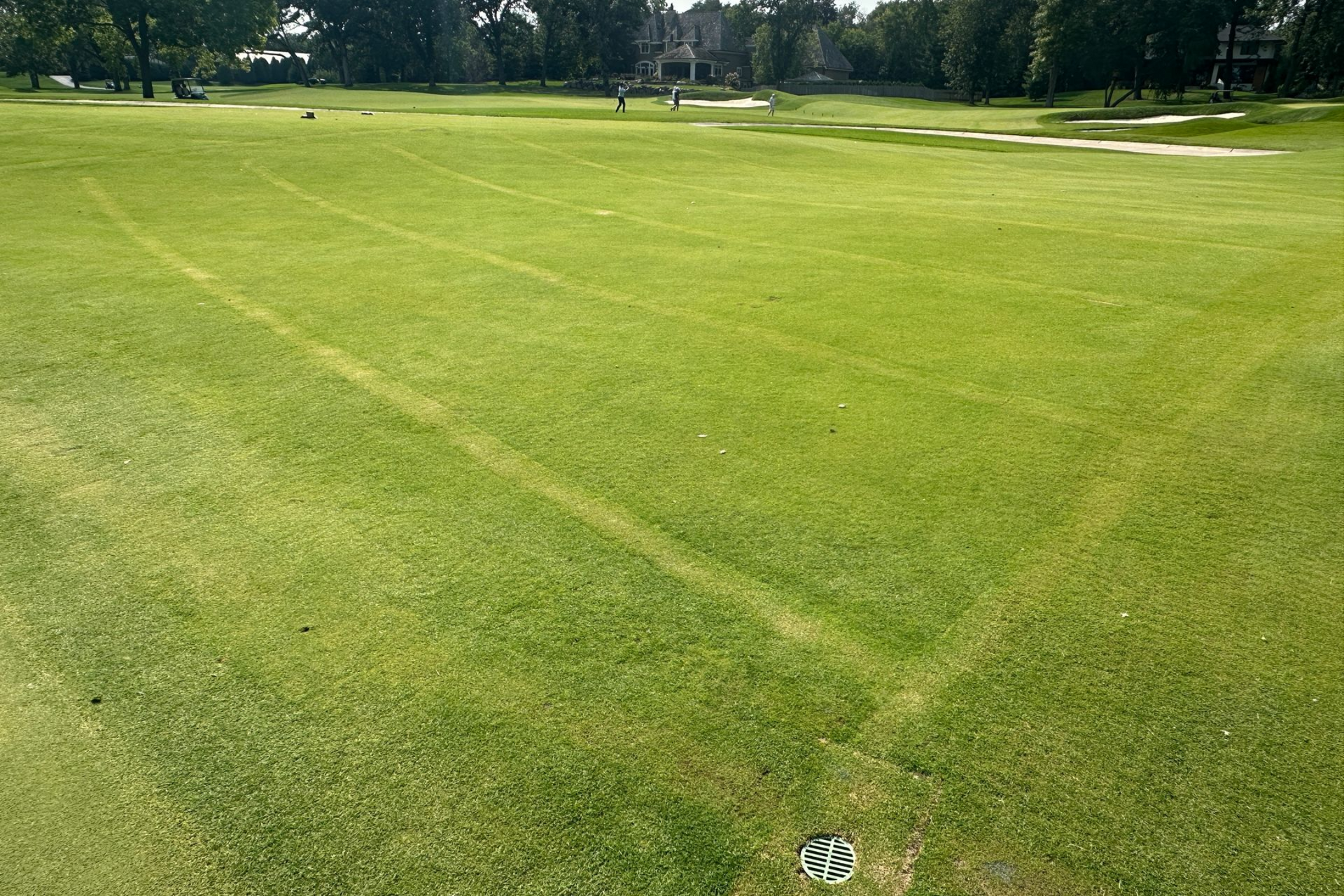
Why stadiums, golf courses & farmers all rely on drain tile
Professional sports fields, golf courses, and even large-scale farms all share one critical principle: healthy plants require well-drained soil. From NFL stadium turf to the tightly managed areas around golf greens — and across agricultural fields — subsurface drain tile is a core part of the engineering.
These systems move excess water out of the soil profile, allowing turf and crops to receive the moisture they need while preventing the saturated conditions that lead to disease, compaction, and poor performance.
These proven drain tiling principles are applied byu KG Landscape on a residential scale
When lawns are properly graded and supported with professionally designed drain tile systems, they dry more consistently, stay healthier, and perform at a higher level throughout the season. At KG Landscape, we apply these time-tested drainage strategies to protect your lawn renovation investment — eliminating soggy conditions and creating the foundation for long-term turf success.
Our Approach to Professional Drain Tile Installation
Solving a chronically wet yard requires more than digging a trench and installing pipe. At KG Landscape, we follow a structured, engineering-focused process to ensure every drain tile system is designed correctly, installed precisely, and built to perform for decades in Minnesota’s demanding soil and climate conditions.
On-Site Drainage Assessment
Every drain tile project begins with a detailed on-site evaluation of your property.
- Drainage consultation fee ranges from $90–$150 depending on property type and location
- A drainage specialist meets you on-site to inspect saturation zones and water flow patterns
- We identify root causes of wet or soggy lawn conditions
- Solutions are presented in a practical “good, better, best” framework
- Preliminary budget ranges are discussed to support informed decision-making
If you proceed with the installation, the full consultation fee is credited toward your project.
Drain Tile System Design & Planning
After the assessment, we develop a site-specific drain tile plan tailored to your yard’s grading and soil profile.
- Written proposal outlining recommended drain tile configuration
- $3,500 minimum for yard drainage projects, including underground downspout tie-ins
- Layout customized for slope, discharge points, and water collection areas
- Pipe routing, trench depth, and outlet placement carefully mapped
- Materials selected for long-term performance in clay-heavy Minnesota soils
Each design is built around how water actually behaves on your property — not a one-size-fits-all template.
Precision Installation of Drain Tile Systems
Our crews install drain tile systems according to detailed plans prepared during the design phase.
- Trench lines follow exact slope calculations
- Laser levels, transits, and grade-measuring tools ensure proper pitch
- Perforated pipe is placed to maximize water capture and gravity-driven flow
- Discharge points are secured to prevent erosion or backflow
- Installation methods prioritize durability through freeze-thaw cycles
Attention to elevation and slope is critical. Even small miscalculations can compromise drainage performance — which is why precision is central to our process.
System Testing & Performance Verification
Before any drain tile project is considered complete, we confirm that it performs as intended.
- Flow paths are tested to verify water movement
- Discharge points are inspected for proper operation
- Site grading is reviewed to ensure seamless integration
- Lawn areas are restored and stabilized
We stand behind the drain tile systems we install. If an issue arises related to our workmanship, we will return to address it.
Many of our drainage clients contact us years later for additional yard improvements — a reflection of the trust built through consistent performance and responsive service.
Built for Long-Term Performance
Drain tile systems must withstand Minnesota’s:
- Spring snowmelt saturation
- Heavy summer rainfall
- Clay soil expansion
- Repeated freeze-thaw cycles
Our structured process ensures your yard drainage solution is not just installed — but engineered for lasting results.
Results Twin Cities Property Owners Can Expect
After drain tile installation, homeowners and commercial property managers across Minneapolis and St. Paul typically see:
- Elimination of standing water
- Drier, firmer lawn surfaces
- Healthier turf growth
- Reduced erosion
- Fewer mud problems
- Improved property usability
- Long-term drainage performance
Your yard becomes functional again. We stand behind our work.
Our Service Area
KG Landscape installs yard drain tile systems across the Twin Cities metro, including Minneapolis, St. Paul, and surrounding suburban communities. We understand local soil profiles, municipal drainage patterns, how neighbors in the Twin cities are designed by buidlers to drain and regional climate demands.
We proudly serve homeowners in the following communities:
Frequently Asked Questions
Will drain tile fix my muddy yard?
If the mud is caused by subsurface water saturation, yes. Drain tile removes excess groundwater that causes persistent softness.
How deep is drain tile installed?
Typically anywhere from 8"-18" inches below grade, depending on soil conditions and the elevation of the discharge location where water empties out of the system. You need to cover the drain tile with an absolute bare minimum of 4" of soil, 6-8" is even better. However, you don't want to go too deep. Going too deep, say 36" below ground will not properly drain saturated soils within the root zone of the lawn.
Is drain tile better than regrading?
Regrading moves surface water. Drain tile addresses water beneath the surface. Many yards require both, especially clay lawns.
How long does drain tile last?
When installed properly, drain tile systems can perform effectively for decades.
Can drain tile be added to an existing lawn?
Yes. Turf is temporarily disturbed during installation and then restored.
About the Expert

Kent Gliadon is the founder of KG Landscape and a graduate of the University of Minnesota’s Landscape Design program. Since 2003, he has specialized in designing, constructing, and installing underground drainage systems as part of integrated outdoor water management solutions for residential properties throughout the Twin Cities.
Kent focuses on resolving drainage problems in existing landscapes—such as basement moisture, soggy yards, and water damage to patios and walkways—while also integrating proactive drainage solutions into new landscape design-build projects to prevent future issues and protect homes and landscape features long into the future.
Request an On-Site Yard Drainage Evaluation
If you’re dealing with water collecting near your home, soggy lawn areas, or downspouts that aren’t draining properly, KG Landscape can help. Our team offers on-site yard drainage evaluations focused on identifying the most effective underground downspout and outdoor drainage solutions for your property.
During your visit, a drainage specialist will assess grading, soil conditions, downspout locations, and water flow patterns throughout your yard. We’ll outline practical solution options, explain how different drainage approaches may work for your site, and discuss estimated cost ranges to help you plan next steps.
When appropriate, we provide a written, fixed-price proposal for the recommended drainage work. If you move forward with installation, your evaluation fee is fully applied toward the project cost.