If a Resident Slips on Ice at a Minneapolis Senior Facility, Who is Liable?
The Fall That Changes Everything for a Facility
A 78-year-old resident at a Minneapolis assisted living facility steps out the front door at 8 AM heading to the dining hall. The sidewalk was plowed overnight, but the temperature dropped after the crew left, and a thin layer of ice formed on the concrete. She slips, fractures her hip, and spends the next three months in recovery.
I've watched this scenario play out at senior care properties across the metro, and it usually comes down to the same gap: the lot was plowed, but nobody came back to check for refreeze. The storm was handled, but the aftermath wasn't. After more than 20 years of servicing commercial properties, including senior living facilities, I can tell you that these properties operate under a standard of care that's significantly higher than any other commercial account on our route. The residents are more vulnerable, the exposure is around the clock, and the consequences of a single fall are more severe than anything you'll see at an office park or retail center.
We service senior living and healthcare-adjacent properties through our Minneapolis snow removal service, and the approach at these facilities is fundamentally different from standard commercial snow removal. Here's what administrators and operations directors need to understand about winter liability, and what a snow and ice management plan should include to protect both residents and the facility.
Why Senior Living Facilities Face Higher Snow and Ice Liability
The legal concept at the center of winter liability is duty of care, the obligation to maintain the property in a reasonably safe condition for people who use it. For most commercial properties, that standard is measured against what a reasonable property owner would do.
For senior living facilities, the bar is higher. These aren't office workers crossing a parking lot once in the morning and once in the evening. These are elderly residents who live on the property full-time, walk the pathways multiple times a day, and face dramatically elevated risk from any fall.
Falls are the leading cause of injury and injury-related death among adults over 65, according to the Centers for Disease Control and Prevention. A hip fracture in a 78-year-old isn't a bruised knee in a 35-year-old. The recovery is longer, the complications are more serious, and the likelihood of long-term decline in health and independence is significant. I've worked with facility administrators who have told me that a single fall incident changed everything for a resident, from independent living to assisted care in a matter of weeks. Courts take this population context into account when evaluating whether a facility met its duty of care.
The 24-hour nature of senior living compounds the exposure. Residents don't arrive at 8 and leave at 5. They're on the property at all hours, walking to meals, to activities, to medical appointments, and sometimes just outside for fresh air. The window of liability isn't limited to business hours. It's continuous. I account for this in every senior living contract I write, because a standard "service by 6 AM" commercial approach doesn't match the actual risk profile of a facility where people are walking the paths at 7 PM and 10 PM too.
Family scrutiny and regulatory oversight add pressure beyond what standard commercial properties face. When a resident is injured, the family expects answers. Regulatory bodies may investigate whether the facility maintained adequate safety protocols. Repeated incidents can trigger compliance reviews that affect operating status. The liability exposure at a senior facility isn't just financial. It can be existential.
What "Premises Liability" Means for Senior Care Properties
Premises liability holds property owners responsible for injuries that occur on their property due to unsafe conditions. In Minnesota, the standard is whether the property owner exercised "reasonable care" to maintain safe conditions. Under Minnesota statute 604A.23, which addresses recreational land use liability, and the broader body of premises liability case law, courts evaluate what the property owner knew, what they should have known, and what steps they took.
For senior living facilities, reasonable care is evaluated in context. Courts consider the population being served, the foreseeability of the hazard, and the steps the facility took to prevent or address the dangerous condition. A court is likely to hold a senior care facility to a higher standard than a retail store because the residents are known to be at elevated fall risk, and the facility has a duty to account for that risk in its maintenance planning.
Two parties are typically involved in winter maintenance liability: the facility itself and the snow removal contractor. Both can be named in a lawsuit. The facility is liable if its winter maintenance plan was inadequate or if it failed to ensure the contractor met agreed-upon standards. The contractor is liable if the work performed was negligent or fell below the contracted scope.
Documentation is the most important defense for both parties. Service logs showing when crews arrived, what areas were treated, what materials were applied, and what conditions existed at the time provide concrete evidence that reasonable care was exercised. Without documentation, the facility's defense rests on testimony and memory, which erode quickly. We provide timestamped service logs with material records for every visit at every senior living property we manage, because that documentation is the first thing an attorney requests and the last thing you want to be missing.
The contract between the facility and the contractor should clearly define the relationship. An indemnification clause establishing the contractor's responsibility for claims arising from their negligence provides a critical layer of protection. The contract should also require the contractor to carry general liability insurance with limits appropriate for healthcare properties and to list the facility as an additional insured.
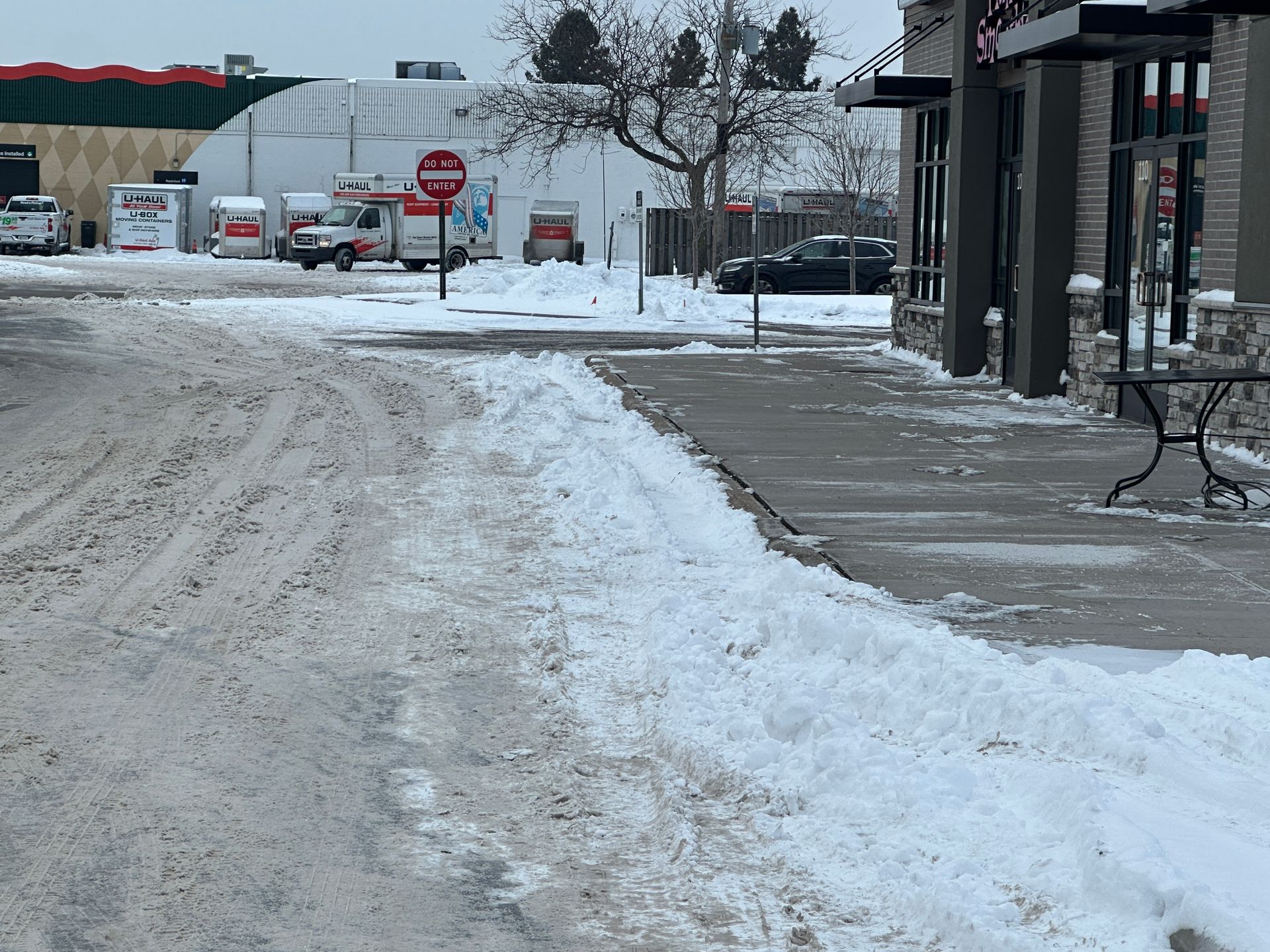
Poor snow stacking near walkways creates exactly the kind of hazard senior care facilities can't afford
Sidewalks, Walkways, and Building-to-Building Paths
At a senior living facility, the snow and ice problem isn't primarily about the parking lot. It's about the walkways.
Residents walk between buildings multiple times a day. From their room to the dining hall. From the main building to the activity center. From the residential wing to the clinic or therapy room. These paths are the circulatory system of the facility, and in winter, they're the most dangerous surfaces on the property. When I walk a senior living campus during a pre-season assessment, I trace every path a resident might take during a typical day, because every one of those paths needs to be in the scope.
Wheelchair and walker accessibility requires completely clear, dry paths. It's not enough to plow the walkway and leave it. Any residual snow, compacted slush, or ice creates a barrier for residents using mobility devices. A walker wheel catching on a ridge of packed snow can cause a fall just as easily as a patch of black ice. The standard for walkway clearing at a senior facility is higher than "passable." It needs to be clean.
Covered walkways present a specific challenge that less experienced contractors miss entirely. The roof keeps snow from accumulating directly on the path, but wind-driven moisture, condensation from temperature changes, and meltwater dripping from the roof edge all create ice on the walking surface. I've walked covered walkways that looked dry from a distance and were slick enough to make me grab the railing. Covered walkways get skipped by crews that only look for visible snow, but they're some of the most dangerous surfaces on the property and need regular ice treatment throughout the season.
Building entrances and vestibule transition zones are high-risk areas. Residents transition from an exterior surface to an interior one, often while managing a walker or wheelchair. Moisture tracked in on shoes and wheels creates slick spots on tile flooring just inside the door. The exterior side of the entrance should be treated with deicing materials that minimize tracking, and mats at the threshold should be maintained to capture moisture. We address entrance transition zones specifically in our de-icing and salting service because that's where fall risk concentrates at any building, and at a senior facility, the stakes are highest.
What a Snow and Ice Management Plan Should Include for Senior Facilities
A standard commercial snow removal contract isn't sufficient for a senior living facility. The plan needs to reflect the elevated duty of care, the 24-hour resident presence, and the vulnerability of the population being served.
A zero-tolerance ice policy is the appropriate standard. This means treating at the first sign of ice formation, not waiting for accumulation. It means pre-treatment before every forecasted event. And it means continuous monitoring for refreeze throughout the day and night, not a single post-storm visit. I implement zero-tolerance ice programs at every senior living property on our route because the cost of continuous monitoring is a fraction of the cost of a single fall-related claim.
Pre-treatment before every forecasted event is the first step. We apply liquid brine to walkways, building entrances, and parking areas before the snow starts, which prevents ice from bonding to the surface and makes post-storm clearing faster and more effective.
Continuous monitoring during events is essential. A storm that starts at noon and continues through the evening can't be addressed with a single visit. Walkways need clearing and re-treatment multiple times during the event, with attention to changing conditions as temperatures shift. Our crews check conditions at regular intervals during active weather, not just when a trigger depth is reached. The difference between a property that had one pass and a property that had continuous attention shows up in the condition of the walkways, and if there's an incident, it shows up in the documentation.
Staff shift changes dictate non-negotiable deadlines. If nursing staff change at 6 AM, 2 PM, and 10 PM, the main walkways and parking areas need to be safe at each of those times. The snow removal schedule is built around the facility's operational schedule, not around our route preferences. I sit down with the administrator before the season to map every shift change, meal time, and high-traffic period so the service plan matches the actual rhythm of the facility.
Medical transport and ambulance access must be maintained at all times, regardless of conditions. The route from the street to the emergency entrance is a priority-one clearing area identified during the pre-season walkthrough and flagged as the first area addressed during any event. Lives can depend on that access being clear, and it's the first surface our crew touches when they arrive on site.
Pro Tip: Walk every resident path on your campus at three different times of day after a storm: morning, mid-afternoon, and after sunset. Conditions change dramatically as temperatures shift, and the path that was safe at 9 AM may be an ice sheet by 4 PM when the sun drops and the temperature follows.
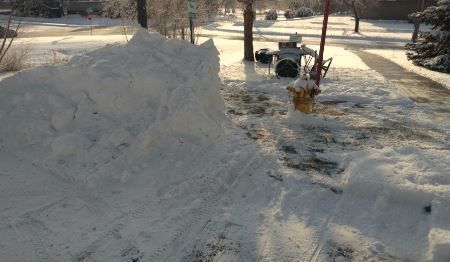
A thorough management plan includes clearing fire hydrants and emergency access points at Minneapolis facilities
Choosing a Snow Removal Partner for a Senior Care Property
Not every commercial snow removal company is equipped to service a senior living facility. The scope, the standards, and the documentation requirements are different from a standard commercial account, and the contractor needs to understand why those differences matter.
Experience with senior living or healthcare properties is the first qualification. A company that primarily services office parks and retail lots may not appreciate the significance of a zero-tolerance ice policy or the importance of walkway clearing relative to parking lot plowing. Ask potential contractors how many senior care or healthcare properties they currently service and request references from those accounts. I've been doing this work long enough to know that the learning curve on senior living properties is steep, and the consequences of learning on the job are too serious.
Documentation capability is critical. The contractor should provide service logs with timestamps, areas cleared, materials applied, quantities used, and weather conditions at time of service. GPS tracking and timestamped photographs add verification layers. For a senior living facility, this documentation isn't just operational. It's legal protection. Ask to see sample reports before committing. The SIMA snow and ice management standards provide the framework we follow for documentation protocols, and any contractor servicing healthcare-adjacent properties should be operating at that level.
Response time guarantees should be written commitments. "We'll try to be there within an hour" is meaningless during a major storm when every property on the route needs service. The contract should state a specific guaranteed response time, and the contractor needs the capacity to honor that commitment even during peak demand. We commit to defined response windows because vague promises create exactly the kind of gap that leads to an untreated walkway at 6 AM.
The same elevated-care principles that apply to senior living apply in a different form at medical offices in Edina, where patients arriving early in the morning may be elderly, post-procedure, or using mobility devices. And the apartment complex challenges in Eden Prairie share the residential property management overlap, though the vulnerability level at a senior facility is substantially higher.
If your senior living facility in Minneapolis needs a winter maintenance partner who understands the elevated standard of care these properties require, contact us to discuss a site-specific snow and ice management plan.
Frequently Asked Questions
Who is liable if someone falls on ice at a senior living facility?
Both the facility and the snow removal contractor can be held liable, depending on the circumstances. The facility has a duty of care to maintain safe conditions for its residents, which includes having an adequate winter maintenance plan. The contractor is liable if their work was negligent or fell below the contracted scope. In many cases, both parties are named. The strongest protections are a comprehensive plan, documented service records, and a contract with clear indemnification and insurance requirements.
What snow removal standards apply to senior care properties?
There are no federal regulations prescribing specific snow removal practices for senior care facilities, but premises liability law holds these properties to a higher standard because of the vulnerable population they serve. The ANSI/SIMA A-1000 standard provides a voluntary framework for commercial snow and ice management including risk assessment, site-specific planning, and documentation protocols. Many senior living operators adopt this standard to demonstrate they meet the expected duty of care.
How often should sidewalks be cleared at a senior living facility?
Sidewalks and walkways should be cleared and treated before every staff shift change and before any period of significant resident foot traffic. During active storms, walkways may need clearing every 1 to 2 hours depending on accumulation rate. Between events, monitoring for refreeze and re-treatment should happen continuously. If ice is forming, it needs to be treated immediately regardless of when the last application occurred.
What is a zero-tolerance ice policy?
A zero-tolerance ice policy means any ice formation on the property is treated immediately upon detection, without waiting for a certain thickness or area of coverage. For senior living facilities, this is the recommended standard because even a small patch of ice can cause a serious fall for an elderly resident. It includes pre-treatment before forecasted events, continuous monitoring during and after storms, and immediate response to any reports of icy conditions.
What documentation should a senior facility keep for snow removal?
Maintain service logs from every visit showing date, time of arrival and departure, areas serviced, equipment used, materials applied and quantities, and weather conditions. GPS tracking data and timestamped photographs provide additional verification. Keep copies of the contract, insurance certificates, and any communication during events. Store these records for at least three years, as slip-and-fall claims may be filed well after the incident. This documentation is the facility's primary defense in any liability claim.
Can a facility reduce its liability by having residents sign a waiver?
Liability waivers have limited effectiveness in senior living. Courts scrutinize waivers signed by elderly individuals, particularly those with cognitive impairment, and may find them unenforceable if the resident didn't fully understand what they were signing. A waiver does not eliminate the facility's duty of care. The most effective protection is a proactive winter maintenance plan with proper documentation, not a waiver that attempts to shift responsibility.
About the Author
I'm Kent Gliadon, founder of KG Landscape and a graduate of the University of Minnesota Landscape Design program. For over 20 years, I've focused on integrating well-planned landscape design and installation work with properly engineered outdoor drainage solutions. I believe discerning homeowners deserve landscaping and drainage renovations that are carefully planned from the beginning, accounting for water movement, grading, soils, hardscaping, and future use, so problems are prevented before they occur. These articles explain how and why specific solutions are implemented and what it takes to maintain properties that truly last.
Ready to Start on Your Next Project?
Call us at (763) 568-7251 or visit our quote page.