7 Tips to Turn a 25-Foot Slope Into Usable Backyard Space in Minnesota
A Sloped Backyard
A sloped backyard looks fine from some angles. Living with one is different.
There's nowhere flat for the kids to play, so they end up inside or at the park instead of in your own yard. The lawn mower slides on the steep parts. Mulch beds that were supposed to cut down on maintenance have turned into weeds. When it rains, water runs toward the house instead of away from it.
This is common in the Twin Cities, especially in Minnetonka and Edina where the terrain rolls and drops. A sloped backyard doesn't have to stay that way. With the right approach, a lot of that hillside can become space your family actually uses.
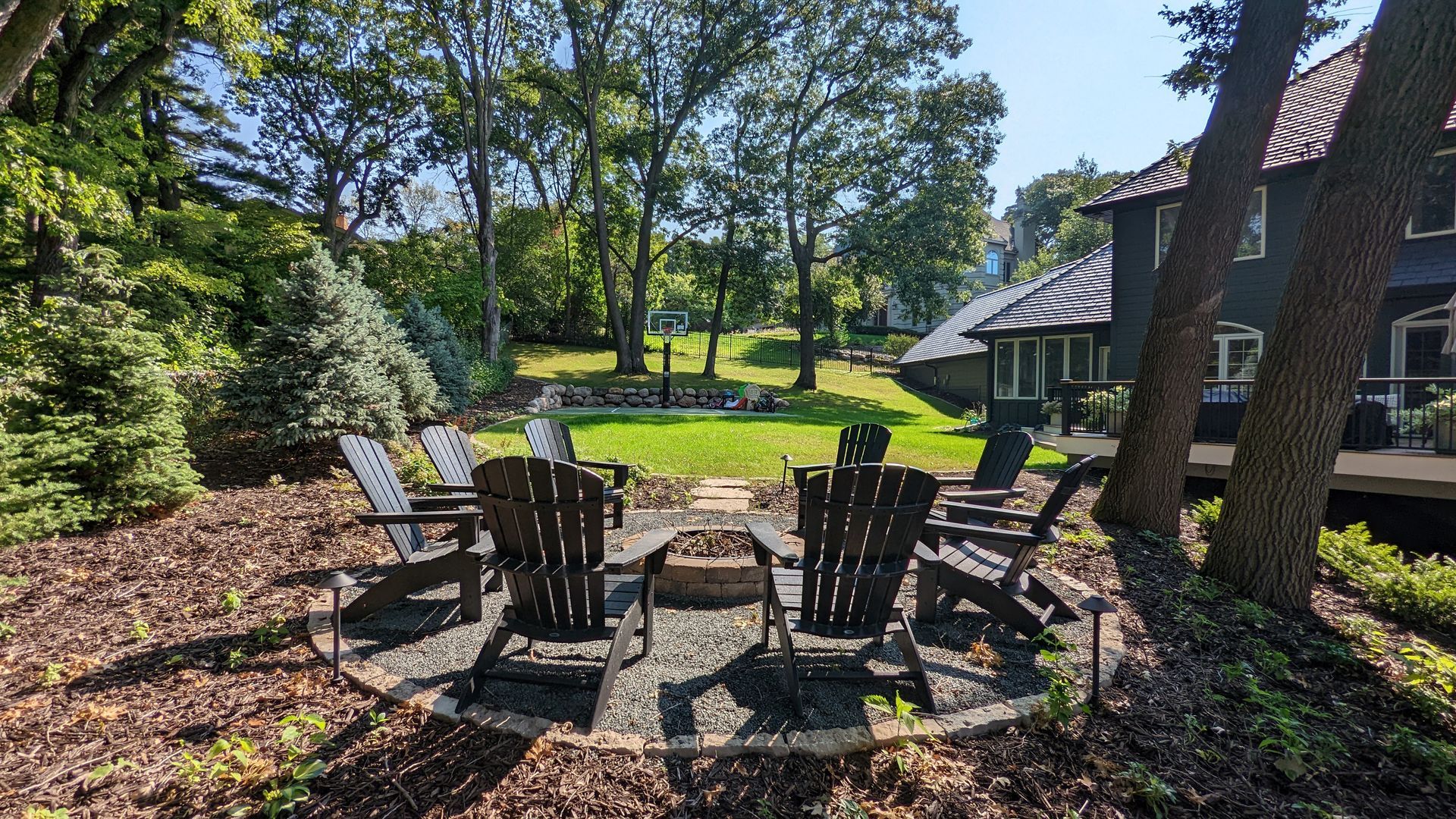
This article walks through how we handle these projects. The example is a backyard in Edina with a 25-foot elevation drop and almost no flat ground. The homeowners had kids and no place for them to play. When we finished, they had a level lawn, an outdoor sport court with a basketball hoop, and a fire pit area. All of it carved out of what had been an unusable slope.
Below, we'll walk through 7 key steps we use to transform slopes into functional family spaces — illustrated by a real project of ours in Edina, MN with a 25-foot drop.
Tip #1: Start by Understanding the Yard
Before changing anything, you need to know what you're working with. How steep is it? Where does water go when it rains? What's the soil like? Are there trees worth keeping?
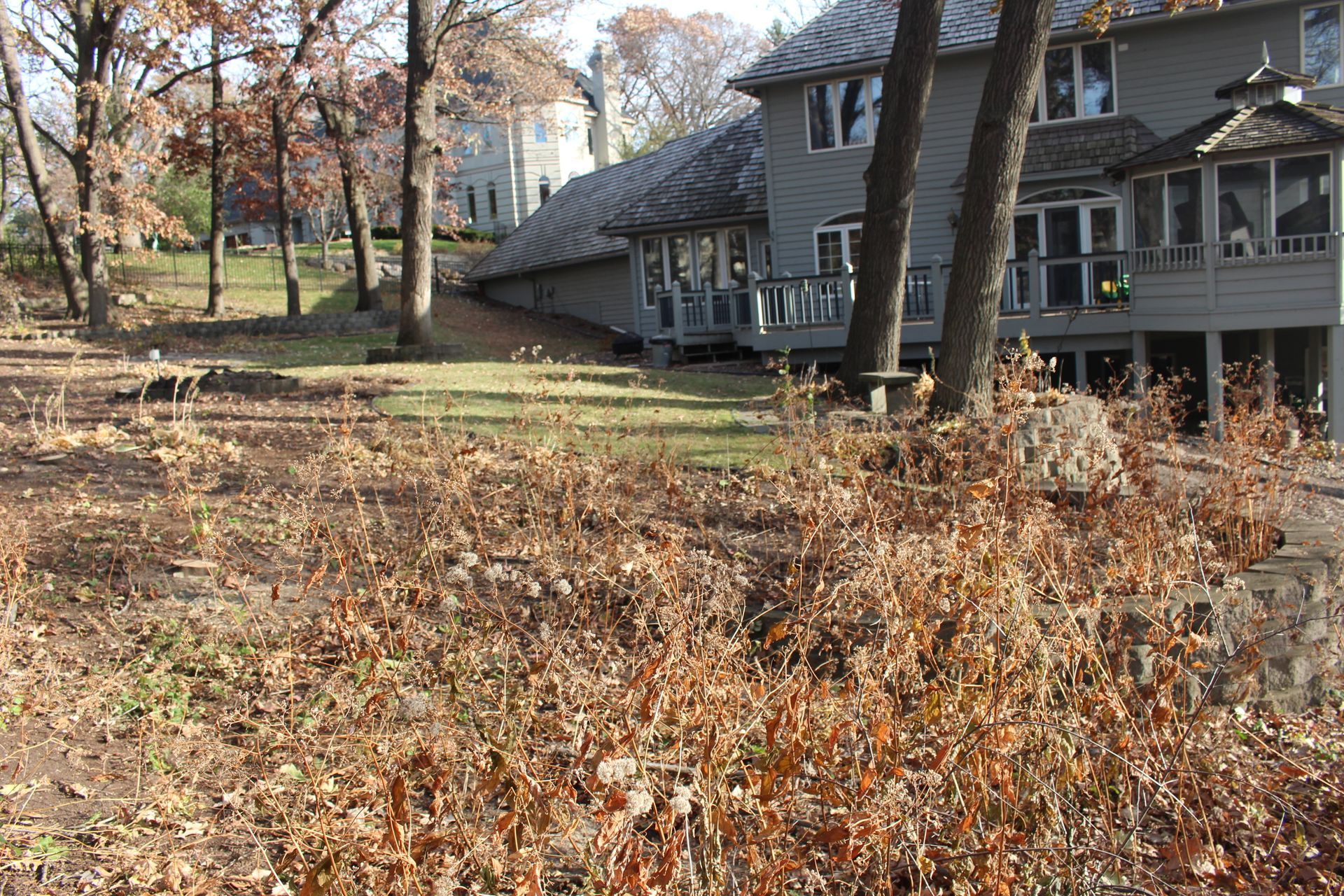
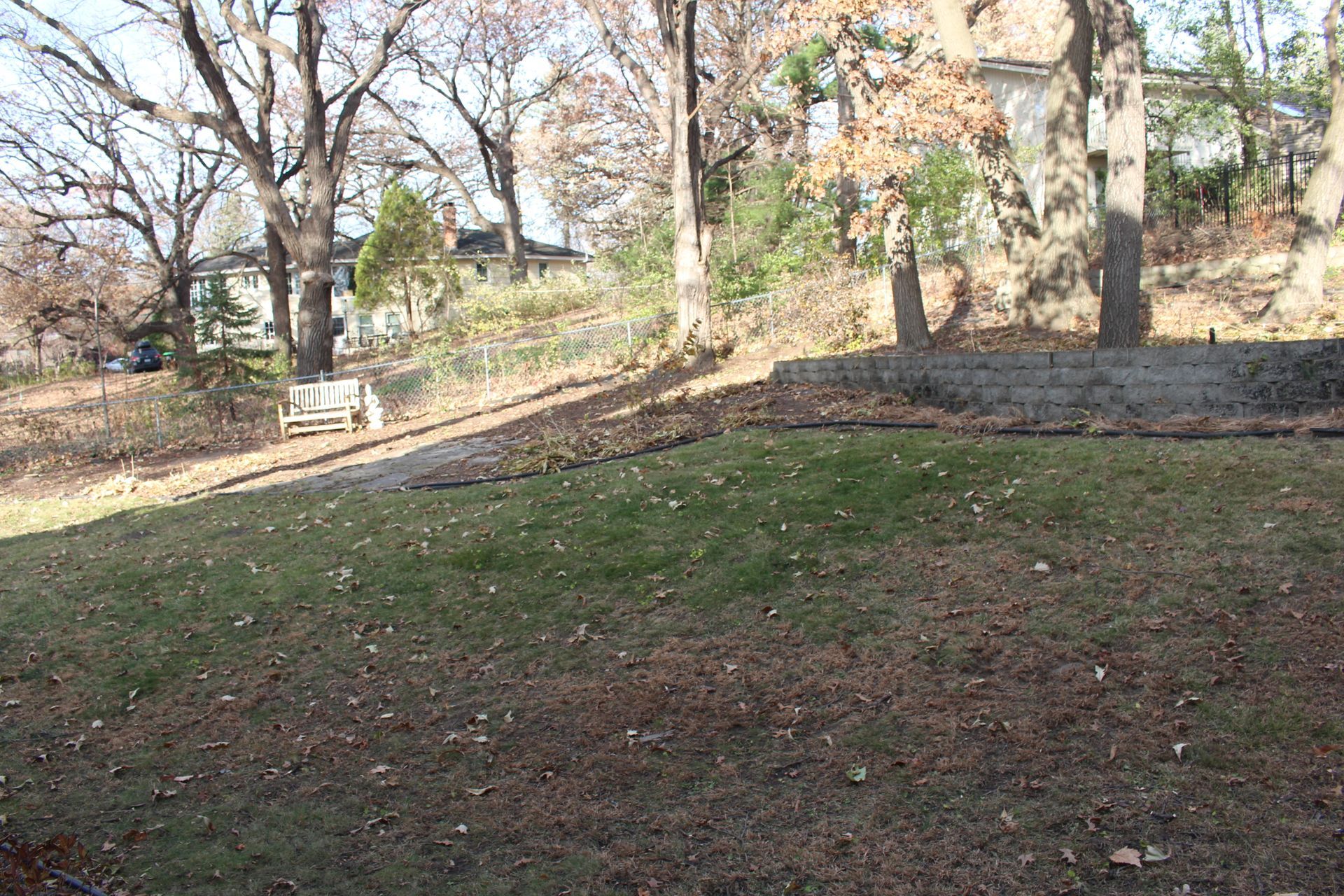
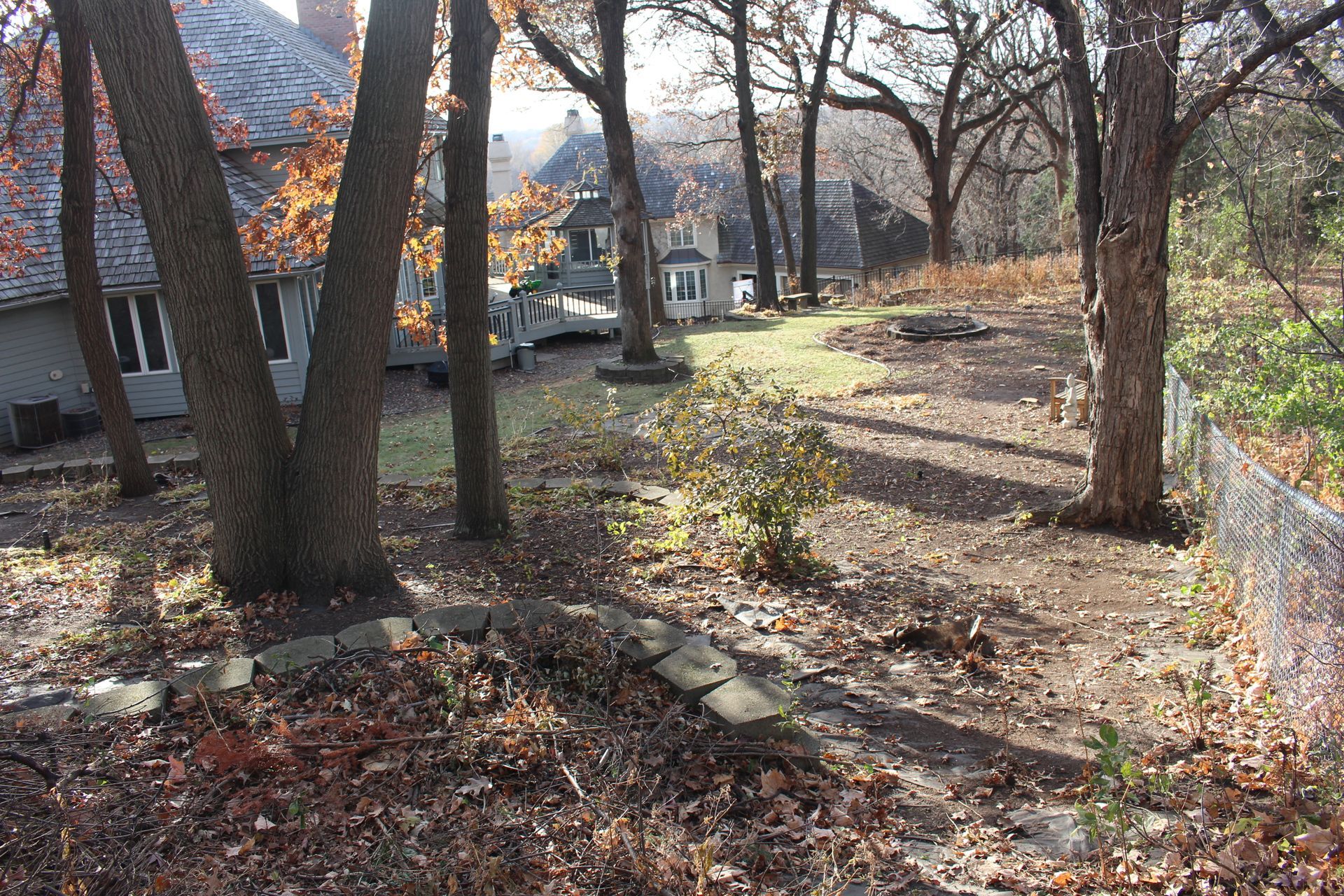
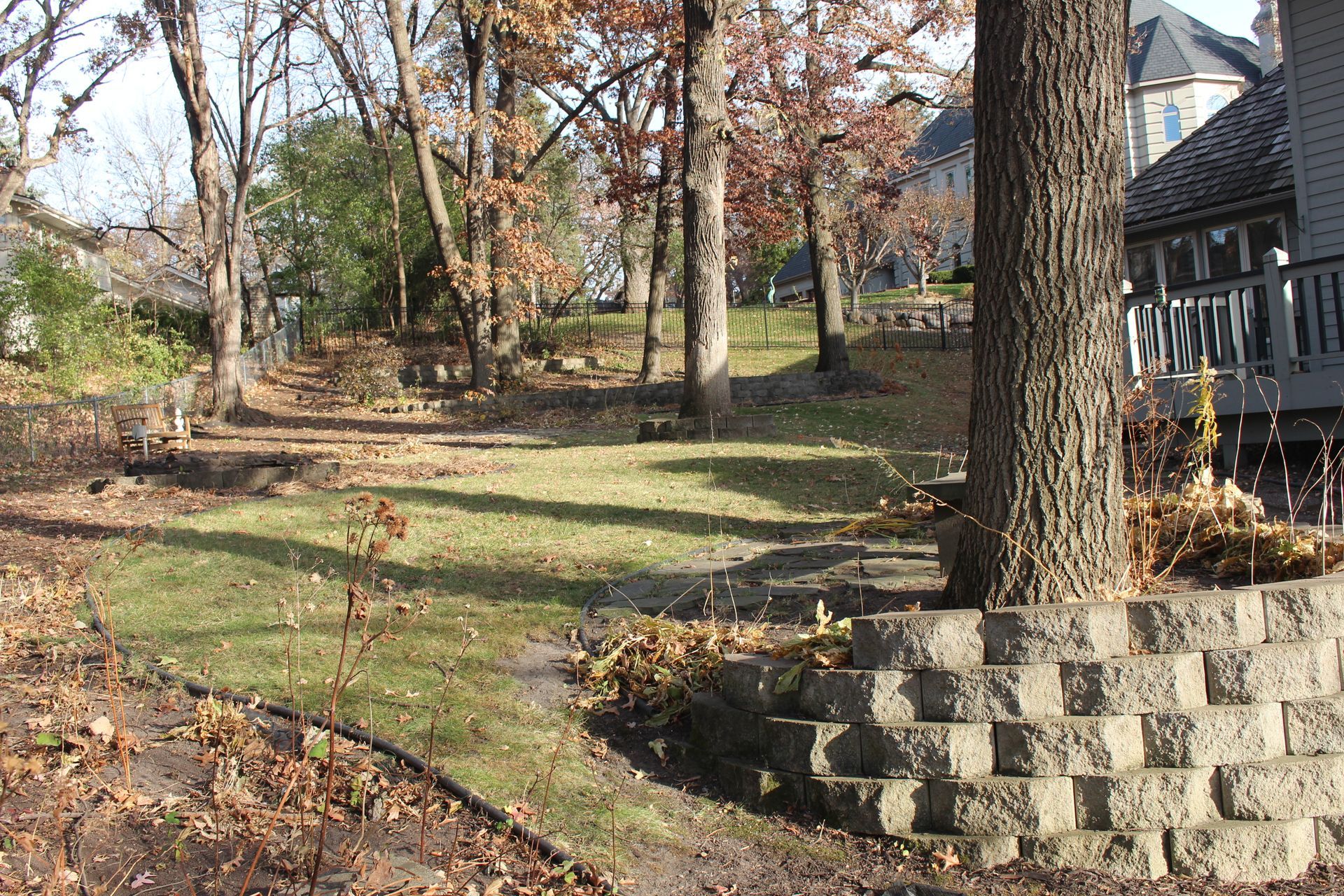
The Edina backyard dropped about 25 feet from one end to the other. The previous owners had put in some small retaining walls for erosion, but those walls didn't create any usable space. They just held dirt.
The lawn sloped back toward the house and also tilted sideways. The only flat spot was a small fire pit area stuck in the middle of the slope, which made it awkward to use. Large mulch beds covered the steepest sections to reduce mowing, but they'd grown over with weeds.
The yard had 10-12 big oak trees. The homeowners liked the wooded feel, but those trees created shade problems and limited where anything new could go.
Tip #2: Figure Out What Matters Most
Once you know what you're dealing with, decide what's important. Most families with sloped yards want the same things: flat space for kids, somewhere to gather outside, and drainage that doesn't threaten the foundation.
The Edina homeowners had a list. A real lawn their kids could run on. A sport court with a basketball hoop. Drainage fixed so water stopped flowing toward the house. The overgrown mulch beds cleaned up. Privacy from neighbors. A fire pit that wasn't awkwardly placed in the middle of a hill.
That's a lot for a yard with a 25-foot slope. But knowing the priorities helps with every decision after. You can make smart tradeoffs instead of trying to do everything.
For more on how we work through priorities with homeowners, see our landscape design process and get in touch.
Tip #3: Make Strategic Tree Decisions
Trees complicate everything on a sloped lot. The roots make grading difficult. The shade makes it hard to grow grass. And nobody wants to remove them.
The Edina yard had 10-12 large oaks. The homeowners wanted to keep them all, which we understood. But three were in spots that made the new layout impossible. We walked through the options with them, and ultimately those three came out. The other six or seven stayed. The yard still feels wooded. It just works better now.
This is a common situation. Removing mature trees is not a decision anyone takes lightly. But sometimes it's the only way to get the result you want. The key is being deliberate about which ones go and which ones stay, rather than working around everything and ending up with something that doesn't really solve the problem.
Tip #4: Use Retaining Walls to Create Flat Ground
On a sloped property, retaining walls do the heavy lifting. They hold soil back on one side so you can have level ground on the other. The wall type, height, and placement depend on what you're trying to create.
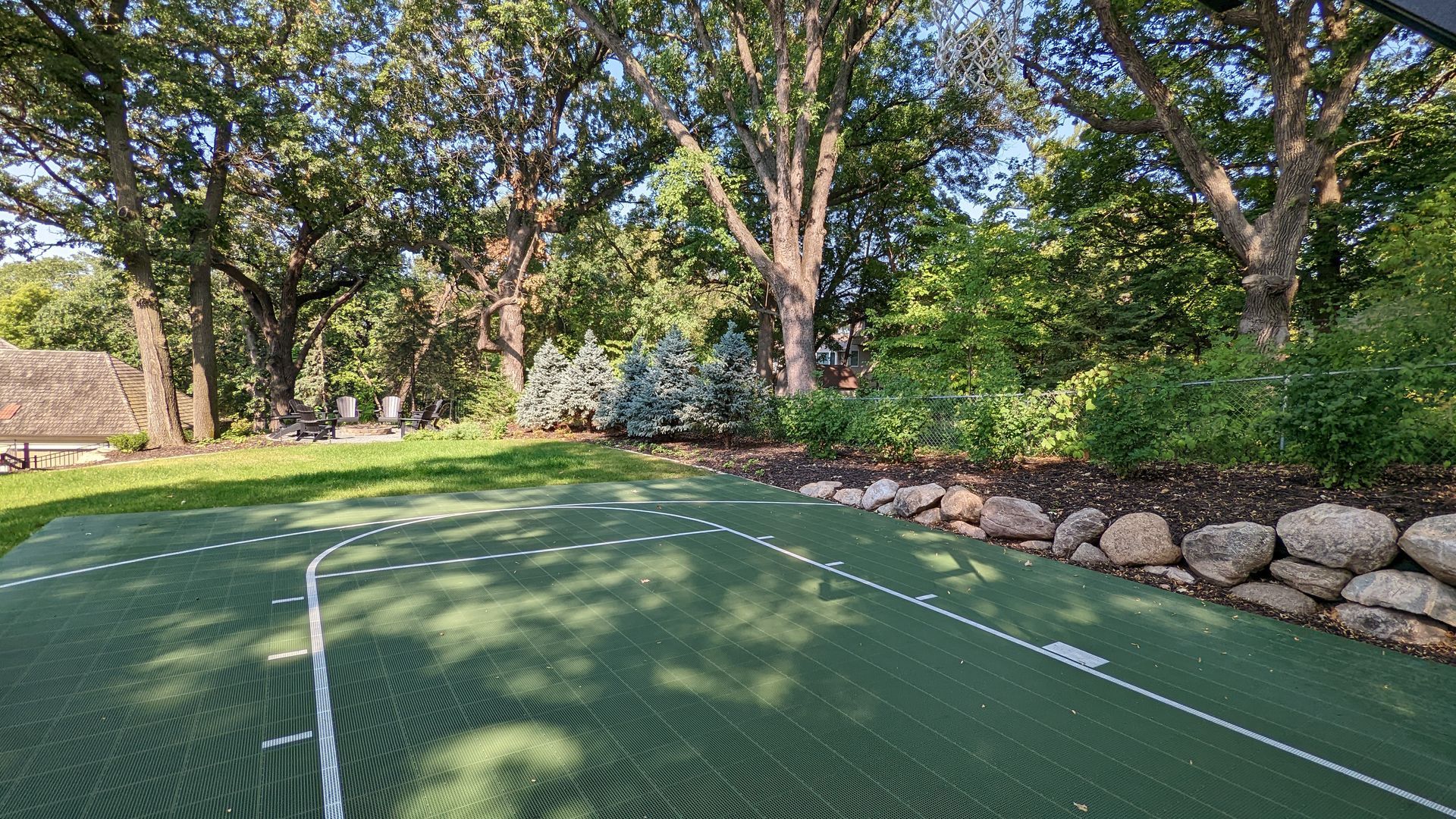
For the sport court in Edina, we cut into the hillside near a group of oak trees. That excavation gave us a flat area roughly 20 feet by 40 feet. We poured a concrete court and added a basketball hoop. A boulder retaining wall holds back the soil where we cut in.
Boulder walls look natural in wooded yards and last a long time. The University of Minnesota Extension notes that well-built retaining walls can last decades with minimal maintenance if the materials and drainage are right.
The previous owners had installed some segmented retaining walls around the yard. They didn't do much. They stabilized a few garden beds but didn't create any room for anything. We took them all out and replaced them with boulder walls that actually served a purpose. One supports the sport court. Another supports the raised fire pit area.
More on wall options at our retaining walls page.
TIP #5: Move Dirt Strategically (Cut and Fill)
One effective way to deal with a slope is moving soil from high spots to low spots. Cut here, fill there. Done right, you can create multiple flat areas without hauling much material on or off the property.
In Edina, most of the soil we dug out for the sport court got reused. We moved it to the lower part of the hill, where it helped create a flat lawn and a raised area for the fire pit.
This takes planning. You need to know how much material is coming out, where it can go, and how to compact it so it doesn't settle later. The National Association of Landscape Professionals notes that proper compaction and grading are critical when you're moving significant amounts of soil.
The lawn we created gives the kids room to run around, play catch, set up a game. It's actually flat, not just less steep. That matters.
See our grading services page for more.
Tip #6: Build Drainage Into the Plan From Day One
Water flows downhill. If you don't tell it where to go, it picks its own path. Usually toward your foundation.
The Edina yard had this problem. The lawn sloped toward the house, so rain went the wrong direction. We regraded along the foundation and created a swale to send water away from the house and off the property.
A swale is just a shallow channel that guides water. It works well on sloped sites and doesn't require extensive underground pipes.
When you create flat areas on a slope, you also have to think about where water will collect on those new surfaces. Flat doesn't drain itself. We built subtle grades into the lawn and fire pit area to keep water moving.
The American Society of Landscape Architects stresses that drainage should be part of the design from the start, not something you figure out later. On sloped properties this is even more important.
More at our outdoor drainage page.
Tip #7: Know When to Stop — Not Everything Is Worth Doing
Fire pits work well on sloped properties when you put them in the right spot. A raised fire pit area can feel private, take advantage of a view, and feel separate from the rest of the yard.
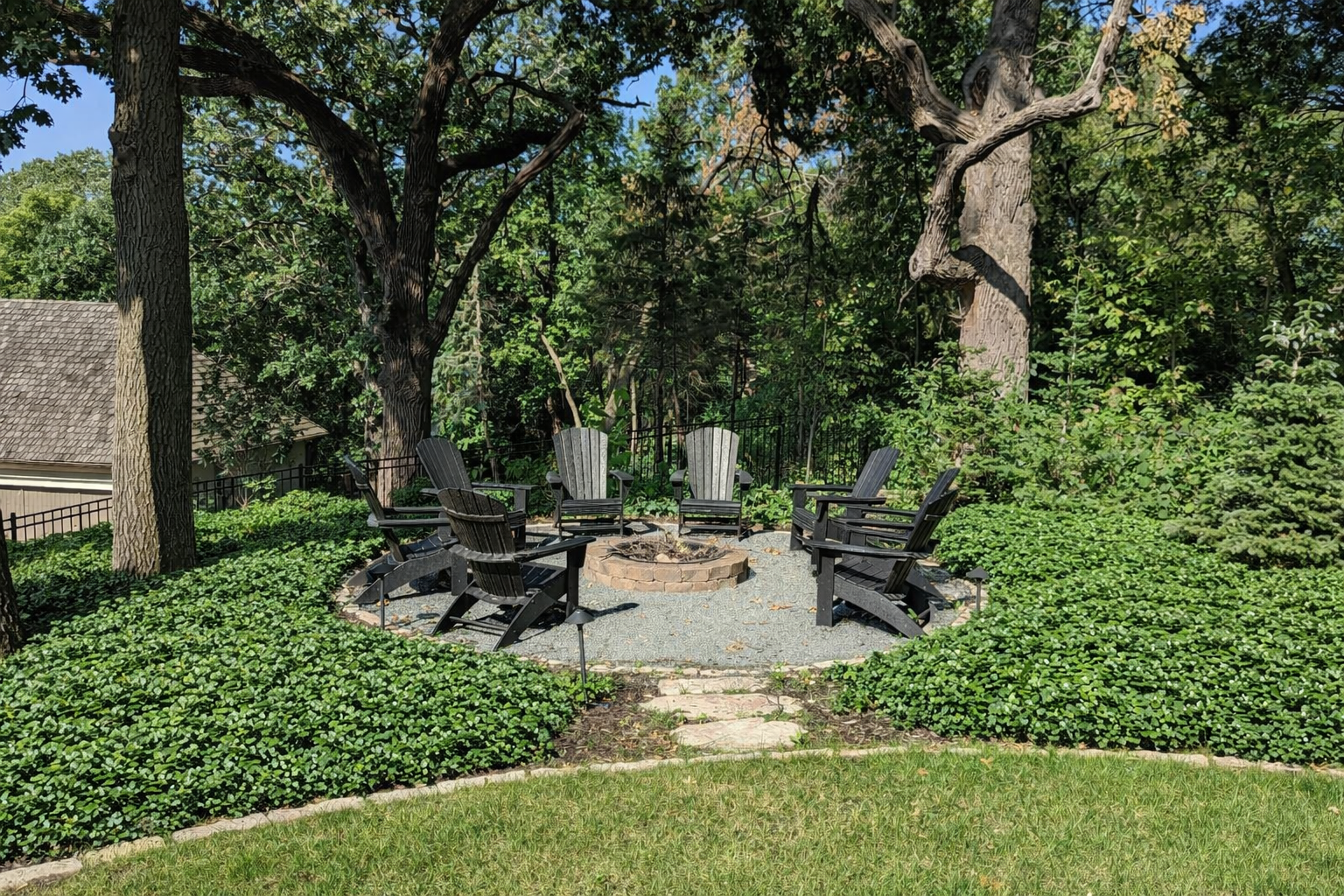
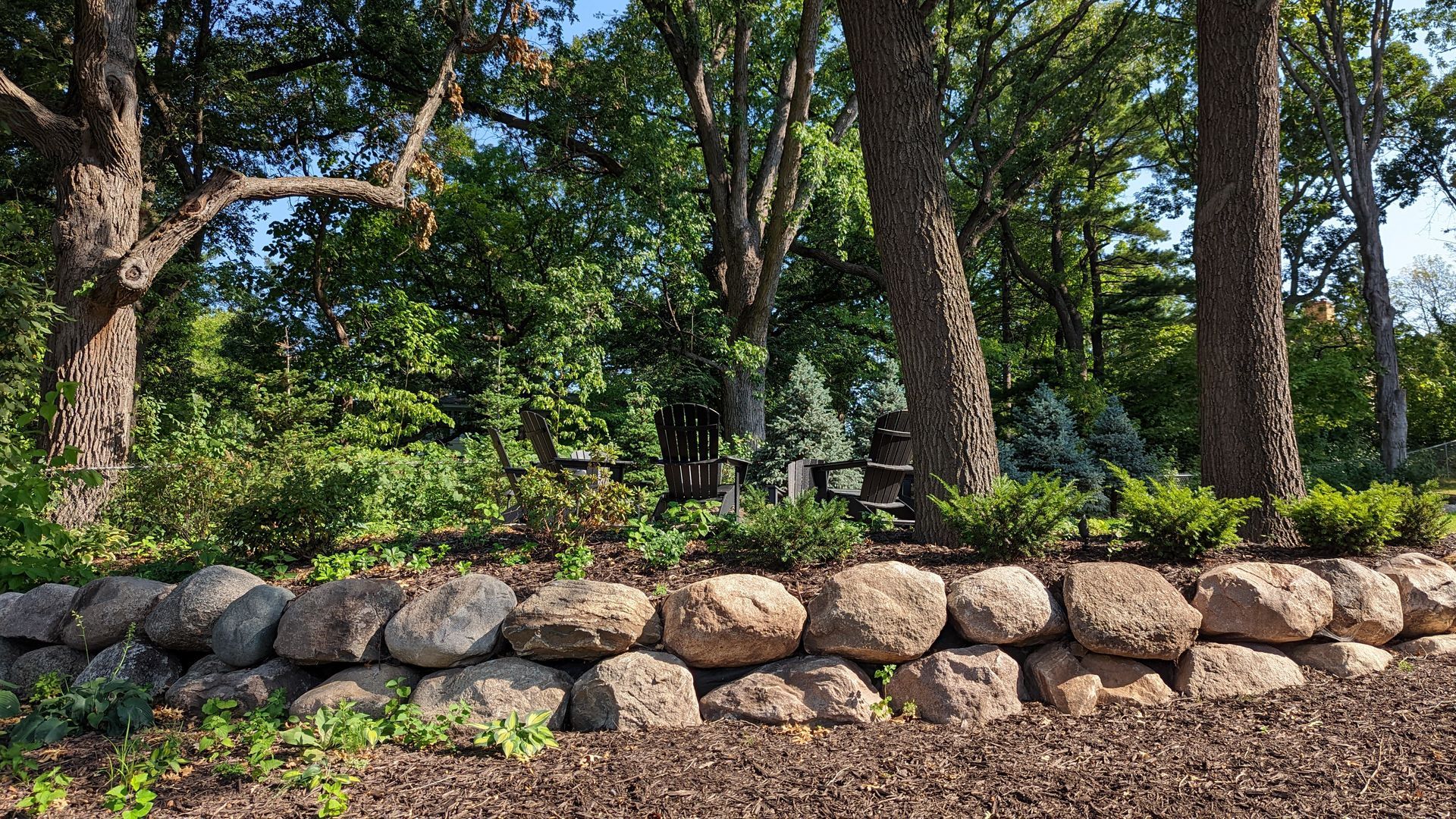
In Edina, the original fire pit sat in the middle of the sloped lawn. Awkward. We moved it to a raised area we created from the fill material that came out of the sport court excavation. It's supported by a boulder wall, surrounded by gravel, and has room for chairs.
It feels like its own space now. You sit there and look down at the lawn and sport court. The boulder wall behind gives it a backdrop.
We also redid the plantings along the back fence. The old ones had grown wild and weren't blocking the neighbors' view. The new plantings screen where it matters. And with so much of the steep area now flat, we didn't need the big mulch beds anymore. We cut them down to what actually made sense.
You don't have to flatten every square foot. Some of it isn't worth the cost.
In Edina, we got 70-80% of the backyard into usable shape. The lawn, sport court, and fire pit. The remaining 20-30% is the steepest section, with a grove of five mature oaks. The homeowners wanted to keep those trees.
We chose not to touch that area. The cost to reclaim it wasn't worth it given everything else we'd already accomplished. They have their oak grove. They have their flat lawn, sport court, and fire pit. The juice wasn't worth the squeeze on that last section.
This is the kind of decision we help people work through. Not everything needs to be fixed. Part of a good design is knowing where to stop.
The Results: What Changed for This Family
The Edina homeowners started with a 25-foot slope, overgrown mulch beds, useless retaining walls, and nowhere for their kids to play.
Now the kids are outside. They shoot hoops on the sport court, run around on the lawn, hang out by the fire pit with the family on weekends. The drainage works. The neighbors can't see in. The yard does what they needed it to do.
That's what changes when you approach a sloped property with a real plan. You stop working around the terrain and start reworking it.
If You Have a Hilly Yard
A slope doesn't have to determine how you use your outdoor space. With the right design and execution, much of it can become ground your family actually enjoys.
The key is working with someone who understands sloped sites. Retaining walls, soil work, drainage, tree decisions, grading. These all connect. Get one wrong and it affects the rest.
Minnetonka and Edina have some of the hilliest yards in the Twin Cities. We've been working onproperties like these for over 20 years. If you have a backyard you can't use, we can talk through what might be possible.
Contact KG Landscape to start the conversation.
Frequently Asked Questions
How much does it cost to flatten a sloped backyard?
It depends on how big the area is, how steep the slope is, what the soil is like, whether you need retaining walls, and what's happening with trees. A project like the Edina example, with a sport court, boulder walls, regrading, drainage work, and new plantings, is a significant investment. Simpler projects focused on one flat area cost less. We give detailed estimates after seeing the property.
Can you flatten a yard without taking out trees?
Sometimes. It depends on where the trees are and how extensive the grading needs to be. Tree roots extend beyond the canopy, and grading can damage them. In some cases we can adjust the layout or use walls to minimize disturbance. In other cases trees have to come out. We look at each one and make recommendations based on its health, its location, and what the homeowner wants.
How long does a project like this take?
Depends on the scope. A project with retaining walls, major grading, drainage work, and plantings usually takes several weeks of construction. Design and planning happen before that. Weather affects scheduling in Minnesota. We give timeline estimates with our proposals.
Will a retaining wall fix my drainage issues?
Not automatically. Walls change how water moves across a property, but they can also create new problems if drainage isn't planned carefully. Walls can trap water if you're not paying attention. We plan drainage alongside everything else, not as an afterthought.
Do you work in Minnetonka?
Yes. Minnetonka has a lot of hilly terrain, so we've done many projects there. Same approach: evaluate the site, understand priorities, figure out where to invest, design accordingly. We work throughout the west metro including Minnetonka, Edina, Plymouth, and surrounding areas.
About the Author
Kent Gliadon is the owner and principal designer at KG Landscape, a Minneapolis-based landscape design and build company serving homeowners across the Twin Cities for over 20 years. Kent studied landscape architecture and earned a bachelor's degree in Environmental Horticulture at the University of Minnesota, with emphasis in turf science and landscape design.
Ready to Start on Your Next Project?
Call us at (763) 568-7251 or visit our quote page.