Reducing Commercial Property Maintenance Costs Without Sacrificing Curb Appeal
Commercial Landscape Costs in St. Paul
The most expensive commercial landscapes I see aren't the ones with premium materials. They're the ones with too much landscape to maintain properly.
Here's what I see repeatedly with St. Paul commercial properties: beautiful installations that become budget nightmares within three years. The problem isn't that the landscaping was bad—it's that there was too much of it. More bed space than anyone can maintain. More plants than the budget can support. More complexity than the property actually needs.
This guide identifies where commercial landscape budgets actually leak—and what to do about it. Not generic cost-cutting tips, but specific strategies for reducing ongoing maintenance expense without your property looking neglected.
The core principle is straightforward: going from poorly maintained to well maintained creates a bigger improvement than going from good to great. You don't need the most impressive landscape on your block. You need one that looks professional and doesn't drain your budget trying to maintain more than you can handle.
For St. Paul commercial properties—from Summit Hill professional offices to Highland Park retail—the answer to cost control isn't cheaper contractors. It's smarter landscape design that matches your actual maintenance capacity.
Why Your Landscape Costs More Than It Should
The landscaping industry has an incentive problem that works against commercial property owners.
Early-career landscapers and even established companies tend to over-design. More bed space, more plant varieties, more features—it all translates to more installation revenue. I'll admit I did this earlier in my career. Certain companies just go overboard, and sometimes clients end up with far more plants than they should have.
The problem is that installation is a one-time cost. Maintenance is forever.
What over-landscaping actually costs compounds year after year. Large bed spaces require dump trucks full of mulch to maintain properly—not bags from the hardware store, but bulk delivery and professional spreading. Distinguishing weeds from intentional plants in densely packed beds becomes expensive labor. More plants means more pruning, more replacement when things die, more disease management when problems spread through overcrowded beds.
Every additional square foot of bed space is a perpetual maintenance commitment you're signing up for.
The timeline typically looks like this: Year one, everything looks great and maintenance seems manageable. Year three, beds are expanding beyond their borders, weeds are establishing in thin mulch, and some plants are struggling. Year five, you're choosing between expensive renovation or accepting visible decline.
The installation cost was just the down payment. The real expense is the decade of maintenance that follows.
Many commercial properties in established St. Paul areas like Mac-Groveland or downtown inherited landscapes from previous owners or tenants. That inheritance might look like an asset, but if the landscape exceeds your maintenance capacity, it's actually a liability. Evaluating whether inherited landscape matches your realistic budget is the first step to controlling costs.
The Questions I Ask Every Commercial Property Manager
Before recommending any changes, I walk commercial properties with three questions. These reveal where costs actually live—and where savings are available.
Question 1: How much area do you actually want to maintain?
Walk your property zone by zone and be honest about each area:
Your entrance and front-facing zones are high visibility and worth real investment. These create first impressions for customers, clients, and tenants. Side areas typically have moderate visibility but are often over-designed relative to how much attention they receive. Rear zones have low visibility and are frequently neglected despite significant installation cost. Utility areas should be functional and screened, not decorative showcases.
Most commercial properties have thirty to fifty percent more maintained landscape than they actually need. That's not an aesthetic problem—it's a budget problem hiding in plain sight.
Question 2: How densely planted do you want every square foot?
Plant density drives maintenance cost more than most property managers realize.
Dense plantings require more frequent pruning to prevent overcrowding. Tight spacing accelerates disease spread when problems occur. Overcrowded beds make weed identification difficult—is that a weed or something intentional? And every single plant is a maintenance commitment: water, fertilizer, pruning, eventual replacement.
The question isn't what looks impressive at installation. It's what you can maintain at a professional standard for the next decade.
Question 3: Is it realistic to pay several thousand dollars every two years for proper mulching?
I put this question directly to property managers because it forces honest budgeting.
Extensive bed spaces require significant mulch investment on a regular cycle. If that investment isn't realistic for your budget, you have two options: reduce bed space to match what you can actually mulch properly, or watch your landscape decline as coverage thins and weeds establish.
There's no third option where extensive beds stay professional without appropriate mulch investment. The math doesn't work.
Pro Tip: Before your next budget cycle, walk your property with these three questions. Mark zones on a simple sketch: "keep as-is," "simplify," and "convert to low-maintenance." You'll likely find twenty to forty percent of your maintained area falls into the last two categories—that's where your cost savings live.
The Right Places to Reduce—And the Wrong Ones
Cost reduction works when it's strategic. Cut in the wrong places and your property looks cheap. Cut in the right places and nobody notices except your accountant.
Where to Invest (Don't Cut Here)
Front entrance and building face. This is what customers, clients, and tenants see first. Detailed plantings here create professional impressions that affect how people perceive your entire operation. Skimping on entrance appearance costs more in perception than you'll ever save in maintenance.
Lawn care fundamentals. Basic lawn maintenance—approximately five hundred dollars per year for mowing, edging, and weed control—delivers outsized value. A well-maintained lawn makes everything else look better. This isn't where to look for savings.
Evergreen foundation. Evergreens represent one-time installation investment with decades of return. They provide structure during Minnesota's six months of dormancy when everything else is bare sticks. Minimal ongoing maintenance compared to flowering plants. You don't realize how important evergreens are until you're looking at nothing but bare branches for six months—then it becomes obvious.
Where to Cut (Safe Reductions)
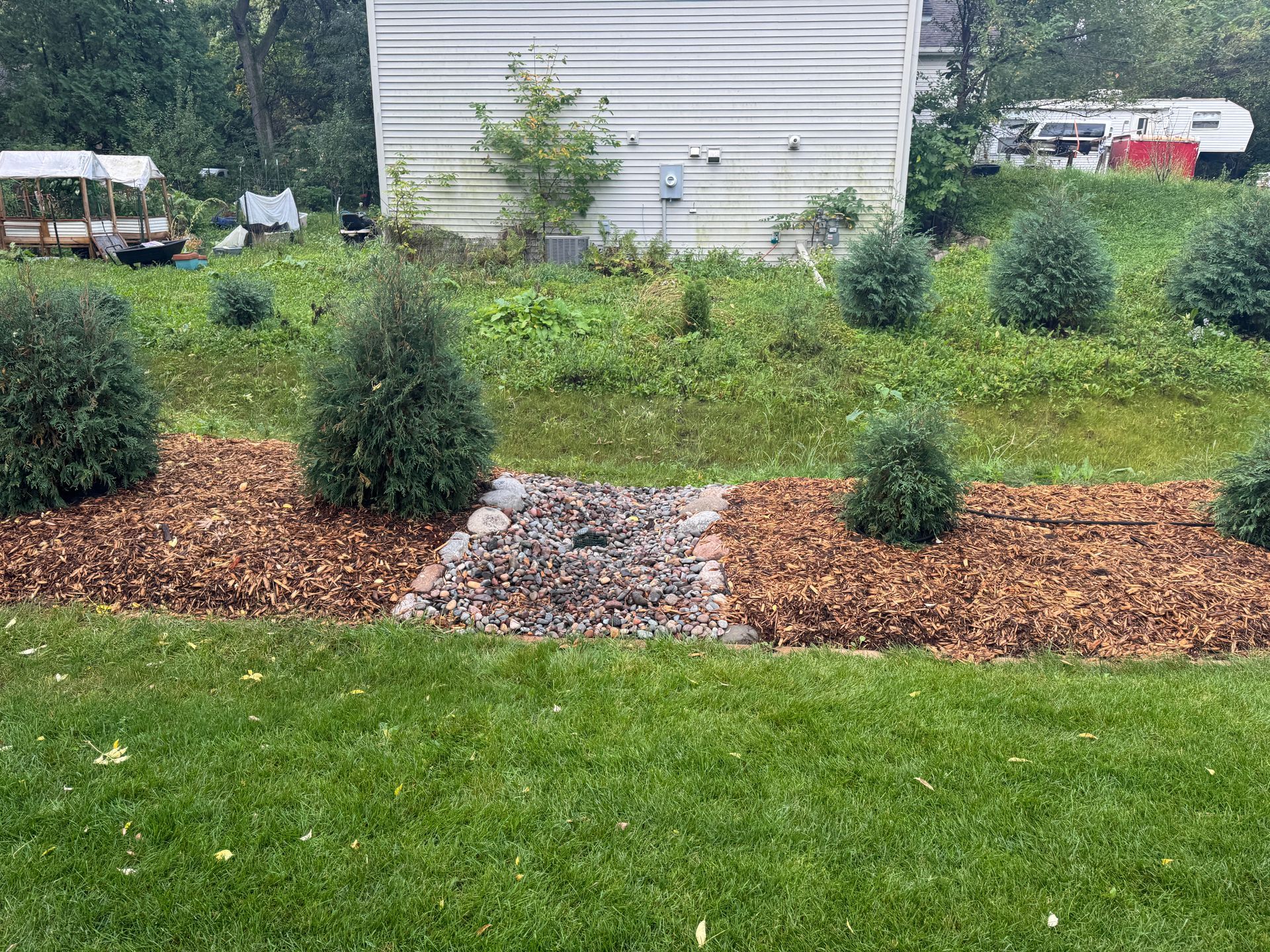
Side and rear bed spaces. Convert extensive mulch beds to rock ground cover. Rock is a one-time installation with minimal ongoing cost—no biennial replacement cycle, no annual refresh, no watching coverage thin because the mulch budget got cut. Maintains neat appearance without the perpetual expense.
Excessive plant density. Thin overcrowded beds rather than struggling to maintain them. Fewer plants, properly spaced, means easier maintenance and healthier remaining plants. Strategic removal often improves appearance while reducing cost.
Annual flower rotations. High cost for temporary impact. Those seasonal color beds require multiple plantings per year, each with labor and material cost. Consider perennial alternatives or eliminate annual beds entirely. That budget is better spent on sustainable improvements.
Over-designed secondary areas. Not every zone on your property needs to be a focal point. Clean and minimal serves most secondary areas perfectly well. Simple turf or rock coverage beats elaborate plantings that struggle from inadequate maintenance attention.
When Rock Ground Cover Makes Financial Sense
The rock versus mulch decision is one of the clearest cost-control opportunities for commercial properties.
The Economics
Organic mulch requires refresh every one to two years—material cost plus labor for removal of old mulch, bed preparation, and new application. For extensive bed spaces, this becomes a significant recurring expense.
Rock ground cover requires one-time installation and provides decades of service. Higher upfront cost, but you're done. No annual refresh, no biennial replacement, no watching beds decline because this year's mulch budget got reallocated.
For extensive side and rear beds, rock typically breaks even within three to four years. Everything after that is savings.
Where Mulch Still Wins
Front-facing beds where appearance is premium priority benefit from mulch's richer aesthetic. Areas where you may change plantings work better with mulch since rock is more permanent. Zones where organic matter benefits soil long-term—though this matters less for commercial properties focused on cost control.
Where Rock Makes Sense
Side areas with limited visibility. Rear zones that need neat appearance without high maintenance investment. Foundation beds where you want permanent, clean coverage. Any bed space you're currently neglecting because mulch budget doesn't stretch far enough.
The installation matters. Rock requires proper landscape fabric underlayment and a deeper material layer than mulch to prevent weed breakthrough and maintain coverage. Initial installation costs more than mulch—but you're making that investment once, not every two years.
Pro Tip: Calculate your current annual mulch spend across all bed areas. Then identify which beds are side or rear with limited visibility. Converting just those areas to rock typically saves forty to sixty percent of ongoing material costs—and the labor savings compound from there.
Professional Appearance Without Premium Price
The fundamental insight that saves commercial properties the most money is this: going from poorly maintained to well maintained is a significantly larger improvement than going from good to great.
What this means practically is that your property doesn't need to be the most impressive on the block. It needs to not be the one that looks neglected or overgrown.
What "Well Maintained" Actually Requires
Basic plantings that aren't overgrown. No visible weeds in bed areas. Clean lawn with defined edges. Mulch or rock coverage appropriate to each area's visibility level. Hardscaping in reasonable repair.
That's the standard. Not elaborate. Not premium. Just professional.
The Comparison Trap
Commercial property managers sometimes compare their landscapes to showcase installations—municipal gardens with dedicated staff, corporate headquarters with unlimited budgets, a competitor's just-completed renovation. That comparison drives overspending and frustration.
The relevant comparison is simpler: Does your property look professional and maintained? Does it signal that you take your business seriously? Does it avoid being the neglected property on the block?
If yes, your landscape is doing its job.
Something basic and well-maintained is really the goal. You don't need permission to have a simple landscape. You need permission to stop chasing elaborate installations you can't realistically maintain.
In established St. Paul neighborhoods like Summit Hill or Highland Park, the commercial properties that stand out positively aren't necessarily the most elaborate. They're the ones that are clearly cared for—even when that care is straightforward maintenance rather than premium features.
What St. Paul Commercial Properties Face
St. Paul's commercial landscape presents specific cost-control challenges.
Downtown and Lowertown properties operate in high-visibility environments where appearance affects tenant attraction. Cost control focuses on efficiency—maintaining standards while eliminating waste. Summit Hill professional offices carry established expectations, but those standards are "well maintained," not "most elaborate." Highland Park retail is customer-facing where landscape affects foot traffic. Strategic entrance investment pays returns; over-investment in rear areas doesn't.
Many St. Paul commercial properties changed ownership with landscapes designed for different budgets. The previous owner's elaborate installation becomes your maintenance burden—unless you strategically simplify.
The question that matters isn't what your landscape looked like at installation. It's what it can look like five years from now with the maintenance you can actually sustain.
Frequently Asked Questions
How much should commercial landscape maintenance cost in St. Paul?
Basic lawn care starts around five hundred dollars per year for mowing, edging, and weed control. Comprehensive maintenance including bed care and seasonal cleanup ranges higher depending on property complexity.
The better question isn't what maintenance costs—it's whether your landscape matches your budget. Right-sizing the landscape to realistic maintenance capacity is more effective than finding marginally cheaper contractors for an over-designed property.
What's the fastest way to reduce commercial landscape costs?
Convert low-visibility bed spaces from organic mulch to rock ground cover. This eliminates ongoing mulch replacement and reduces weeding labor. The conversion pays back within three to four years for most properties.
Second fastest: strategic removal. Struggling plants and neglected beds—remove them rather than continuing inadequate maintenance. Removal often improves appearance while cutting costs.
Should I eliminate landscaping entirely to reduce costs?
No. Some landscaping is essential for professional appearance. The goal is reducing complexity, not elimination.
Keep: front entrance detail, basic lawn care, evergreen structure. Simplify: side and rear areas, excessive density, annual rotations. The principle holds: well-maintained simple beats neglected elaborate every time.
How do I know if my commercial property is over-landscaped?
If you can't maintain everything to professional standard with your current budget, you have more landscape than you need. Signs include beds with visible weeds despite regular service, mulch thinning between applications, and areas you find yourself deprioritizing. Those zones are candidates for simplification.
What Right-Sized Landscape Looks Like
Imagine walking your property next spring without the familiar stress points.
The front entrance looks professional—detailed plantings, fresh mulch, creating exactly the impression you want for customers and clients. The side areas are clean and simple—rock ground cover, defined edges, no weeds establishing, no mulch to refresh on a cycle you can't sustain. The rear is functional and appropriate—neat enough to not embarrass you, not demanding attention it won't receive.
Your maintenance contractor handles the property efficiently because the scope matches realistic service levels. Your budget is predictable because you're not chasing declining beds with emergency interventions. Your property actually looks better than it did when you were trying to maintain too much, because what remains gets the attention it deserves.
That's what right-sizing delivers: better appearance, lower cost, sustainable maintenance that works year after year.
For St. Paul commercial properties ready to evaluate their landscape against realistic maintenance capacity—and develop a plan for strategic simplification—a professional assessment identifies what to keep, what to convert, and what to remove. The goal isn't the cheapest possible landscape. It's the right landscape for your property, your budget, and your long-term maintenance reality.
Contact KG Landscape for a commercial property landscape evaluation in St. Paul and the greater Twin Cities area.
Ready to Start on Your Next Project?
Call us at (763) 568-7251 or visit our quote page.