Retaining Walls That Last a Lifetime - Orono
Retaining Walls That Last
Three months ago, this Orono backyard was a sloped mess—unusable space that the homeowners walked past on their way to somewhere else. Now it's where they spend every weekend. The difference wasn't just adding a retaining wall. It was choosing the right type of wall, integrating it properly with a patio, and designing the whole space to flow naturally between outdoor rooms.
That transformation happens when the decisions made before construction are the right ones. The wrong decisions—wrong wall type for the height, elevated patio instead of grade-level, shortcuts on base preparation—create spaces that settle, drain poorly, and never quite work the way homeowners imagined.
For Orono properties, where outdoor living space is a significant part of the investment, getting this right matters. This article covers how wall height determines wall type, why raised patios fail and what to build instead, and how professional design creates spaces you'll actually use for decades.
How Wall Height Determines Wall Type
The most important decision in retaining wall construction comes down to a single measurement: height. Four feet is the threshold that changes everything.
Walls under four feet can be built as gravity walls. These rely on the wall's own mass to resist soil pressure—the blocks or stones are heavy enough to stay in place without additional reinforcement. Properly constructed with drainage, gravity walls are straightforward, effective, and appropriate for modest grade changes.
Walls over four feet require geo-grid reinforcement. This isn't optional, and it isn't a premium upgrade. It's a structural requirement based on physics. Taller walls face exponentially more soil pressure than shorter ones. A wall twice as tall doesn't face twice the pressure—it faces significantly more. Gravity alone can't resist these forces.
Geo-grid consists of layers of high-strength material that extend back into the retained soil, typically several feet behind the wall face. These layers tie the wall to the earth behind it, creating an engineered system where the wall and soil work together. Instead of the wall face alone resisting all that pressure, the entire reinforced soil mass shares the load.
A contractor who proposes a five-foot wall without geo-grid either doesn't understand the engineering or is cutting corners. Either way, the wall will fail. I've seen it happen repeatedly—walls that looked solid for a few years, then started leaning as the soil pressure won.
For Orono properties with significant grade changes—common along Lake Minnetonka and throughout the rolling terrain near Navarre and Long Lake—understanding this threshold is essential before any wall project begins.
Why Elevated Patios Fail (And What to Build Instead)
Here's a mistake I see from less experienced contractors that creates problems for years: instead of building steps down to a patio at ground level, they construct the entire patio elevated.
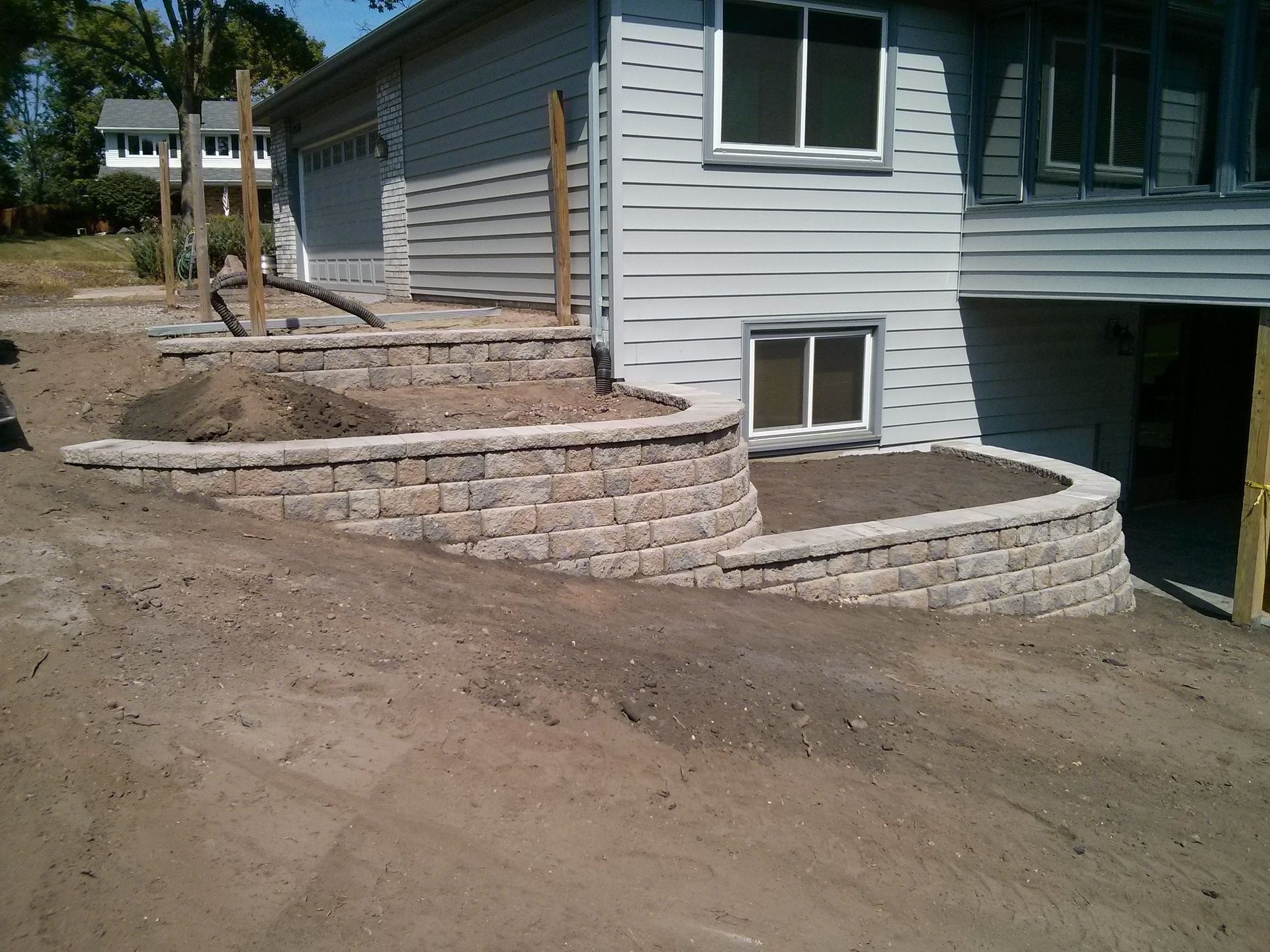
The approach looks like this: build a retaining wall around the patio perimeter, fill the interior with soil, install the patio surface on top of that fill. The result is a patio sitting twelve to eighteen inches above the surrounding yard, accessible only through one entry point.
It seems logical. The door is elevated, so make the patio match. But this approach fails in multiple ways.
Why Raised Patios Don't Work
The fill settles. Nobody compacts twelve inches of backfill properly when they're rushing to install a patio on top. Over time—sometimes just a season or two—the fill compresses unevenly. The patio surface that was carefully pitched to drain loses its slope. Water pools instead of flowing off. The whole surface becomes problematic.
Beyond the technical failure, raised patios create spaces that don't function well. You're isolated on a platform, disconnected from the rest of your yard. Want to walk to the lawn? Find the steps. Want to expand your entertaining area onto the grass when you're hosting a larger group? You can't—there's a wall in the way. Furniture placement becomes constrained to whatever fits on the platform.
What Works Instead
The better approach separates the elevation change from the patio itself. Build a proper landing at the door level—minimum four feet deep so you're not stepping directly onto stairs. Then steps down to a patio constructed at grade, sitting approximately one inch above the lawn for drainage.
This design lets water flow off the patio surface naturally. You can step onto the grass anywhere along the patio edge, not just at one designated point. When you're hosting and need more space, the party expands onto the lawn seamlessly. The space flows instead of feeling trapped.
Pro Tip: Before approving a patio design, ask yourself: can I easily move between the patio and lawn? Can I expand onto the grass when hosting? If the design requires going up and down steps every time you want to walk to the yard, you'll use the space less than you expect. Grade-level patios with proper landings give you flexibility that elevated platforms never will.
Orono properties along Lake Minnetonka often have terrain that seems to require elevated solutions. But there's almost always a better approach that maintains flow while handling the grade change gracefully.

Function First, Then Aesthetics
The question I ask every homeowner before discussing wall materials or patio patterns: how do you want to use this space?
Professional design starts with function. Before style choices, before material selection, you need to establish that the space will actually work:
- Does furniture fit without crowding?
- Is there room to move chairs back without stepping onto grass?
- Are traffic patterns clear—can people move through the space naturally?
- How does drainage integrate with the design?
- Is there flexibility for how you might use the space differently in the future?
Once function is locked in, style becomes a choice rather than a compromise.
The Five-Concept Approach
For significant projects, I provide clients with five different concept plans. All five accomplish the same functional goals—the patio fits the furniture, traffic flows properly, drainage works, the retaining wall handles the grade change correctly. But each concept takes a different aesthetic approach.
Some designs are linear and modern. Others are curvilinear with a more rustic feel. Some include dedicated built-in fire pit areas. Others are designed for portable fire features that can be moved or stored. The variety lets homeowners see possibilities they might not have imagined, and choose based on personal style rather than being forced into whatever the contractor prefers to build.
One-option contractors limit your choices to their comfort zone. Multiple concepts reveal what's actually possible on your specific site.
For properties in Orono—along the Lake Minnetonka shoreline, near Navarre, around Long Lake—these are significant investments. The design process should reflect that significance, not rush toward a single solution.
What Retaining Walls and Patios Actually Require
Understanding the physical reality of proper installation helps explain why quality work costs what it does—and why shortcuts fail.
Here's the math for a 500-square-foot patio, which is a modest size for Orono properties:
Proper installation requires excavating approximately nine inches of soil. Then you install five to six inches of class five base material, compacted in layers. Add a one-inch bedding layer of fine gravel. Set three-inch pavers on top. Total depth from original grade: approximately ten inches.
Now consider the volume. Five hundred square feet at ten inches depth equals roughly fifteen cubic yards of material—to remove and to replace. A standard pickup truck holds about one and a half to two cubic yards. That's seven to eight full truck loads hauled out, and seven to eight loads hauled in. This is heavy, equipment-intensive work.
This volume is exactly why DIY installations and contractor shortcuts fail. Reducing gravel depth from six inches to three saves hauling and material cost. Skipping proper compaction saves time. But the result is pavers that shift and move, creating an uneven surface within two to three years.
Improperly installed pavers give pavers a bad name. People see DIY work settling and shifting and think "I don't want pavers because they move." But the pavers aren't moving because of anything wrong with the material. They're moving because installation steps were skipped.
The same principle applies to retaining walls. Proper base preparation, gravel backfill behind the wall instead of just pushing soil back, drain pipe installation, compaction at each stage—these steps take time and materials. Skipping them saves money initially and costs more when the wall fails.
Pro Tip: When evaluating patio or retaining wall quotes, ask about excavation depth and base material. Six inches of class five base, compacted in layers, is standard for most patios. If a quote seems significantly lower than others, base preparation is usually where corners are being cut—and it's where cutting corners costs you most later.
Making the Right Choice for Your Site
Bringing it together for Orono homeowners planning retaining wall and patio projects:
Grade change under four feet: Gravity wall construction is appropriate. Focus on proper drainage (gravel backfill, drain pipe) and quality materials.
Grade change over four feet: Geo-grid reinforced wall is required. Don't let anyone convince you otherwise—the engineering isn't optional.
Patio integration: Design for grade-level whenever possible. Landing at door height, steps down, patio approximately one inch above lawn. Preserve flow between patio and yard.
Material choice: Stone doesn't rot. The cost difference between stone and wood is minimal—usually just the contractor's preference. For Orono investment levels, stone is the clear choice for longevity.
Orono-Specific Considerations
Properties along Lake Minnetonka's shoreline often involve complex terrain, permit requirements, and integration with lake views. Professional assessment is essential before finalizing any design.
The Navarre and Long Lake areas present varying soil conditions—some clay, some sandy, some mixed. Soil type affects drainage requirements and base preparation specifications.
Executive
home expectations in Orono mean quality and longevity matter more than minimizing initial cost. A wall or patio that needs replacement in fifteen years isn't a good investment, regardless of what it cost to build.
Frequently Asked Questions
How much does a retaining wall cost in Orono?
Cost varies significantly based on wall height, total length, material selection, and site conditions. The biggest cost factor is height—walls over four feet require geo-grid reinforcement, which adds engineering and materials. Access difficulty, drainage complexity, and whether you're replacing a failed wall also affect pricing. For Orono properties, I'd encourage focusing less on finding the lowest bid and more on verifying that proposals include proper specifications. A wall built correctly costs more than a wall built cheap, but it doesn't cost more than building the cheap wall twice.
What's the difference between a gravity wall and a reinforced wall?
Gravity walls rely on mass—the weight of the blocks or stones resists soil pressure. They're appropriate for walls under four feet where the forces involved are manageable. Reinforced walls use geo-grid, layers of high-strength material extending back into the retained soil, tying the wall to the earth behind it. This creates an engineered system that handles the greater pressures taller walls face. Using gravity construction for a wall that needs reinforcement means eventual failure—the physics don't change based on what a contractor prefers to build.
How long do retaining walls last?
Properly built stone walls with functioning drainage have no defined lifespan—they can last indefinitely. What shortens wall life is failed drainage (water pressure builds until something gives), skipped reinforcement on tall walls (inadequate structure for the forces involved), and wood materials in soil contact (rot is inevitable). When I say "no limit," I mean it—stone walls with proper construction have been standing for generations. The walls I replace failed because something was done wrong initially, not because walls have an expiration date.
Can I build a retaining wall without a permit in Orono?
Permit requirements depend on wall height, location, and scope of work. Walls over four feet typically require permits because they require engineering. Walls near property lines, in drainage easements, or affecting neighboring properties may require permits regardless of height. The city of Orono can clarify requirements for your specific situation. A qualified contractor handles permit requirements as part of the project—if your contractor seems unfamiliar with the permit process, that's a concern.
Why do some patios sink or become uneven?
Inadequate base preparation is almost always the cause. Proper patio installation requires significant excavation—approximately nine inches—followed by compacted gravel base, bedding layer, and then pavers. The total material volume is substantial. When installers reduce gravel depth or skip proper compaction to save time and money, the base settles unevenly under use and weather. Pavers that seemed level at installation develop lips, dips, and uneven surfaces within two to three years. The pavers themselves are fine—the base underneath failed.
Building Spaces That Work for Decades
The right retaining wall doesn't just hold soil—it creates usable space where there wasn't any before. A sloped yard becomes a level patio. A drainage challenge becomes a design feature. An awkward grade change becomes a natural transition between outdoor living areas.
For Orono properties, these transformations represent significant investment in how you'll live outdoors. The four-foot rule determines structure. The grade-level approach determines flow. Professional design determines whether the finished space works the way you imagined—or becomes something you walk past on the way to somewhere else.
The decisions made before construction starts are the ones that matter most. Wall type, patio elevation, base preparation, drainage integration—these choices are invisible once the project is complete, but they determine everything about how the space performs for the next several decades.
For homeowners ready to turn unusable slopes into functional outdoor living, the starting point is understanding what your specific site requires.
Schedule a consultation to discuss your retaining wall and patio project and see what's possible on your Orono property.
KG Landscape serves Orono, Lake Minnetonka, and surrounding Twin Cities communities with retaining wall construction, patio installation, and outdoor living design built to last.
Ready to Start on Your Next Project?
Call us at (763) 568-7251 or visit our quote page.